Temperature20 – 25 °C
Natural range
- South Asia area
- Southeast Asia area
- India area
- Myanmar area
CatfishConservation status: Least concern LC
Other scientific names: Saccobranchus fossilis, Saccobranchus microcephalus, Saccobranchus singio, Silurus biserratus, Silurus fossilis, Silurus laticeps
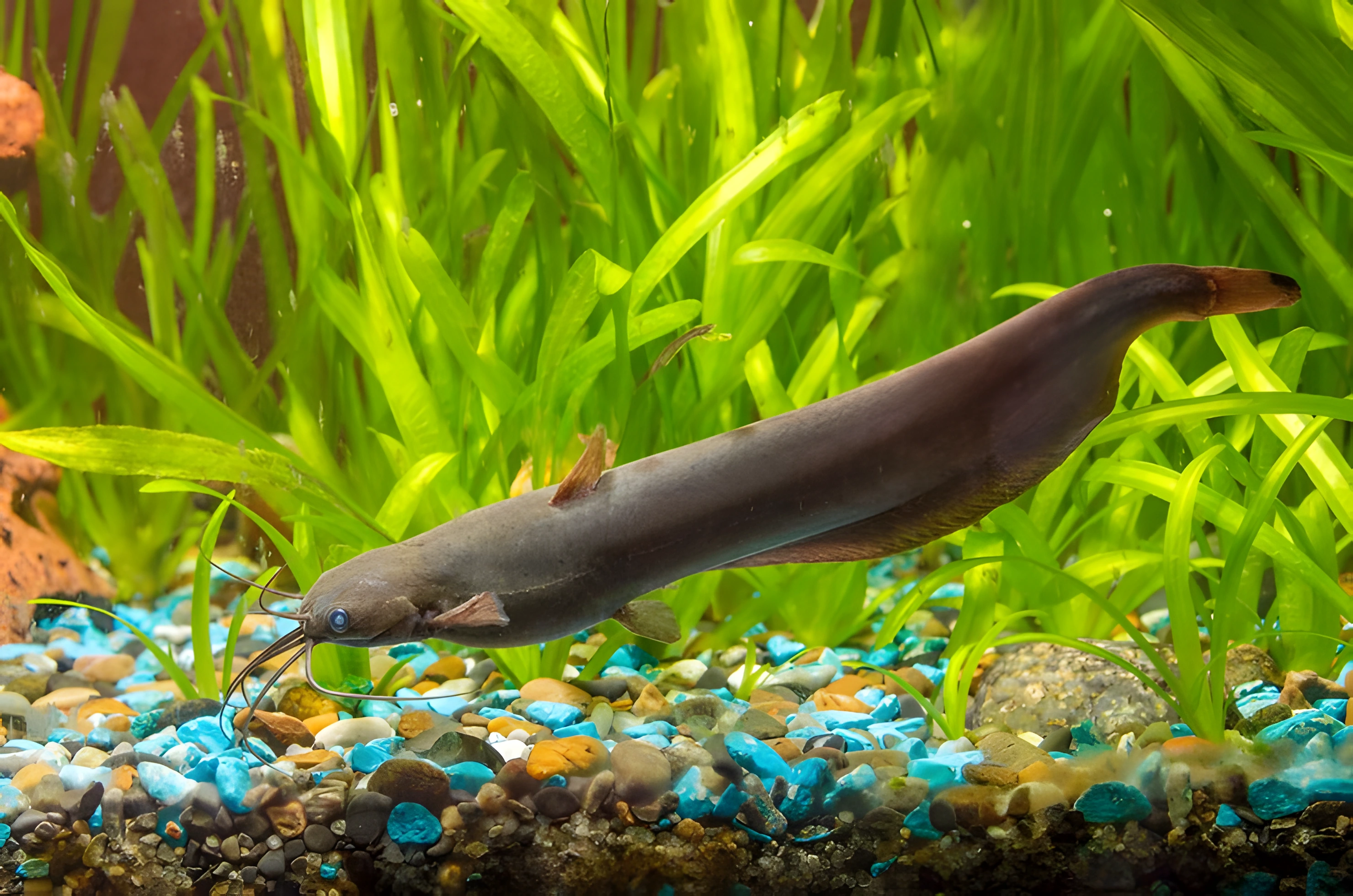
The Stinging Catfish, scientifically known as Heteropneustes fossilis, belongs to the family Heteropneustidae. A distinctive feature of this catfish is its incredible adaptability, which is evident in the structure of its swim bladder. It has evolved into an air sac connected to the gill chamber, functioning as a type of lung. Thanks to this adaptation, the fish can breathe atmospheric air and survive out of water for extended periods. To prevent desiccation, the catfish produces a specific mucus.
- Required aquarium volume
- 250 L
- Size in aquarium
- 30 cm
- Temperature
- 20 – 25 °C
- Temperament
- Semi-peaceful (dangerous to smaller ones)
Parameters
Water pHSlightly acidic (6) – Slightly alkaline (8)
Water dHSoft (5) – Very hard (20)
Water salinitylow (3–5 g/L)
Size in aquarium30 cm
Lifespan15 years
TemperamentSemi-peaceful (dangerous to smaller ones)
Toward small fishnot a predator
Required aquarium volume250 L
Lightingdimmed or moderate
Substrateany (no restrictions)
Water flownone or stagnant (no flow)
FeedingAny (universal)
CareSmall group (3–4 individuals)
Description
On average, adult catfish reach 30 cm in length, although individuals exceeding 40 cm have been recorded. The fish's body is elongated, resembling a lancet, with a large abdominal section and a ribbon-like tail. Their tail and most fins are small. The exception is the long anal fin with soft rays, which extends from the middle of the body to the tail. Young specimens are typically grayish, which darkens with age, becoming black, chocolate, or dark gray. Albino forms are sometimes found.
Habitat
The natural habitats of this catfish span a wide range: it can be found throughout South Asia (including India, Pakistan, Nepal, Bangladesh, and other countries), as well as in Southeast Asia, for example, in Myanmar and Thailand. It inhabits diverse biotopes, showing a preference for bodies of water with weak currents. These can be swamps, lakes, ponds, river backwaters, rice paddies, and ditches. Sometimes this species is found in the brackish water of river estuaries.
Behavior and Compatibility
The Stinging Catfish prefers to live in a group of its own kind. Suitable tank mates include large cyprinids, characins, and labyrinth fish. The catfish has a peaceful and calm disposition. However, its indiscriminate eating habits should be considered: it can eat any small fish that fits into its mouth. This species is nocturnal, showing the most activity after the lights are turned off. Therefore, cohabitation with other bottom-dwelling species that need rest during nighttime should be avoided.
Care and Maintenance
For 2–3 catfish, the optimal aquarium volume starts from 250–300 liters. It is important to create suitable hiding places inside the aquarium. These can be grottoes and crevices formed by rock piles, as well as driftwood surrounded by thickets of aquatic plants. In their natural environment, catfish can move short distances in search of other bodies of water. Therefore, the aquarium must be equipped with a lid or other device to prevent them from jumping out of the tank. Water parameters are not critical for this species. The Stinging Catfish demonstrates high endurance and adapts well to a wide range of temperatures, as well as pH and GH values. Standard aquarium maintenance includes several necessary procedures: weekly partial water changes, removal of organic waste, and preventive equipment maintenance. Since this fish produces a significant amount of waste, regular aquarium cleaning is paramount, especially when kept with more demanding species. This is an omnivorous species that feeds on a variety of foods. The basis of their diet can be popular dry sinking foods. It is important to ensure a high protein content in the food, supplementing the diet with bloodworms, earthworms, shrimp meat, and other suitable products. Small feeder fish can also be offered.
Diet
Being an omnivorous species, the Stinging Catfish consumes a variety of foods. Common dry sinking foods are excellent as a staple diet. It is important to provide food with a high protein content; for this, bloodworms, earthworms, shrimp meat, and other similar products can be given separately. Offering small feeder fish to the catfish is also permissible. Breeding this species in aquarium conditions is extremely rare. More often, Stinging Catfish are bred on specialized fish farms. In nature, spawning begins with the onset of the rainy season, and during this period, the catfish form temporary pairs to protect the clutch and care for the fry.
Breeding and Reproduction
Breeding this species in aquarium conditions is extremely rare. Most often, Stinging Catfish are bred on specialized fish farms. In the natural environment, spawning coincides with the onset of the rainy season. The catfish form temporary pairs that then guard the eggs and care for the offspring.
Diseases
The Stinging Catfish has high endurance and disease resistance, but is sensitive to sharp changes in environmental parameters. A characteristic problem is the malfunction of the swim bladder caused by oxygen supersaturation of the water, as the species is adapted to life in conditions of oxygen deficiency. Symptoms may include a tilted body position, the appearance of blisters, a curved tail, or popeye. Prevention includes maintaining water cleanliness, regular water changes, and controlling dissolved oxygen levels.
How to choose
When purchasing, choose active individuals without visible skin or fin damage. It should be noted that the pectoral and dorsal fins of the fish contain sharp spines with venom glands, so when transporting and transferring, avoid using nets in which the fish can get tangled and injured. It is recommended to use thick plastic bags. Due to the presence of venom, it is not recommended to acquire this species for aquariums where frequent hand contact with water is planned, especially for individuals prone to allergic reactions.
Frequently asked questions
The essentials: size, tank volume, water parameters and care
How big does Stinging Catfish get?
An adult reaches 30 cm in length. Plan the tank around the maximum size: the fish quickly outgrows a cramped setup.
What size aquarium does Stinging Catfish need?
The minimum recommended volume is 250 L. A smaller tank speeds up nitrate build-up and raises stress levels.
What water parameters does Stinging Catfish need?
Temperature 20–25 °C, pH 6–8, hardness 5–20 dGH. Stability matters more than exact values: sudden swings are harder on the fish than a small deviation from the ideal.
How long does Stinging Catfish live?
Around 15 years when kept properly. Lifespan depends directly on tank volume, water quality and a varied diet.
Is Stinging Catfish aggressive?
Temperament: semi-peaceful (dangerous to smaller ones). Keep this in mind when choosing tank mates.
How many Stinging Catfish should be kept together?
Recommended setup: small group (3–4 individuals). Ignoring this is a common cause of stress and disease.
What does Stinging Catfish eat?
Diet type: any (universal). Feed small portions that are finished within a couple of minutes — overfeeding does more harm than underfeeding.
What is the scientific name of Stinging Catfish?
The scientific name of the species is Heteropneustes fossilis, family Heteropneustidae. It also appears in the literature as: Saccobranchus fossilis, Saccobranchus microcephalus, Saccobranchus singio.