Temperature25 – 28 °C
Natural range
- New Guinea area
- Indonesia area
RainbowfishConservation status: Least concern LC
Other scientific names: Rhombatractus vanheurni
Van Heurn's Rainbowfish, scientifically known as Melanotaenia vanheurni, belongs to the family Melanotaeniidae. This fish was named in honor of the Dutch explorer Cornelis Willem van Heurn, who discovered this species during his New Guinean jungle expedition on the island in 1920–1921.
- Required aquarium volume
- 150 L
- Size in aquarium
- 16 cm
- Temperature
- 25 – 28 °C
- Temperament
- Peaceful (regular)
Parameters
Water pHNeutral (7.1) – Neutral (7.5)
Water dHSoft (5) – Hard (16)
Water salinityno salt (freshwater)
Size in aquarium16 cm
Lifespan6 years
TemperamentPeaceful (regular)
Toward small fishnot a predator
Required aquarium volume150 L
Lightingmoderate (regular)
Substrateany (no restrictions)
Water flowmoderate
FeedingAny (universal)
CareMedium group (6–8 individuals)
Description
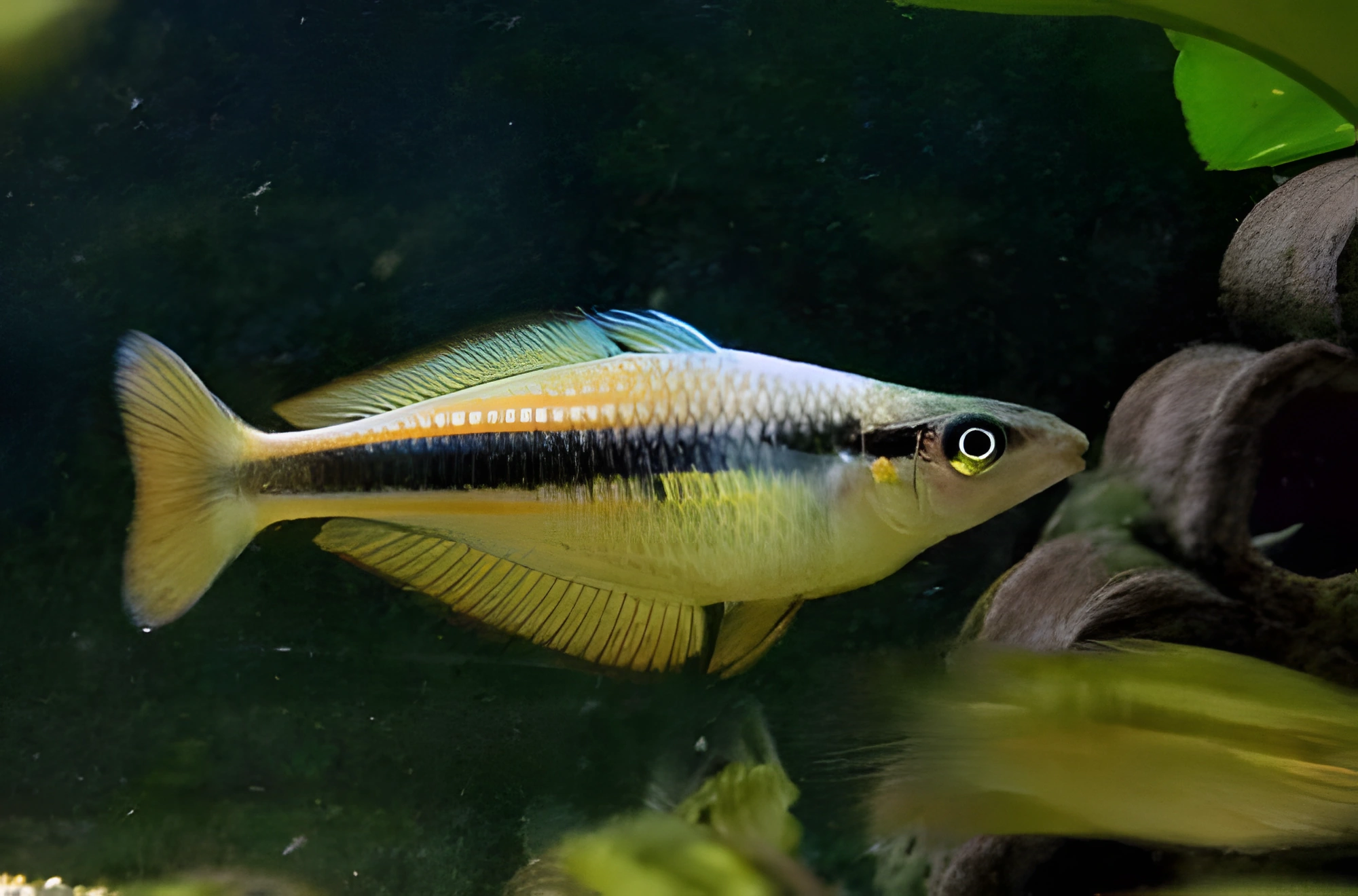
Adults of this fish can reach a length of up to 16 cm. Their coloration is dominated by yellow hues with a pronounced golden sheen. The back sometimes takes on a brownish, blue, or olive color with a metallic tint. A wide black-blue stripe, bordered by a pale yellow outline, is noticeable along the entire body. Females are generally less brightly colored than males and grow somewhat smaller, their length typically reaching about 10 cm.
Habitat
The homeland of this fish is the island of New Guinea, where it predominantly inhabits the basin of the largest river, Mamberamo. It can be found in small streams flowing through humid tropical forests, where the water is clean and the bottom consists of stones or sand. Notably, in its natural habitat, Van Heurn's Rainbowfish lives alongside the well-known aquarium fish, the Fasciata Rainbowfish.
Behavior and Compatibility
This is a friendly and active fish that prefers to live in schools, making it necessary to keep them in a group of conspecifics. It is recommended to acquire 6–8 individuals for a home aquarium. It coexists well with many other aquarium species, including other rainbowfish.
Care and Maintenance
For keeping a school of 6–8 Van Heurn's Rainbowfish, an aquarium of 150 L or more will be optimal. The aquarium's decor can be varied, but it is important to provide ample free swimming space. The use of decorative elements characteristic of their natural habitat, such as natural driftwood, a sand or gravel substrate, and aquatic plants attached to stones, is welcome. Water parameters should be slightly alkaline with a pH, while water hardness should be medium to high. The accumulation of organic waste should be avoided, as this can disrupt the nitrogen cycle. Regular aquarium maintenance is important: weekly partial water changes with fresh water, waste removal, and checking the functionality of equipment, especially the filtration system. Van Heurn's Rainbowfish is not picky about food and readily accepts most popular foods in dry, frozen, and live forms.
Diet
Van Heurn's Rainbowfish is not particularly demanding when it comes to its diet. It readily consumes a variety of popular foods, whether dry granules or flakes, as well as frozen or live options.
Breeding and Reproduction
Currently, reliable information on the successful breeding of this species in aquarium conditions is unavailable. Like other members of the family, the species is an egg-layer. Sexually mature males acquire more intense coloration during the spawning period, especially in the head region. Given the rarity of the species and its natural habitat conditions, the reproduction process requires specific knowledge and conditions that are not currently described in specialized literature.
Diseases
The species exhibits typical rainbowfish sensitivity to water quality; however, specific pathologies characteristic of this particular species have not been identified. The main risks are associated with environmental parameter disturbances, which can lead to reduced immunity and the development of bacterial infections or infestations. Prevention involves maintaining stable hydrochemical parameters, regular water changes, and providing quality nutrition.
How to choose
Acquiring individuals of this species is extremely difficult due to their rarity in aquaristics. When choosing, attention should be paid to the overall activity of the fish, the integrity of the fins, and the absence of visible skin damage. Healthy fish should exhibit schooling behavior and actively respond to food. It is important to avoid purchasing individuals with signs of emaciation, lethargy, or atypical spots on the body, as the adaptation of wild or rare species to captivity requires a high level of owner expertise.
Frequently asked questions
The essentials: size, tank volume, water parameters and care
How big does Van Heurn's Rainbowfish get?
An adult reaches 16 cm in length. Plan the tank around the maximum size: the fish quickly outgrows a cramped setup.
What size aquarium does Van Heurn's Rainbowfish need?
The minimum recommended volume is 150 L. A smaller tank speeds up nitrate build-up and raises stress levels.
What water parameters does Van Heurn's Rainbowfish need?
Temperature 25–28 °C, pH 7.1–7.5, hardness 5–16 dGH. Stability matters more than exact values: sudden swings are harder on the fish than a small deviation from the ideal.
How long does Van Heurn's Rainbowfish live?
Around 6 years when kept properly. Lifespan depends directly on tank volume, water quality and a varied diet.
Is Van Heurn's Rainbowfish aggressive?
Temperament: peaceful (regular). Keep this in mind when choosing tank mates.
How many Van Heurn's Rainbowfish should be kept together?
Recommended setup: medium group (6–8 individuals). Ignoring this is a common cause of stress and disease.
What does Van Heurn's Rainbowfish eat?
Diet type: any (universal). Feed small portions that are finished within a couple of minutes — overfeeding does more harm than underfeeding.
What is the scientific name of Van Heurn's Rainbowfish?
The scientific name of the species is Melanotaenia vanheurni, family Rainbowfishes (Melanotaeniidae). It also appears in the literature as: Rhombatractus vanheurni.