Temperature22 – 32 °C
Natural range
- Port Moresby area
- Papua New Guinea area
RainbowfishConservation status: Vulnerable VU
Melanotaenia papuae, known by its scientific name Melanotaenia papuae, belongs to the family Melanotaeniidae (Rainbowfishes). The native habitats of this fish are numerous streams on the southern tip of the island of Papua New Guinea.
- Required aquarium volume
- 100 L
- Size in aquarium
- 6 cm
- Temperature
- 22 – 32 °C
- Temperament
- Peaceful (regular)
Parameters
Water pHNeutral (7.2) – Slightly alkaline (7.8)
Water dHMedium hardness (10) – Very hard (20)
Water salinityno salt (freshwater)
Size in aquarium6 cm
Lifespan5 years
TemperamentPeaceful (regular)
Toward small fishnot a predator
Required aquarium volume100 L
Lightingmoderate or bright
Substrateany (no restrictions)
Water flowweak or moderate
FeedingAny (universal)
CareMedium group (6–8 individuals)
Description
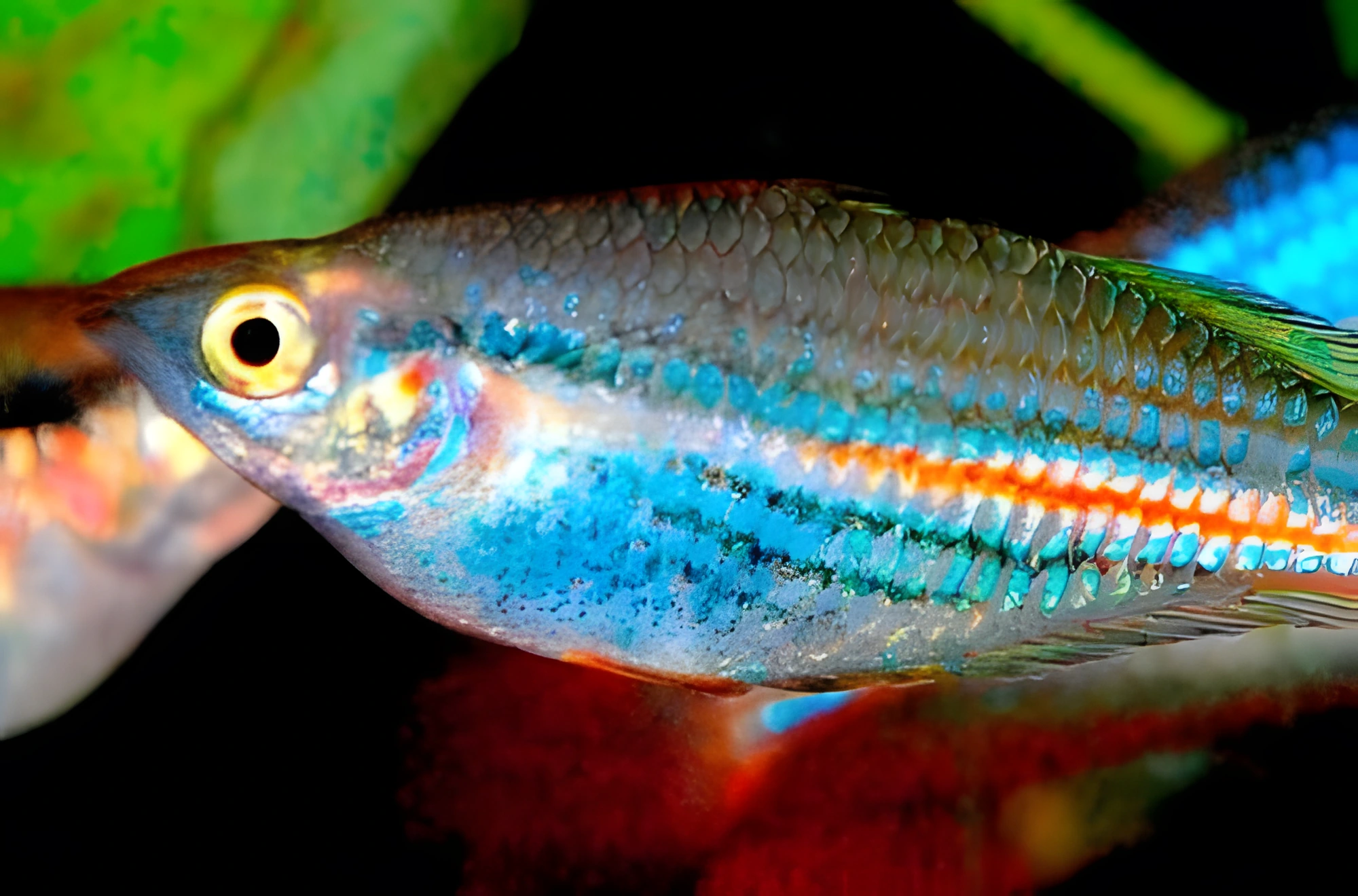
Adult specimens reach a length of about 6 cm. Their body has the characteristic shape of Rainbowfishes, complemented by a remarkable bifurcated dorsal fin. In ideal conditions and with a properly selected diet, their coloration is dominated by bluish-green tones. In unfavorable conditions, the coloration fades and becomes gray. Black and red horizontal stripes are noticeable along the body, which are especially pronounced towards the tail. In males, these stripes are more saturated and contrasting, while in females they appear paler.
Habitat
The species is endemic to the island of New Guinea and inhabits small forest streams within a 35 km radius of Port Moresby. In their natural environment, the fish prefer areas with abundant aquatic vegetation, snags, and a rocky bottom. Natural conditions are characterized by a tropical climate, moderate current, and clear water with neutral or slightly alkaline pH levels.
Behavior and Compatibility
These active and peaceful fish prefer to live in shoals of 6–8 individuals. They get along well with most other species of aquarium fish of comparable size. However, when choosing tank mates, slow-moving fish should be avoided, as their excessive activity may cause them distress.
Care and Maintenance
For a shoal of 6–8 fish, an aquarium of at least 100 liters will be optimal. The placement of decorations is at the discretion of the aquarist, but it is important to provide spacious areas for swimming, as well as a sufficient number of shelters. Therefore, it is recommended to place decor elements along the side and back walls. It should be remembered that the fish are prone to jumping out of the aquarium, so appropriate barriers must be provided, for example, using a lid and floating plants. To maintain their well-being, clean, flowing water, well-saturated with oxygen, is required. Although the fish can adapt to a wide range of water hardness (dGH), they prefer a slightly alkaline environment (pH above neutral). For long-term keeping, high water quality is crucial, depending not only on the uninterrupted operation of the filtration system but also on regular aquarium maintenance. In particular, it is necessary to change part of the water for fresh water every week and remove accumulated organic waste. Melanotaenia papuae, originating from flowing waters, is sensitive to the oxygen level in the water. If the filter is not equipped with an aeration function, it is recommended to install additional air diffusers.
Diet
Fish raised in captivity usually readily accept most available dry foods. A balanced diet consisting of high-quality products helps them display the brightest coloration.
Breeding and Reproduction
Breeding Melanotaenia papuae requires some experience. A beginner aquarist will find it difficult to succeed without prior knowledge. Fish reach sexual maturity at approximately one year of age. A separate small aquarium is needed for breeding. The brightest males and several large females are placed in it. Their diet includes live or frozen foods. Approximately one month after transfer, the water temperature is gradually raised by a couple of degrees — this serves as a stimulus for spawning. If the fish are ready, at dawn on one of the days, they lay more than a hundred eggs among dense thickets of plants. Spawning can continue for several days. Since the fish do not show parental care and are capable of eating their own eggs, they must be promptly transferred back to the main aquarium. Fry hatch within a week. In the first days, they feed on the remnants of the yolk sac, remaining in one place. Then they begin to swim freely in search of food. They should be fed specialized fry foods, Artemia nauplii, and other micro-foods.
Diseases
No specific diseases have been described for the species, however, the fish are sensitive to water quality and keeping conditions. If environmental parameters are not met or organic waste accumulates, immunity decreases, which can lead to bacterial or fungal infections. Prevention includes weekly partial water changes, effective filtration, and maintaining stable hydrochemical parameters.
How to choose
When selecting individuals, attention should be paid to the cleanliness of the fins, the absence of visible damage, spots, or plaque on the scales. A healthy fish should be active and have a good appetite. It is important to consider that at a young age, the coloration may be pale and not correspond to the bright appearance of adult individuals. It is recommended to avoid buying fish that look emaciated, apathetic, or stay away from the shoal.
Frequently asked questions
The essentials: size, tank volume, water parameters and care
How big does Melanotaenia papuae get?
An adult reaches 6 cm in length. Plan the tank around the maximum size: the fish quickly outgrows a cramped setup.
What size aquarium does Melanotaenia papuae need?
The minimum recommended volume is 100 L. A smaller tank speeds up nitrate build-up and raises stress levels.
What water parameters does Melanotaenia papuae need?
Temperature 22–32 °C, pH 7.2–7.8, hardness 10–20 dGH. Stability matters more than exact values: sudden swings are harder on the fish than a small deviation from the ideal.
How long does Melanotaenia papuae live?
Around 5 years when kept properly. Lifespan depends directly on tank volume, water quality and a varied diet.
Is Melanotaenia papuae aggressive?
Temperament: peaceful (regular). Keep this in mind when choosing tank mates.
How many Melanotaenia papuae should be kept together?
Recommended setup: medium group (6–8 individuals). Ignoring this is a common cause of stress and disease.
What does Melanotaenia papuae eat?
Diet type: any (universal). Feed small portions that are finished within a couple of minutes — overfeeding does more harm than underfeeding.
What is the scientific name of Melanotaenia papuae?
The scientific name of the species is Melanotaenia papuae, family Melanotaeniidae (Rainbowfishes).