Temperature22 – 33 °C
Natural range
- Papua New Guinea area
- Southern Papua New Guinea area
RainbowfishConservation status: Least concern LC
Other scientific names: Aristeus goldiei, Rhombatractus goldiei
The Goldie River Rainbowfish, also known by its scientific name Melanotaenia goldiei, belongs to the family Melanotaeniidae, or Rainbowfishes. This fish was named after the Goldie River in Papua New Guinea, where it was first discovered. Although the species has been known in aquaristics since the 1950s, it only gained true popularity in Europe in the late 1980s, when the renowned German researcher Heiko Bleher introduced it as a new species under the name "Tapini."
- Required aquarium volume
- 150 L
- Size in aquarium
- 10 cm
- Temperature
- 22 – 33 °C
- Temperament
- Peaceful (regular)
Parameters
Water pHNeutral (7) – Slightly alkaline (8)
Water dHHard (15) – Very hard (22)
Water salinityno salt (freshwater)
Size in aquarium10 cm
Lifespan6 years
TemperamentPeaceful (regular)
Toward small fishnot a predator
Required aquarium volume150 L
Lightingdimmed
Substrateany, but dark
Water flowweak or moderate
FeedingAny (universal)
CareMedium group (6–8 individuals)
Description
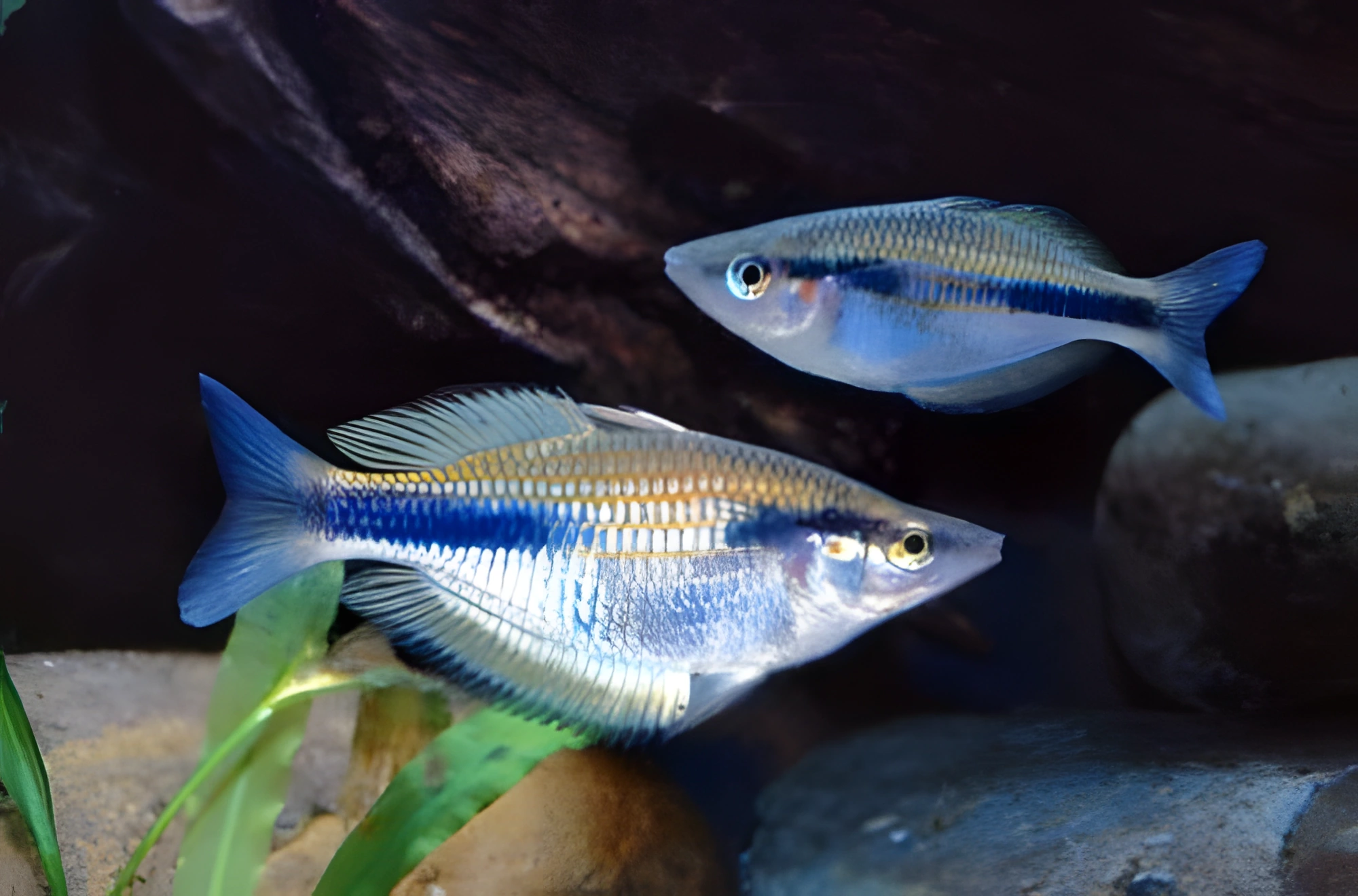
Adult specimens of this fish can reach a length of up to 10 cm. Visually, there are no significant differences between males and females, although females may be slightly smaller. The coloration is characterized by a rich variety of colors, but blue hues remain predominant. A black stripe is visible along the body, which can narrow or gradually disappear towards the middle of the torso.
Habitat
The native habitat of this fish is the southern regions of Papua New Guinea, where it is widespread. Its natural range includes a wide variety of water bodies: swamps, quiet backwaters, small streams, and even large rivers. The typical habitat is a dimly lit area with slow current, where the bottom is covered with fallen leaves and numerous snags, and aquatic vegetation grows profusely.
Behavior and Compatibility
During spawning, males often persistently pursue females. These "courtships" can be excessively intense, and if the female does not have an opportunity to hide, the chase can result in injuries. It is recommended to keep these fish in mixed groups, with 2–3 females per male, which helps reduce aggression. In general, intraspecific conflicts are not observed outside the spawning period. The fish are peaceful and get along well with other non-aggressive species of comparable size.
Care and Maintenance
For Melanotaenia goldiei, optimal keeping conditions include a spacious aquarium that recreates their natural aquatic environment. The setup should provide both open swimming areas and secluded hiding spots. Floating plants, branched driftwood, or other natural and artificial decor can help create these. It is recommended to use dark elements in the decor, including the substrate, and maintain subdued lighting. Since these fish are prone to jumping, an aquarium lid is essential. They prefer soft, slightly alkaline water. To maintain a stable biological balance, regular cleaning of organic waste from the aquarium, weekly water changes of 20–30% of the volume with fresh water, and prophylactic inspection and maintenance of equipment are necessary.
Diet
In their natural environment, the diet of these fish consists primarily of small insects and their larvae, crustaceans, and other zooplankton. In a home aquarium, it is recommended to offer them similar live or frozen foods, as well as dry high-protein flakes. Feeding occurs in the upper and middle water layers, so any food remnants that settle to the bottom usually remain uneaten.
Breeding and Reproduction
In aquarium conditions, the breeding season does not have clear boundaries. Females lay their eggs among dense plant thickets, securely attaching them to leaves. The appearance of fry usually occurs within one week. The parent fish show no interest in their offspring, so to ensure their survival, it is advisable to transfer the fry to a separate tank. Feeding is done with micro-foods, such as Artemia nauplii, finely crushed dry flakes, or special foods designed for aquarium fish fry.
Diseases
Under favorable conditions, cases of disease in these fish are rare. If the first symptoms of an ailment appear, such as lethargy, body deformation, or the appearance of spots, it is first necessary to check the water quality. Often, bringing all environmental parameters back to normal allows the fish's body to cope with the disease on its own. Otherwise, medication may be required. More detailed information can be found in the "Diseases of Aquarium Fish" section.
How to choose
When selecting individuals in a store, prioritize active fish with clean fins and no visible damage or film on their scales. Healthy rainbowfish have vibrant coloration appropriate for their age and show interest in food. Avoid purchasing fish that appear sluggish, stay at the water's surface, or have a sunken belly, as this may indicate hidden diseases or stress from improper keeping conditions. It is recommended to acquire a group of 5–6 individuals simultaneously to reduce stress levels during adaptation to a new aquarium.
Frequently asked questions
The essentials: size, tank volume, water parameters and care
How big does Goldie River Rainbowfish get?
An adult reaches 10 cm in length. Plan the tank around the maximum size: the fish quickly outgrows a cramped setup.
What size aquarium does Goldie River Rainbowfish need?
The minimum recommended volume is 150 L. A smaller tank speeds up nitrate build-up and raises stress levels.
What water parameters does Goldie River Rainbowfish need?
Temperature 22–33 °C, pH 7–8, hardness 15–22 dGH. Stability matters more than exact values: sudden swings are harder on the fish than a small deviation from the ideal.
How long does Goldie River Rainbowfish live?
Around 6 years when kept properly. Lifespan depends directly on tank volume, water quality and a varied diet.
Is Goldie River Rainbowfish aggressive?
Temperament: peaceful (regular). Keep this in mind when choosing tank mates.
How many Goldie River Rainbowfish should be kept together?
Recommended setup: medium group (6–8 individuals). Ignoring this is a common cause of stress and disease.
What does Goldie River Rainbowfish eat?
Diet type: any (universal). Feed small portions that are finished within a couple of minutes — overfeeding does more harm than underfeeding.
What is the scientific name of Goldie River Rainbowfish?
The scientific name of the species is Melanotaenia goldiei, family Rainbowfishes (Melanotaeniidae). It also appears in the literature as: Aristeus goldiei, Rhombatractus goldiei.