Temperature24 – 28 °C
Natural range
- Lake Malawi area
- Chipoka area
CichlidsConservation status: Critically endangered CR
Other scientific names: Aulonocara chipokae, Melanochromis chipoke
Melanochromis chipokae, known scientifically as Melanochromis chipokae, belongs to the family Cichlidae. This species represents the Mbuna group of cichlids, characterized by their aggressive behavior. This particular trait creates the main difficulties in keeping them, which is why this fish is not recommended for beginner aquarists.
- Required aquarium volume
- 200 L
- Size in aquarium
- 12 cm
- Temperature
- 24 – 28 °C
- Temperament
- Aggressive / incompatible / unfriendly
Parameters
Water pHSlightly alkaline (7.6) – Alkaline (8.8)
Water dHMedium hardness (10) – Very hard (25)
Water salinityno salt (freshwater)
Size in aquarium12 cm
Lifespan8 years
TemperamentAggressive / incompatible / unfriendly
Toward small fishnot a predator
Required aquarium volume200 L
Lightingmoderate (regular)
Substratesandy (regular, light)
Water flowweak or moderate
FeedingPlant-based (algae, vegetables)
CareHarem (1 male and several females)
Description
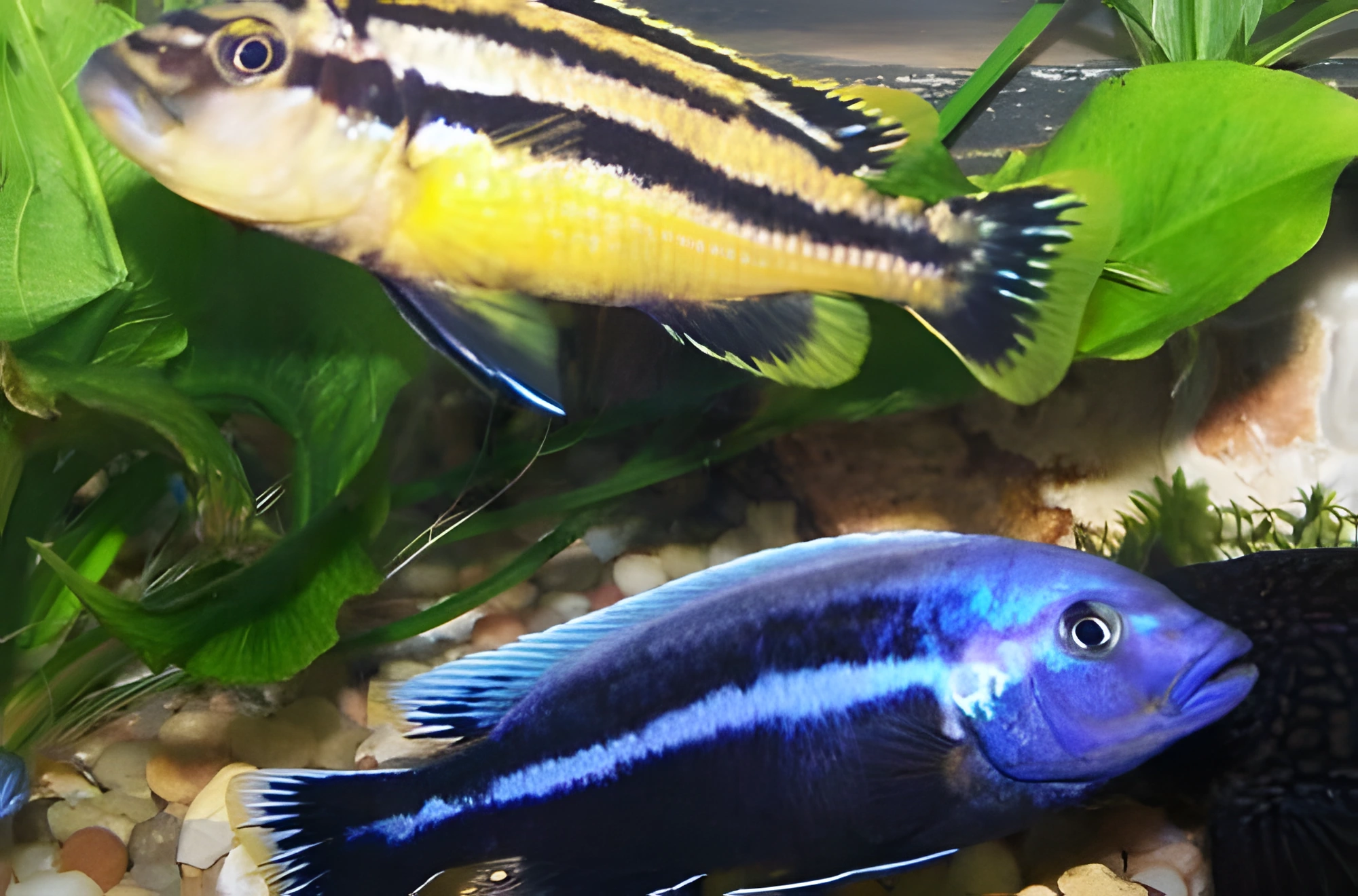
Adult Melanochromis chipokae can reach a length of about 12 cm. Sexual dimorphism in this species is quite pronounced: the alpha male has a characteristic yellow coloration with distinct black horizontal stripes. In contrast, females, juveniles, and subdominant males are distinguished by rich blue and light blue hues.
Habitat
This species is endemic to the African Lake Malawi. It can be found exclusively in the southwestern part of the reservoir, near the city of Chipoka. Melanochromis chipokae inhabits areas close to the coast, where sandy substrates cover the bottom, and the shores are dotted with rocks.
Behavior and Compatibility
This species is characterized by aggressive and territorial behavior, which is particularly pronounced in males. In an aquarium up to 200 liters, it is recommended to keep only one dominant male (identifiable by his coloration) with several females. The alpha male occupies a specific area on the bottom and actively guards it, and females may also be subject to attacks; therefore, it is essential to provide a sufficient number of shelters. Increasing the number of species is only possible with a significant increase in aquarium volume.
Care and Maintenance
For the comfortable keeping of a small group of these fish, the optimal aquarium volume starts from 200 liters. The decor can be quite simple: usually, a sandy substrate and several large rocks or rock fragments with smooth edges are used to form grottoes and crevices. Any hollow objects suitable for placement in the aquarium can also serve as shelters. The presence of live plants is not mandatory. Additionally, natural driftwood can be used, which, with sufficient lighting, will become covered with algae, serving as an additional food source for Melanochromis chipokae.
Diet
Melanochromis chipokae readily accepts most aquarium foods, be it dry, frozen, or live. However, a key condition is a significant amount of plant-based additives in its diet. For this purpose, spirulina flakes, pieces of nori, and other similar products can be used.
Breeding and Reproduction
Breeding Melanochromis chipokae in a home aquarium is a challenging task, though entirely possible. The main difficulty lies in the male's increased aggression, which becomes particularly pronounced during the breeding season. His persistent attempts to persuade females to mate can sometimes even lead to their death. To avoid such a tragic outcome, it is recommended to provide reliable shelters in the aquarium and keep at least three females, which will help to disperse the male's aggression. When a female is ready to reproduce, she accepts courtship and successively lays several batches of eggs. Then, immediately after fertilization, she collects them into her mouth, where the entire incubation period will take place. This specific spawning behavior is the result of evolutionary development and is due to the need to protect offspring in the highly competitive environment of Lake Malawi.
Diseases
The main cause of most diseases in Malawian cichlids is unsuitable living conditions and poor-quality food, which often leads to a condition known as Malawi Bloat. Upon detecting the first symptoms, it is important to check water parameters and ensure there are no high concentrations of dangerous substances such as ammonia, nitrites, and nitrates. All parameters must be normalized before proceeding with treatment. More detailed information on symptoms and treatment methods is available in the "Aquarium Fish Diseases" section.
How to choose
When choosing individuals, pay attention to their activity and the absence of visible damage, such as ulcers, fin rot, or whitish spots on the body. Avoid fish with sunken bellies or unnaturally bloated abdomens, as this may indicate internal diseases. Given the high territoriality and aggressiveness of the species, it is recommended to acquire young individuals so that they can adapt to aquarium conditions together, or to select a group with the correct sex ratio (there should be 3-8 females per male).
- Assess behavior: healthy fish show curiosity and swim actively, avoiding individuals that hide in corners or show signs of apathy.
- Check the clarity of coloration: in young individuals and females, the pattern should be clear, without signs of paleness or stress spots.
- Clarify the keeping conditions in the store: it is important that the fish are in an aquarium with a sufficient number of shelters, as constant stress from the lack of hiding places negatively affects the cichlids' immune system.
Frequently asked questions
The essentials: size, tank volume, water parameters and care
How big does Melanochromis chipokae get?
An adult reaches 12 cm in length. Plan the tank around the maximum size: the fish quickly outgrows a cramped setup.
What size aquarium does Melanochromis chipokae need?
The minimum recommended volume is 200 L. A smaller tank speeds up nitrate build-up and raises stress levels.
What water parameters does Melanochromis chipokae need?
Temperature 24–28 °C, pH 7.6–8.8, hardness 10–25 dGH. Stability matters more than exact values: sudden swings are harder on the fish than a small deviation from the ideal.
How long does Melanochromis chipokae live?
Around 8 years when kept properly. Lifespan depends directly on tank volume, water quality and a varied diet.
Is Melanochromis chipokae aggressive?
Temperament: aggressive / incompatible / unfriendly. Keep this in mind when choosing tank mates.
How many Melanochromis chipokae should be kept together?
Recommended setup: harem (1 male and several females). Ignoring this is a common cause of stress and disease.
What does Melanochromis chipokae eat?
Diet type: plant-based (algae, vegetables). Feed small portions that are finished within a couple of minutes — overfeeding does more harm than underfeeding.
What is the scientific name of Melanochromis chipokae?
The scientific name of the species is Melanochromis chipokae, family Cichlids (Cichlidae). It also appears in the literature as: Aulonocara chipokae, Melanochromis chipoke.