Temperature22 – 28 °C
Other scientific names: Colisa chuna, Colisa sota, Polyacanthus sota, Trichopodus chuna, Trichopodus sota
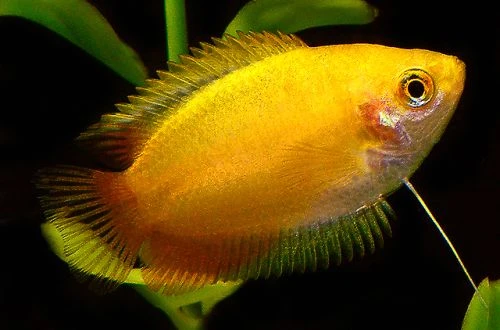
Trichogaster chuna, more commonly known as the Honey Gourami, is a member of the Osphronemidae family. This small, graceful fish is characterized by its soft coloration, ranging from silvery-gray to delicate yellow. Interestingly, the species name is explained by the behavior of males during the spawning period, when they acquire a rich honey hue.
Among gouramis, the Honey Gourami is one of the most miniature species, with adults rarely exceeding 5 cm. Its body shape resembles that of the Dwarf Gourami (Colisa lalia), but its fins are significantly smaller. The main color palette includes silvery-gray and light yellow tones, often complemented by a dark horizontal stripe along the center of the body. During the spawning period, males transform: their anal and caudal fins acquire rich honey or reddish-orange colors, and their belly shimmers with dark blue. There are also several selective forms, such as red and gold. These forms are more popular than the original species due to their bright coloration, which remains unchanged even in retail conditions. The female's coloration remains unchanged throughout her life, while in males, it becomes significantly brighter and more intense during the spawning period.
The natural range of these fish is South Asia: the Ganges and Brahmaputra basins in northern India, including the floodplain and delta in Bangladesh, with records from Nepal. There they inhabit various bodies of water — from rivers and lakes to ponds, ditches, and even temporarily flooded fields. Many of these areas are subject to seasonal changes caused by annual monsoons from June to October. Honey Gouramis prefer environments with abundant aquatic vegetation, as well as weak currents or still water. Their diet consists of various small invertebrates, insects, and other zooplankton. Their unique hunting method is noteworthy: Gouramis are capable of catching food even above the water surface. Upon approaching a victim, the fish sharply compresses its mouth cavity, releasing a jet of water that knocks the insect off a branch, leaf, or even out of the air.
The Honey Gourami is a peaceful and rather timid species, requiring significant time to adapt to a new aquarium environment. It can be easily frightened by active and energetic tank mates, so small, calm fish, such as those from the carp family, are preferable as companions. Keep them in a group of no fewer than 4–6: they do not form shoals, but they need contact with conspecifics and behave far more interestingly in numbers. An internal hierarchy with a dominant individual forms within the group. Honey Gouramis often form long-term pairs.
Honey Gouramis are undemanding regarding keeping conditions and successfully adapt to limited aquarium space. To maintain optimal water quality, an efficient filtration system and weekly 25% water changes are necessary. When choosing a filter, it is important to consider the fish's preference for weak currents or still water, i.e., avoid devices that create strong flows. Other necessary equipment includes an air pump, lighting system, and heater. The aquarium should always be covered. This will prevent "splashes" during possible hunting for flying insects and minimize the risk of damage to the labyrinth organ when breathing atmospheric air, as a layer of air with increased humidity and a temperature above room temperature is created under the lid. In the aquarium setup, provide numerous hiding places and shelters, which is especially important when keeping them with larger fish. Plants are best placed in groups near shelters or along the side walls. Dark substrate will help enhance the fish's natural coloration.
In a home aquarium, these fish readily accept a variety of dry commercial foods, such as flakes and pellets. It is also recommended to add plant-based components to their diet. Specialized foods for Gouramis are available on the market, which enhance coloration and contain all necessary vitamins, trace elements, and plant substances. Fish should be fed once or twice a day.
Breeding this species is relatively simple. The fish build a bubble nest; if floating leaves are present in the aquarium, they will serve as a good base for its attachment. Unlike its close relative, the Dwarf Gourami, the male Honey Gourami behaves more tolerantly towards the female after spawning, guarding the clutch. If other fish are kept in the aquarium besides the pair, a separate tank will be required for breeding. A volume of 20 L will be quite sufficient, with the water level recommended to be no higher than 20 cm, and its parameters should match the main aquarium. Equipment needed includes a simple air-driven filter, an air pump, a heater, and a lighting system. An important element of the setup is floating plants with broad leaves, under which the male builds the nest, making it more robust than if it were simply on the water surface. Adding meaty foods to the daily diet will stimulate spawning. After some time, the female will become noticeably rounded with eggs, and the male will become even more colorful. At this point, the pair should be moved to a separate tank. After the nest construction is complete, the courtship ritual begins: the male swims around the female, inviting her to follow him to the new nest. This process continues until the female begins to lay eggs. At one time, the female releases several dozen eggs, which the male immediately fertilizes and carefully transfers to the nest. The total number of eggs can exceed 300. At the end of spawning, the male vigilantly guards the future offspring from everyone, including the female, who must be returned to the main aquarium. Fry hatch after 24–36 hours, depending on the water temperature. After the offspring appear, the male can also leave the nest. After three days, the fry begin to move freely around the aquarium; they should be fed specialized micro-food, which can be purchased in pet stores.
In an aquarium where a stable biosystem has been successfully established and the necessary water parameters are maintained, fish usually do not encounter health problems. However, any deterioration in conditions can provoke a number of diseases; one of the most common is "Velvet disease. In recent years, many fish infected with incurable viral strains have appeared on the market. The reason for this is the breeding methods in commercial farms, where hormonal additives are actively used to enhance coloration. It is important to remember that before placing a new fish in a community aquarium, it must undergo a quarantine period, which should be at least 2 weeks.
When choosing a Honey Gourami, preference should be given to individuals with clean fins and no visible damage, ulcers, or white film on the body. A healthy fish should show activity, be interested in its surroundings, and not constantly hide in the corners of the aquarium. Avoid purchasing fish that appear emaciated, have sunken bellies, or unnaturally bloated areas, as this may indicate the presence of internal parasites or bacterial infections. Given the risk of acquiring individuals from commercial farms, where hormonal preparations are often used to enhance brightness, it is recommended to choose fish with natural coloration and always quarantine them for at least two weeks before introducing them into the main aquarium.
The essentials: size, tank volume, water parameters and care
An adult reaches 5 cm in length. Plan the tank around the maximum size: the fish quickly outgrows a cramped setup.
The recommended volume is 54 L. A smaller tank speeds up nitrate build-up and raises stress levels.
Temperature 22–28 °C, pH 6–8, hardness 5–19 dGH. Stability matters more than exact values: sudden swings are harder on the fish than a small deviation from the ideal.
Around 8 years when kept properly. Lifespan depends directly on tank volume, water quality and a varied diet.
Temperament: peaceful (regular). Keep this in mind when choosing tank mates.
Recommended setup: pair (male/female). Ignoring this is a common cause of stress and disease.
Diet type: any (universal). Feed small portions that are finished within a couple of minutes — overfeeding does more harm than underfeeding.
The scientific name of the species is Trichogaster chuna, family Osphronemidae. It also appears in the literature as: Colisa chuna, Colisa sota, Polyacanthus sota.
Matched by family, categories and overlapping keeping conditions
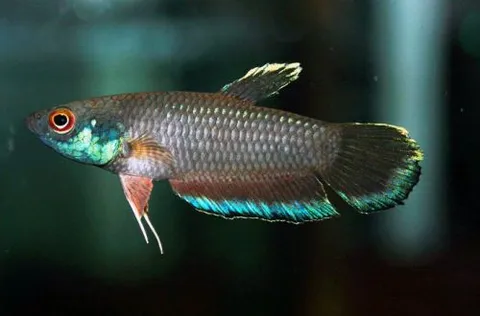
Betta taeniata
The Striped Betta, also known as the Borneo Betta, bears the scientific name Betta taeniata and belongs to the family Osphronemidae. Despite being classified within the Betta group, their behavior is completely at odds…
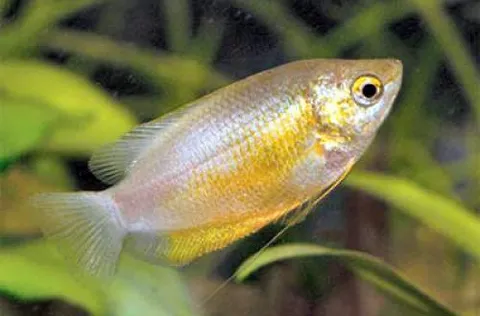
Trichogaster labiosa
Trichogaster labiosa, more commonly known as the Thick-lipped Gourami or Labiosa, belongs to the family Osphronemidae. This fish will be a wonderful addition to any aquarium. Thanks to its modest size and natural,…
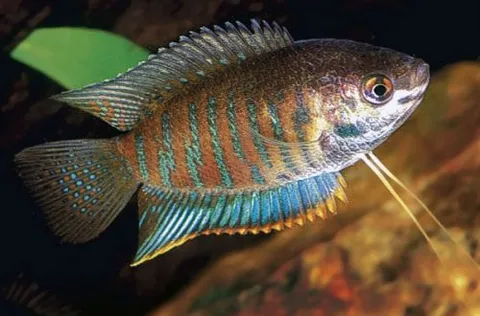
Trichogaster fasciata
Trichogaster fasciata, also known as the Banded Gourami or Striped Gourami, belongs to the family Osphronemidae. This fish possesses a range of qualities that make it an excellent choice for beginner aquarists: it is…
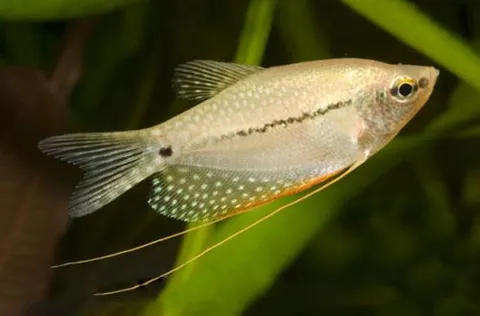
Trichopodus leerii
The Pearl Gourami, known scientifically as Trichopodus leerii, is a member of the Osphronemidae family. This fish is rightfully considered one of the most attractive among freshwater aquarium inhabitants. Its name is…