Temperature16 – 28 °C
LivebearersConservation status: Least concern LC
Other scientific names: Mollienisia helleri, Poecilia helleri, Xiphophorus brevis, Xiphophorus guentheri, Xiphophorus guntheri, Xiphophorus helleri
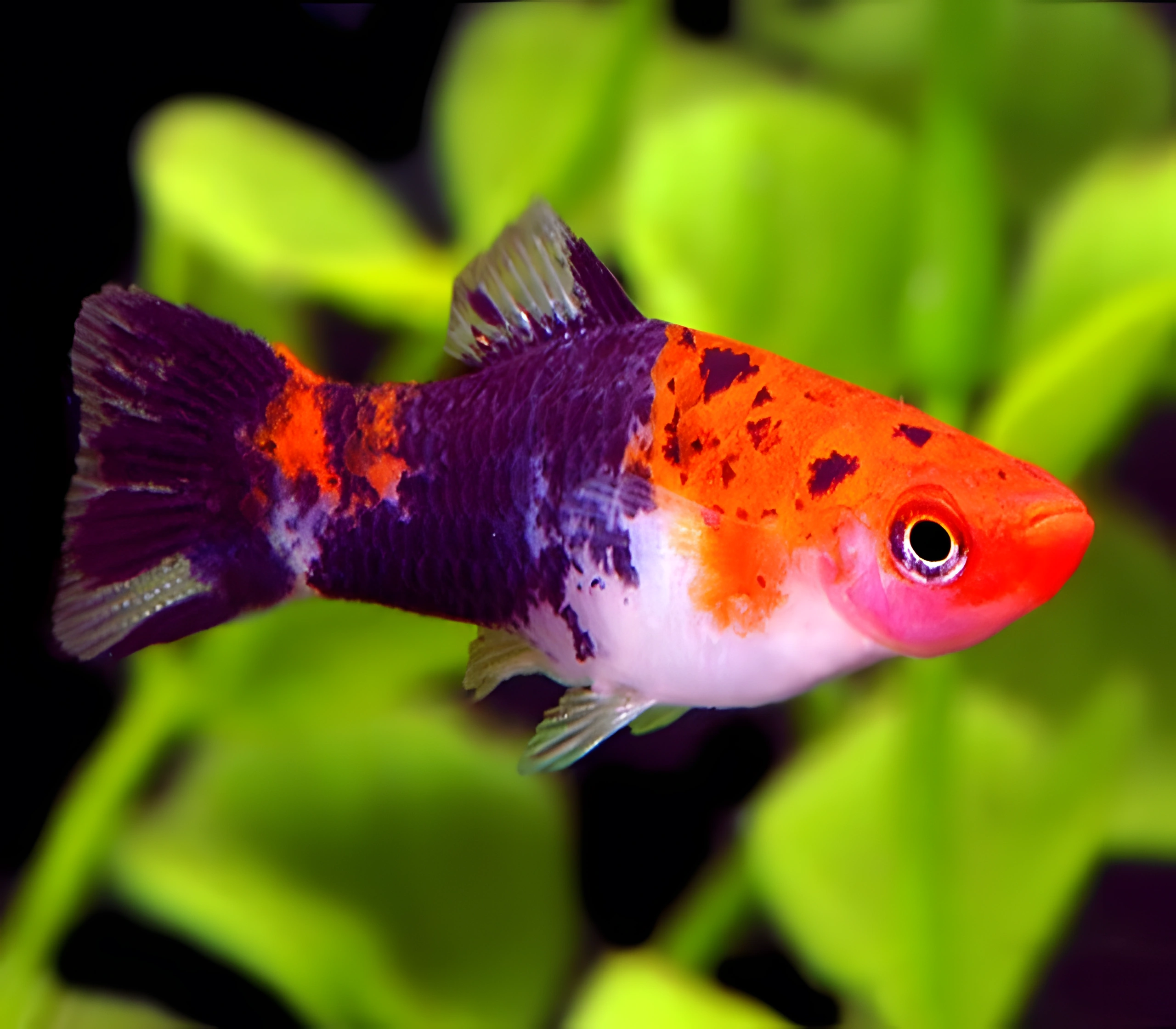
The Calico Swordtail, known scientifically as Xiphophorus hellerii (Showa strain), belongs to the Poeciliidae family. This fish earned its name due to its body coloration, which resembles the pattern of the decorative Japanese Koi carp of the same Showa strain.
- Required aquarium volume
- 100 L
- Size in aquarium
- 7 – 10 cm
- Temperature
- 16 – 28 °C
- Temperament
- Peaceful (regular)
Parameters
Water pHNeutral (7) – Slightly alkaline (8)
Water dHMedium hardness (10) – Very hard (30)
Water salinityvery low (up to ~3 g/L)
Size in aquarium7 – 10 cm
Lifespan4 years
TemperamentPeaceful (regular)
Toward small fishnot a predator
Required aquarium volume100 L
Lightingweak (low)
Substrateany (no restrictions)
Water flowweak or moderate
FeedingAny (universal)
CareMixed (solitary / pair / group)
Description
The Calico Swordtail is a selective breeding form, obtained by crossing the Heller's Swordtail and the Platy. The fish has an elongated body, 7–10 cm long, with a characteristic elongated lower ray of the caudal fin in males, called a sword. The coloration combines three colors: white, red or orange, and black, forming a variegated pattern reminiscent of Japanese Koi carp of the Showa strain. Sexual dimorphism is pronounced: males are more slender and have a gonopodium, while females are larger and more robust.
Habitat
In nature, Xiphophorus hellerii inhabits waters of Central America, including rivers and streams in Honduras and Guatemala. The Calico variety is an entirely artificially bred form, not found in the wild. In aquarium conditions, these fish adapt to a wide range of parameters: temperatures of 16–28 °C, pH of 7.0–8.0, and hardness of 10–30 dGH.
Behavior and Compatibility
This is an active and peaceful fish, suitable for keeping in community tanks with similarly sized species. Males may exhibit intraspecific aggression, so it is recommended to keep them in a ratio of at least 2–3 females per male to reduce competition. The species primarily occupies the middle water layers. It is compatible with most peaceful fish, but slow-moving species with long fins should be avoided.
Care and Maintenance
The Calico Swordtail, like other livebearing fish, is generally considered an undemanding aquarium inhabitant. This fish easily adapts to conditions including various temperature regimes and hydrochemical water parameters, and does not have special requirements for aquarium setup. It can even be kept in brackish water. Often, caring for such fish does not require significant effort. For example, in a specialized swordtail aquarium, a heater may sometimes be unnecessary, and if the water volume is large and the number of fish is small (at a rate of 1–2 individuals per 100 liters), a simple air-driven filter is sufficient. Regular aquarium maintenance includes weekly replacement of 15–20% of the total water volume with fresh water, as well as removal of accumulated organic matter, such as uneaten food residues and excrement. Regarding nutrition, the Calico Swordtail readily accepts various types of appropriately sized food. A varied diet, including dry, frozen, and live foods, is considered optimal. However, daily feeding can also be based on ordinary flakes or pellets. For example, Aqvium flake food for aquarium fish has proven to be a bestseller on Ozon with a rating of 4.9. It is suitable for most aquarium fish, and its raw materials are produced according to new European standards (EU 2018/848), and it is also enriched with vitamins A, C, D3, E, and Omega 3-6. It can be purchased on Ozon. Regarding behavior and compatibility, these fish peacefully coexist with their conspecifics and other non-aggressive freshwater species. However, aggressive or territorial inhabitants should be avoided. It is important to remember that swordtails can interbreed with related species such as platies and mollies, producing hybrid offspring, which may raise questions regarding their cohabitation.
Diet
Swordtails are omnivorous fish. Their diet should include both high-quality dry foods in the form of flakes or pellets, as well as plant supplements such as spirulina or blanched vegetables. Foods containing carotenoids are beneficial for maintaining vibrant coloration. Feeding 1–2 times a day in small portions that the fish can consume within a few minutes is recommended.
Breeding and Reproduction
These fish are livebearers, which makes their reproduction relatively simple. Fertilization is internal, using a gonopodium. Gestation lasts about 4–6 weeks, after which the female gives birth to fully formed fry. Parental instinct is absent, so for the survival of the offspring, dense plant thickets or the use of a breeding trap is necessary. Fry are able to immediately feed on small specialized foods.
Diseases
With proper keeping conditions and regular water changes, these fish generally have robust health. Common problems include infections caused by protozoa or bacteria, often arising from poor water quality or overcrowding. Prevention through quarantining new individuals and maintaining substrate cleanliness is important. They are sensitive to abrupt changes in hydrochemical parameters.
How to choose
When purchasing, choose active fish with clean fins and no visible spots or film on their bodies. It is important to ensure that the fish's belly does not appear excessively sunken, and its behavior is not lethargic. It is recommended to avoid individuals that stay near the surface or constantly hide. It is best to buy from reputable places where stocking density and aquarium hygiene standards are observed.
Frequently asked questions
The essentials: size, tank volume, water parameters and care
How big does Calico Swordtail get?
An adult reaches 7–10 cm in length. Plan the tank around the maximum size: the fish quickly outgrows a cramped setup.
What size aquarium does Calico Swordtail need?
The minimum recommended volume is 100 L. A smaller tank speeds up nitrate build-up and raises stress levels.
What water parameters does Calico Swordtail need?
Temperature 16–28 °C, pH 7–8, hardness 10–30 dGH. Stability matters more than exact values: sudden swings are harder on the fish than a small deviation from the ideal.
How long does Calico Swordtail live?
Around 4 years when kept properly. Lifespan depends directly on tank volume, water quality and a varied diet.
Is Calico Swordtail aggressive?
Temperament: peaceful (regular). Keep this in mind when choosing tank mates.
How many Calico Swordtail should be kept together?
Recommended setup: mixed (solitary / pair / group). Ignoring this is a common cause of stress and disease.
What does Calico Swordtail eat?
Diet type: any (universal). Feed small portions that are finished within a couple of minutes — overfeeding does more harm than underfeeding.
What is the scientific name of Calico Swordtail?
The scientific name of the species is Xiphophorus hellerii (порода Showa), family Poeciliidae. It also appears in the literature as: Mollienisia helleri, Poecilia helleri, Xiphophorus brevis.