Temperature16 – 28 °C
LivebearersConservation status: Least concern LC
Other scientific names: Mollienisia helleri, Poecilia helleri, Xiphophorus brevis, Xiphophorus guentheri, Xiphophorus guntheri, Xiphophorus helleri
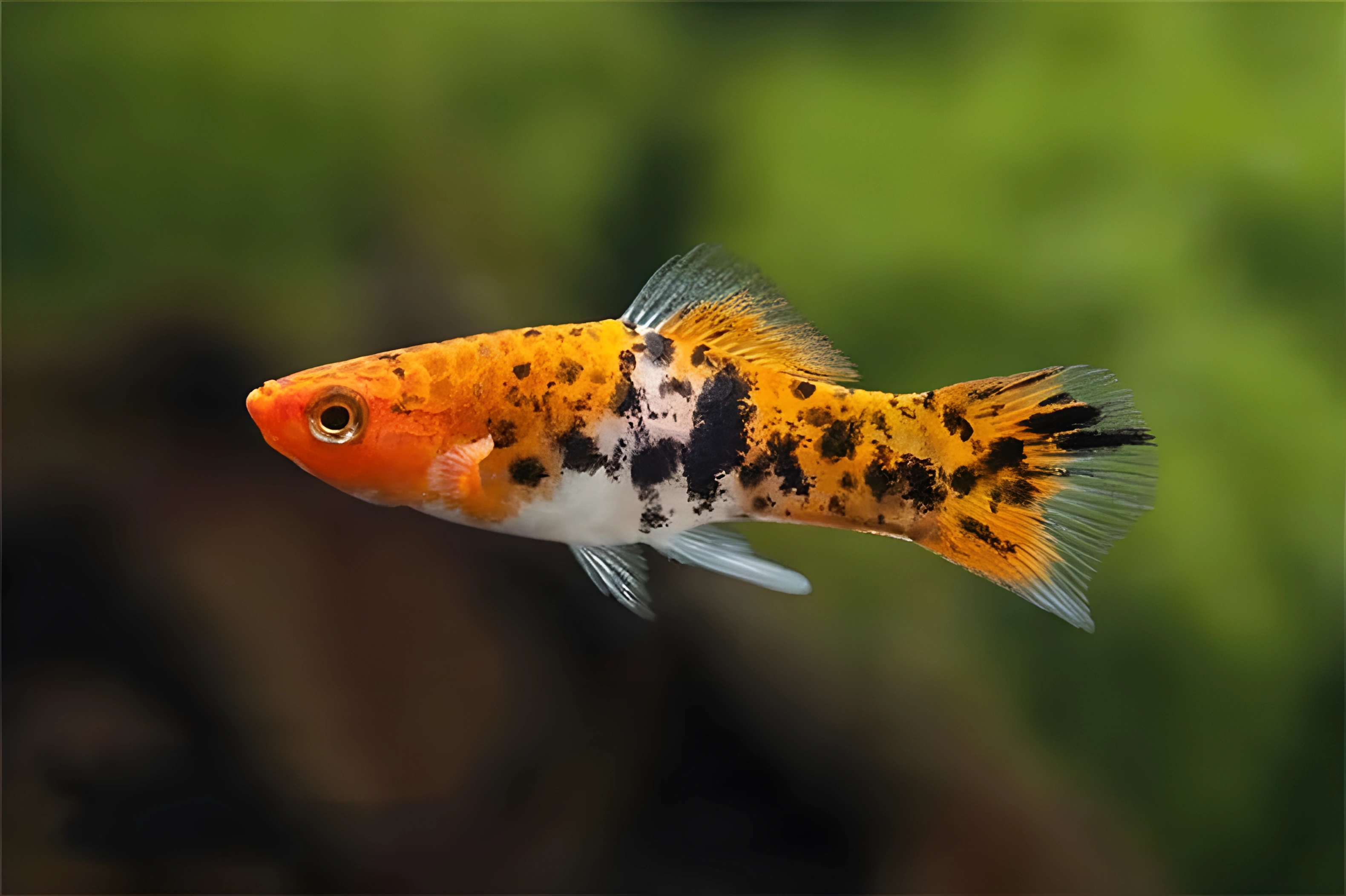
The Sanke Swordtail, known scientifically as Xiphophorus hellerii (Koi Sanke variety), is a product of selective breeding from the common Green Swordtail and is not found in the wild. This fish belongs to the Poeciliidae family. Notably, its body coloration inherits its name from the ornamental Koi Sanke carp, which possesses a similar color pattern.
- Required aquarium volume
- 100 L
- Size in aquarium
- 7 – 10 cm
- Temperature
- 16 – 28 °C
- Temperament
- Peaceful (regular)
Parameters
Water pHNeutral (7) – Slightly alkaline (8)
Water dHMedium hardness (10) – Very hard (30)
Water salinityvery low (up to ~3 g/L)
Size in aquarium7 – 10 cm
Lifespan4 years
TemperamentPeaceful (regular)
Toward small fishnot a predator
Required aquarium volume100 L
Lightingweak (low)
Substrateany (no restrictions)
Water flowweak or moderate
FeedingAny (universal)
CareMixed (solitary / pair / group)
Description
The Sanke Swordtail is a selectively bred form of Xiphophorus hellerii, not found in the wild. Its body has the characteristic Koi coloration: a combination of white and red (orange) with irregular black speckles or spots. The pattern is unique to each individual. Sexual dimorphism is pronounced: males have a characteristic elongated lower ray of the caudal fin, called a sword, and a more slender body. Adult fish reach sizes of 7–10 cm.
Habitat
The species is an artificially bred selective form, so there is no natural biotope for it. The ancestral species, Xiphophorus hellerii, inhabits the Atlantic river systems of Central America (Mexico, Guatemala, Honduras). In nature, these fish live in clear water bodies with moderate currents and abundant vegetation, preferring areas with sandy or rocky bottoms.
Behavior and Compatibility
These are active and peaceful fish, suitable for a community tank. They get along well with similarly sized, non-aggressive species. Intraspecific aggression can occur between males, so it is recommended to keep them in groups with a predominance of females (optimally 1 male to 3 females). The fish primarily occupy the middle water layers.
Care and Maintenance
These fish are highly adaptable and are considered undemanding species that can successfully adjust to various keeping conditions. The Sanke Swordtail can comfortably exist in a wide range of temperatures, as well as hydrochemical parameters, including brackish water. The requirements for aquarium decoration for these inhabitants are not high. To maintain their well-being, the aquarist will need to perform standard procedures: weekly partial water changes, regular removal of organic waste such as uneaten food and excrement, cleaning the aquarium walls of plaque, and equipment maintenance. It is recommended to use an aquarium lid, as this will prevent fish from accidentally jumping out; dense thickets of floating plants can also serve as a barrier. Regarding feeding, Sanke Swordtails are very omnivorous, accepting almost any type of food intended for aquarium fish. The basis of their daily diet can be dry foods in the form of flakes or granules, and live or frozen foods will serve as an excellent supplement. Aqvium flake food for aquarium fish is developed in accordance with new European standards (EU 2018/848) and contains essential vitamins A, C, D3, E, as well as Omega 3-6. This product, available on Ozon and boasting a high rating of 4.9, is suitable for most aquarium fish. *Purchase on Ozon*. As for behavior and compatibility, Sanke Swordtails prove to be active and friendly inhabitants. They are peaceful towards their conspecifics and representatives of other species, getting along perfectly with non-aggressive fish of comparable size. However, when choosing tank mates, it is important to consider that Swordtails can produce hybrid offspring when crossed with other varieties, as well as with related species such as Platies and Mollies.
Diet
Omnivorous species. In the aquarium, they accept any quality dry food in the form of flakes or granules. To maintain health and vibrant coloration, the diet is recommended to be supplemented with live or frozen foods (Artemia, Daphnia, bloodworms), as well as plant additives such as spirulina or blanched vegetables. Feeding is done 1–2 times a day in small portions.
Breeding and Reproduction
Livebearing species: the female gives birth to already formed fry. Sexual maturity occurs early. Spawning can occur in a community tank, but for the survival of the offspring, it is preferable to use a breeding tank with dense plant thickets or floating species where the fry can hide from adult fish. Gestation lasts 4–6 weeks, and one brood can number from 20 to 100 fry.
Diseases
The health of fish directly depends on water quality and a balanced diet. If keeping conditions are not met, swim bladder diseases, bacterial infections (e.g., aeromonosis), and protozoan infestations are possible. Prevention includes regular water changes, monitoring environmental parameters, and mandatory quarantine for new specimens.
How to choose
When purchasing, choose active fish with clean scales without visible damage, ulcers, or film. Fins should be spread, and breathing should be even. Avoid specimens with signs of emaciation, sunken bellies, or unnatural behavior (constantly hovering at the surface or bottom). It is advisable to acquire fish from reputable breeders, as the intensity of coloration can vary.
Frequently asked questions
The essentials: size, tank volume, water parameters and care
How big does Sanke Swordtail get?
An adult reaches 7–10 cm in length. Plan the tank around the maximum size: the fish quickly outgrows a cramped setup.
What size aquarium does Sanke Swordtail need?
The minimum recommended volume is 100 L. A smaller tank speeds up nitrate build-up and raises stress levels.
What water parameters does Sanke Swordtail need?
Temperature 16–28 °C, pH 7–8, hardness 10–30 dGH. Stability matters more than exact values: sudden swings are harder on the fish than a small deviation from the ideal.
How long does Sanke Swordtail live?
Around 4 years when kept properly. Lifespan depends directly on tank volume, water quality and a varied diet.
Is Sanke Swordtail aggressive?
Temperament: peaceful (regular). Keep this in mind when choosing tank mates.
How many Sanke Swordtail should be kept together?
Recommended setup: mixed (solitary / pair / group). Ignoring this is a common cause of stress and disease.
What does Sanke Swordtail eat?
Diet type: any (universal). Feed small portions that are finished within a couple of minutes — overfeeding does more harm than underfeeding.
What is the scientific name of Sanke Swordtail?
The scientific name of the species is Xiphophorus hellerii (порода Koi Sanke), family Poeciliidae. It also appears in the literature as: Mollienisia helleri, Poecilia helleri, Xiphophorus brevis.