Temperature24 – 28 °C
Natural range
- Tamaulipas area
- Mexico area
LivebearersConservation status: Data deficient DD
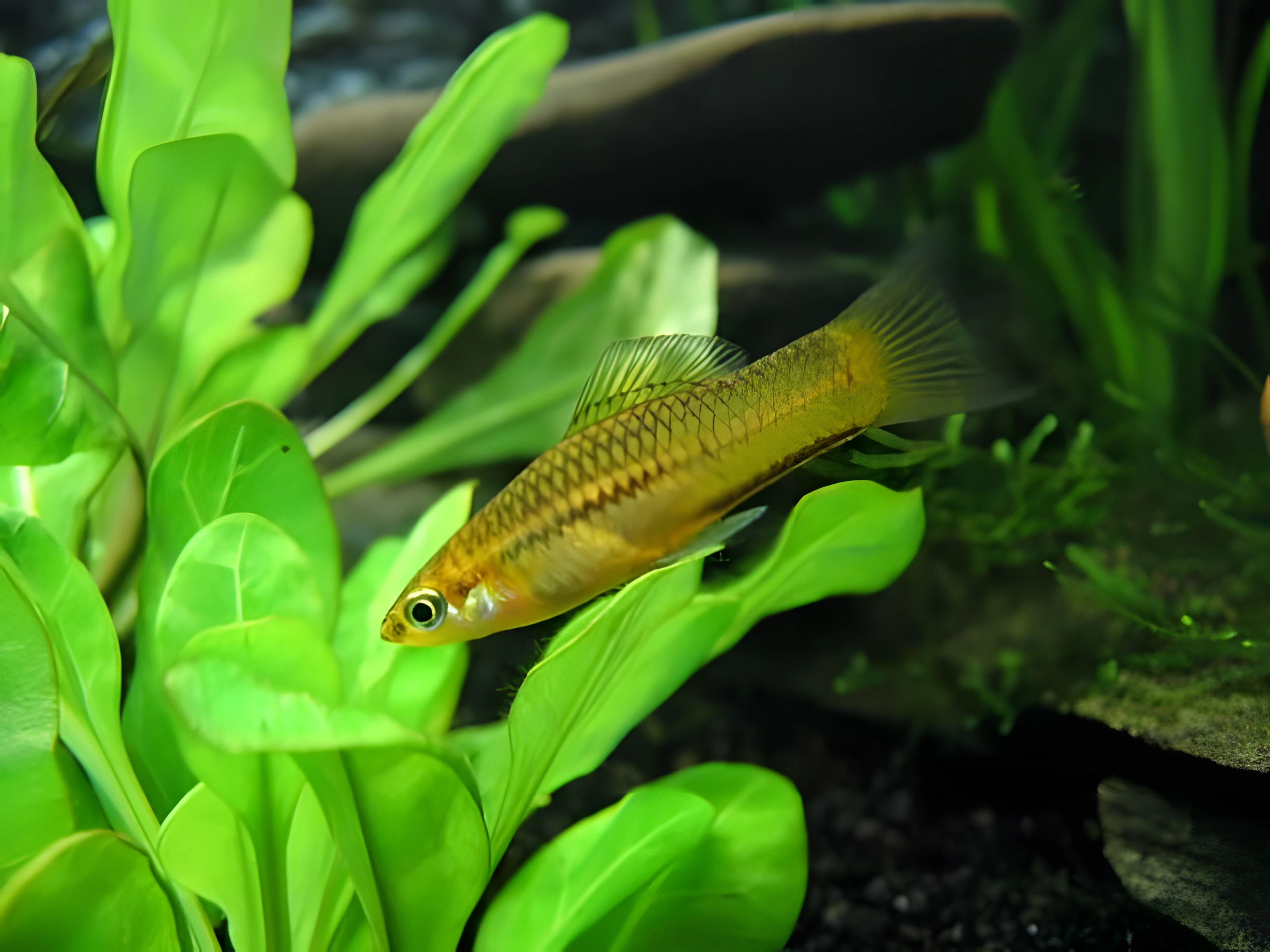
The Pygmy Swordtail, also known by its scientific name Xiphophorus pygmaeus, belongs to the family Poeciliidae. The prefix "pygmy" in its name indicates the miniature size of this fish, which is the smallest representative among all Swordtails.
- Required aquarium volume
- 80 L
- Size in aquarium
- 3 – 4 cm
- Temperature
- 24 – 28 °C
- Temperament
- Peaceful (regular)
Parameters
Water pHNeutral (7) – Slightly alkaline (8)
Water dHSoft (5) – Very hard (18)
Water salinitywide range (from ~1 to ~20 g/L)
Size in aquarium3 – 4 cm
Lifespan3 years
TemperamentPeaceful (regular)
Toward small fishnot a predator
Required aquarium volume80 L
Lightingweak (low)
Substrateany (no restrictions)
Water flowmoderate
FeedingAny (universal)
CareMixed (solitary / pair / group)
Description
This name fully corresponds to the fish's appearance: adult specimens rarely exceed 3.5 cm in length. Males have a more graceful build compared to females and possess a characteristic "sword" – slightly elongated lower rays of the caudal fin. The coloration of males delights with yellow hues, while females are distinguished by a silvery color with a clear black stripe running from head to tail.
Habitat
Its natural habitat is in the eastern regions of Mexico, where it is found in the extensive Pánuco River basin, whose waters flow into the Gulf of Mexico. This species prefers areas with fast, and sometimes even turbulent, currents. Only during dry periods can the Pygmy Swordtail be observed alongside other members of the genus in calmer, stagnant bodies of water.
Behavior and Compatibility
These active fish are peaceful and get along well with other species of similar size and temperament. Male Pygmy Swordtails may compete among themselves for dominance within the group and for the attention of females; therefore, in small aquariums, it is recommended to keep one male with several females.
Care and Maintenance
Despite its modest size, the Pygmy Swordtail feels best in spacious aquariums. Important conditions include enhanced filtration and moderate water movement, which simulates a turbulent river current. The aquascape should ideally provide many hiding places, such as dense thickets of undemanding plants. Since this species originates from flowing waters, it is quite sensitive to the accumulation of organic waste – food remnants and excrement. Maintaining high water quality is critically important. Regular aquarium maintenance, including cleaning the substrate, decor elements, and partial water changes with fresh water, is key here. Keeping the fish in slightly brackish water, with a salt concentration of 5 to 10 grams per liter, is also permissible.
Diet
These fish readily accept a variety of appropriately sized foods: dry, frozen, and live. The basis of their diet can be high-quality flakes and granules. These can be supplemented with small frozen or live foods, such as bloodworms, Artemia, and Daphnia. Our new product, Aqvium flake food for aquarium fish, has become a bestseller on Ozon with a rating of 4.9. It is suitable for most aquarium fish, as it is made from raw materials according to new European Union standards (EU 2018/848) and enriched with vitamins A, C, D3, E, as well as Omega 3-6. It can be purchased on Ozon.
Breeding and Reproduction
Breeding Pygmy Swordtails does not present particular difficulties. Fry are highly likely to appear if the fish are kept in suitable conditions and receive a balanced diet. Fertilization, as with all livebearing species, occurs inside the female. The incubation period lasts approximately 4–6 weeks. Fry are born fully formed and begin actively searching for food within an hour of birth. In the first months of life, they are very small and can become easy prey for other aquarium inhabitants. To ensure the survival of the offspring, it is recommended to move them to a separate tank with identical water parameters. This will also significantly simplify the feeding process.
Diseases
The likelihood of various diseases increases in unsuitable environments, with poor nutrition, or due to injuries. However, in general, under normal keeping conditions, cases of illness in these fish are quite rare. More detailed information on symptoms and treatment methods can be found in the "Aquarium Fish Diseases" section.
How to choose
When choosing a Pygmy Swordtail, it is important to carefully inspect the fish for signs of disease: clean fins without signs of rot, no white spots or film on the body, clear eyes, and normal breathing without rapid gill movement. A healthy specimen should be active, show curiosity towards its surroundings, and not constantly hide in the corners of the aquarium. Avoid purchasing fish that appear emaciated, have sunken bellies, or exhibit sluggish, apathetic behavior.
- give preference to specimens from aquariums with clear water and no dead fish nearby
- choose fish with vibrant coloration appropriate for the species, without signs of spinal deformity
- ask the seller about the keeping conditions, as this species is sensitive to sudden changes in water parameters and requires a stable environment
Frequently asked questions
The essentials: size, tank volume, water parameters and care
How big does Pygmy Swordtail get?
An adult reaches 3–4 cm in length. Plan the tank around the maximum size: the fish quickly outgrows a cramped setup.
What size aquarium does Pygmy Swordtail need?
The minimum recommended volume is 80 L. A smaller tank speeds up nitrate build-up and raises stress levels.
What water parameters does Pygmy Swordtail need?
Temperature 24–28 °C, pH 7–8, hardness 5–18 dGH. Stability matters more than exact values: sudden swings are harder on the fish than a small deviation from the ideal.
How long does Pygmy Swordtail live?
Around 3 years when kept properly. Lifespan depends directly on tank volume, water quality and a varied diet.
Is Pygmy Swordtail aggressive?
Temperament: peaceful (regular). Keep this in mind when choosing tank mates.
How many Pygmy Swordtail should be kept together?
Recommended setup: mixed (solitary / pair / group). Ignoring this is a common cause of stress and disease.
What does Pygmy Swordtail eat?
Diet type: any (universal). Feed small portions that are finished within a couple of minutes — overfeeding does more harm than underfeeding.
What is the scientific name of Pygmy Swordtail?
The scientific name of the species is Xiphophorus pygmaeus, family Poeciliidae.