Temperature20 – 26 °C
Natural range
- Veracruz area
- Mexico area
LivebearersConservation status: Data deficient DD
The Montezuma Swordtail, known scientifically as Xiphophorus montezumae, is a member of the Poeciliidae family. This fish was first described in 1899 when scientists Jordan and Snyder discovered it in the Moctezuma River basin during their expedition to Central America. Its unique sword-like tail structure earned it the honorable nickname "King of the Swordtails."
- Required aquarium volume
- 50 L
- Size in aquarium
- 4 – 5 cm
- Temperature
- 20 – 26 °C
- Temperament
- Peaceful (regular)
Parameters
Water pHNeutral (7) – Slightly alkaline (8)
Water dHSoft (5) – Very hard (18)
Water salinitywide range (from ~1 to ~20 g/L)
Size in aquarium4 – 5 cm
Lifespan4 years
TemperamentPeaceful (regular)
Toward small fishnot a predator
Required aquarium volume50 L
Lightingweak (low)
Substrateany (no restrictions)
Water flowweak or moderate
FeedingAny (universal)
CareMixed (solitary / pair / group)
Description
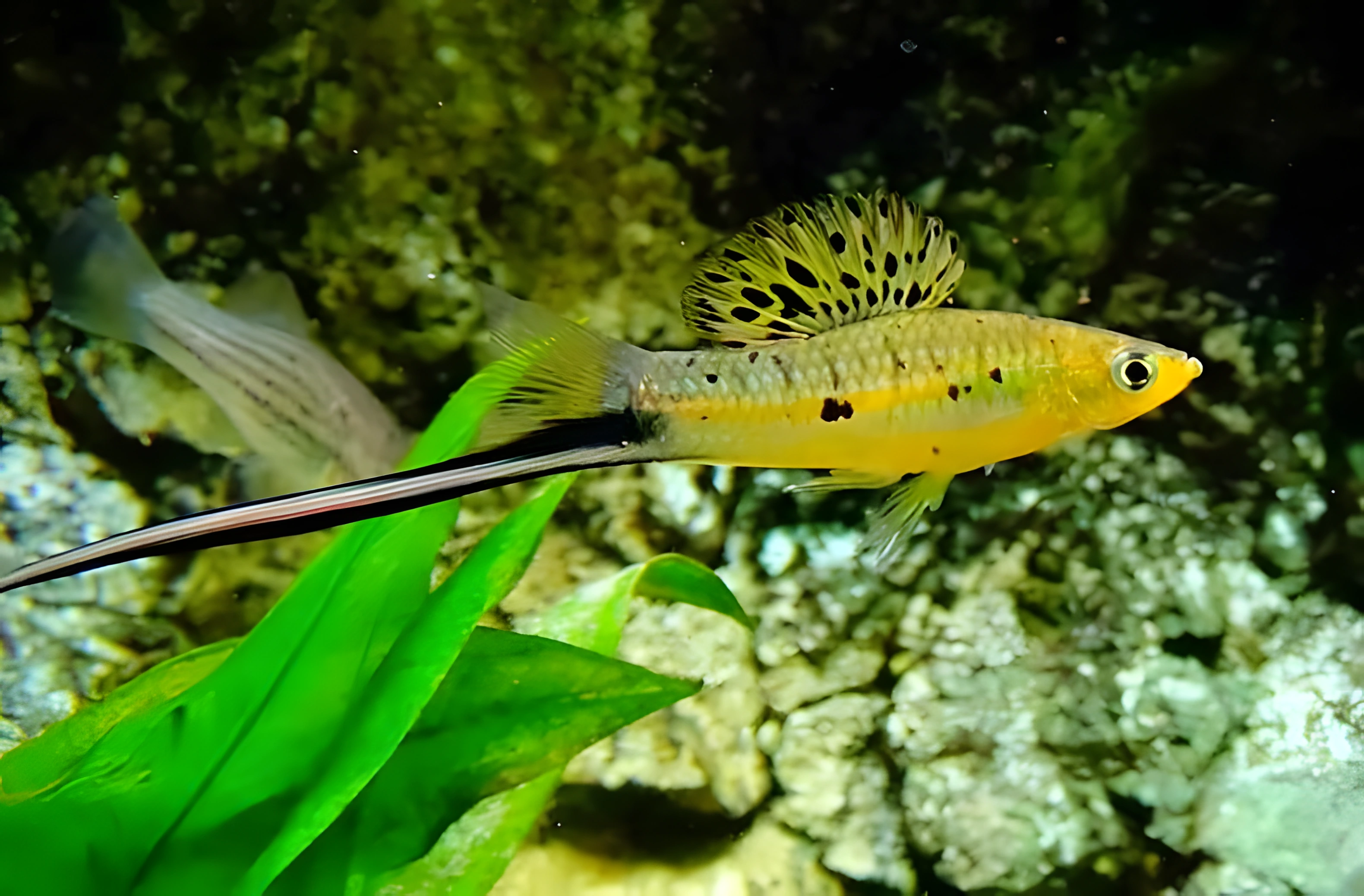
Adult males can reach 4–5 cm in length, and it's worth noting that this size does not include the tail. The tail of males, thanks to elongated lower rays forming a characteristic "sword," can exceed the length of the fish's body by twofold. Their coloration is silvery, often with yellow or greenish iridescence. Several black speckles can be seen on the fish's body, most noticeable on the dorsal fin. Females are similar in size, but their coloration is less pronounced, predominantly gray. A distinct black stripe runs along the entire body of the females, extending from the head to the tail. It is important to note that female specimens do not possess such a prominent "sword."
Habitat
The natural habitat of these fish covers the northeastern regions of modern Mexico. They prefer to live in numerous river systems that flow from the hilly terrain to the Gulf of Mexico. Montezuma Swordtails are often found near the shoreline, where they hide among dense thickets of aquatic vegetation.
Behavior and Compatibility
Males of this species display a temperamental character, often competing with each other for territory and the attention of females. In a small aquarium, it is recommended to form a harem group, where one male is kept with several females. They are peaceful towards other fish species. Montezuma Swordtails are compatible with many freshwater species of similar size and temperament. However, cohabitation with fish that tend to nip or damage fins, such as some barb species, should be avoided.
Care and Maintenance
For keeping 4–5 Montezuma Swordtails, a suitable aquarium volume starts from 100 liters. When setting up the tank, it is important to provide hiding places. These can be dense thickets of live plants, various branched snags, or artificial decorative elements. This swordtail species is considered undemanding to keep. Maintaining a slightly alkaline hydrochemical water composition with moderate to high hardness (dGH) is crucial. To keep organic pollution levels low, weekly partial water changes with fresh water and a reliable filtration system are necessary. It is also recommended to create a moderate internal current, effectively mimicking the natural water flow in a river, which is easily achieved with a powerful internal filter.
Diet
The fish readily accept all types of food intended for aquarium inhabitants. The recommended daily diet can include dry flakes or granules, which can be supplemented with live or frozen brine shrimp, bloodworms, daphnia, and other invertebrates. We offer Aqvium flake food for aquarium fish. Check out our new product, which has become a bestseller on Ozon with a rating of 4.9. This food is suitable for most aquarium fish. Its production uses raw materials that comply with new European Union standards (EU 2018/848). The composition is enriched with vitamins A, C, D3, E, and Omega 3-6. Purchase on Ozon.
Breeding and Reproduction
Under favorable conditions and with a balanced diet, spawning can occur every 4–6 weeks. This is the incubation period. A distinctive feature of swordtails is livebearing — females give birth to fully formed fry. On average, a single female's brood numbers from 10 to 30 individuals. Within an hour of birth, the fry are ready to eat. Since parental instincts are not developed in these fish, there is a risk of predation by adult specimens on their own young.
Diseases
The likelihood of diseases increases if the fish are kept in unsuitable conditions, receive poor-quality food, or are injured. In conditions close to natural, cases of disease are extremely rare. More detailed information on symptoms and treatment methods can be found in the "Diseases of Aquarium Fish" section.
How to choose
When choosing Montezuma Swordtails, pay attention to the fish's activity and the cleanliness of their skin. Healthy individuals should show curiosity, swim actively, and have no visible damage, ulcers, or white film on their scales. Avoid purchasing fish that stay at the surface, breathe heavily, or have clamped fins, as this may indicate problems with water quality in the aquarium or the presence of infections.
- Inspect the fins: they should be intact, without signs of splitting or erosion.
- Check behavior: males in the store often display territorial skirmishes, which is a sign of their normal vital activity.
- Ensure there is no emaciation: the fish's belly should not be sunken, and the body shape should conform to species standards without spinal deformities.
Frequently asked questions
The essentials: size, tank volume, water parameters and care
How big does Montezuma Swordtail get?
An adult reaches 4–5 cm in length. Plan the tank around the maximum size: the fish quickly outgrows a cramped setup.
What size aquarium does Montezuma Swordtail need?
The minimum recommended volume is 50 L. A smaller tank speeds up nitrate build-up and raises stress levels.
What water parameters does Montezuma Swordtail need?
Temperature 20–26 °C, pH 7–8, hardness 5–18 dGH. Stability matters more than exact values: sudden swings are harder on the fish than a small deviation from the ideal.
How long does Montezuma Swordtail live?
Around 4 years when kept properly. Lifespan depends directly on tank volume, water quality and a varied diet.
Is Montezuma Swordtail aggressive?
Temperament: peaceful (regular). Keep this in mind when choosing tank mates.
How many Montezuma Swordtail should be kept together?
Recommended setup: mixed (solitary / pair / group). Ignoring this is a common cause of stress and disease.
What does Montezuma Swordtail eat?
Diet type: any (universal). Feed small portions that are finished within a couple of minutes — overfeeding does more harm than underfeeding.
What is the scientific name of Montezuma Swordtail?
The scientific name of the species is Xiphophorus montezumae, family Poeciliidae.