Temperature16 – 28 °C
Natural range
- Mexico area
- Guatemala area
- Honduras area
- Central America area
LivebearersConservation status: Least concern LC
Other scientific names: Mollienisia helleri, Poecilia helleri, Xiphophorus brevis, Xiphophorus guentheri, Xiphophorus guntheri, Xiphophorus helleri
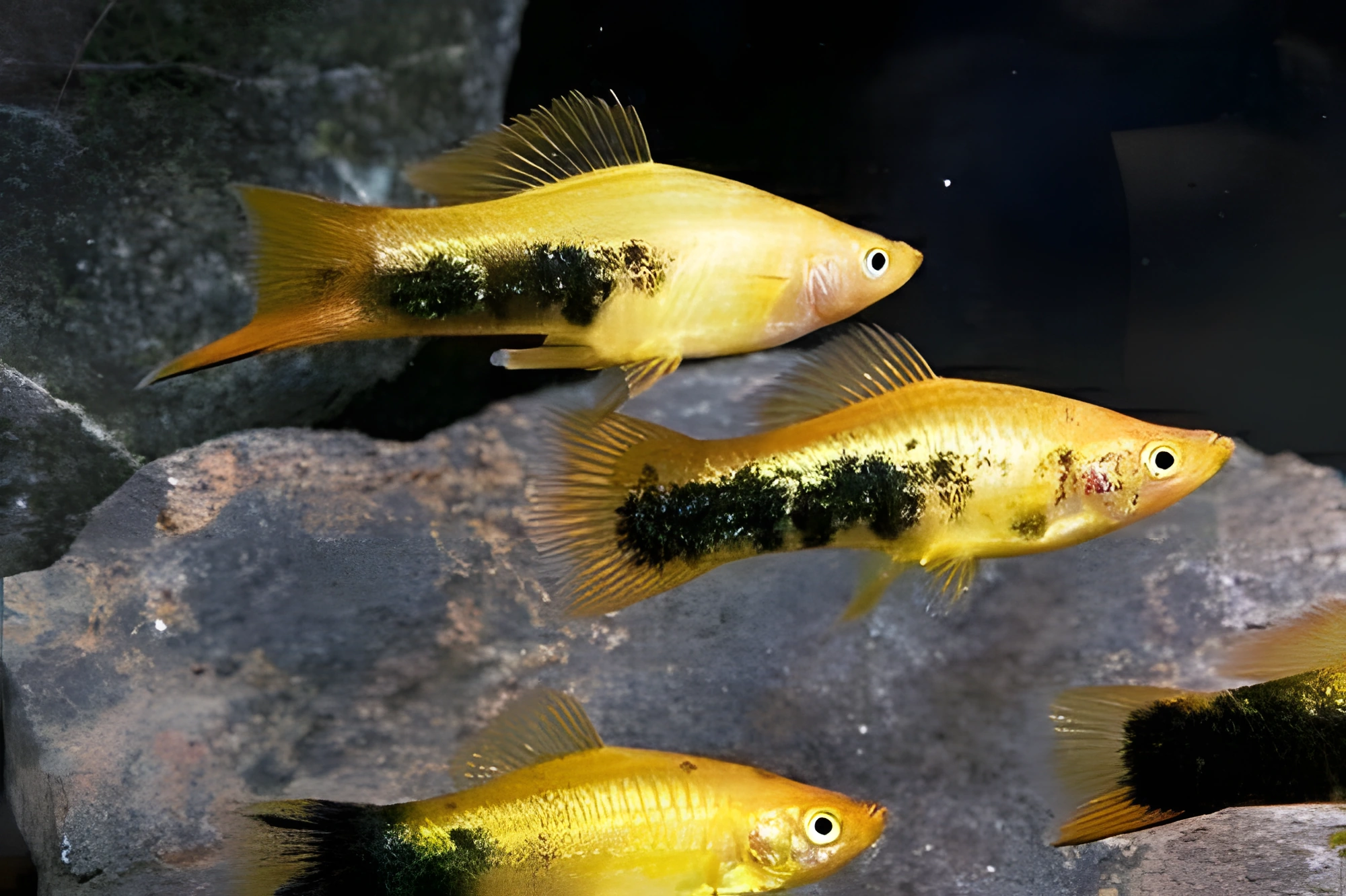
The Cuban Swordtail, known in the trade as the Tuxedo Swordtail, is the result of crossbreeding. This fish is a hybrid between the Green Swordtail and the Tuxedo Platy. From the former ancestor, males inherited the characteristic "sword" on the caudal fin, which is absent in females. The unique body coloration was acquired from the latter species.
- Required aquarium volume
- 50 L
- Size in aquarium
- 4 – 5 cm
- Temperature
- 16 – 28 °C
- Temperament
- Peaceful (regular)
Parameters
Water pHNeutral (7) – Slightly alkaline (8.5)
Water dHMedium hardness (10) – Very hard (25)
Water salinityvery low (up to ~3 g/L)
Size in aquarium4 – 5 cm
Lifespan4 years
TemperamentPeaceful (regular)
Toward small fishnot a predator
Required aquarium volume50 L
Lightingweak (low)
Substrateany (no restrictions)
Water flowweak or moderate
FeedingAny (universal)
CareMixed (solitary / pair / group)
Description
The Cuban Swordtail is a selective breeding form obtained through targeted breeding. The fish has an elongated, laterally compressed body, reaching 8–12 cm in length. A characteristic feature of males is the elongated lower ray of the caudal fin, resembling a sword. Females lack this appendage; they are larger, more robust, and have a more rounded abdomen. The coloration of the Cuban form typically varies in a red-black palette, where the back has a red hue and the belly is black.
Habitat
In nature, the species Xiphophorus hellerii inhabits water bodies in Central America, including territories of Mexico, Guatemala, and Honduras. These fish populate rivers, streams, ponds, and swamps with flowing or stagnant water, preferring areas with dense vegetation and sandy or rocky substrate. In their natural environment, they are adapted to a temperature range of 18–28 °C and water of medium to high hardness.
Behavior and Compatibility
These are active and peaceful fish, suitable for keeping in a community tank. They primarily occupy the middle water layers. Intraspecific aggression may occur between males, so it is recommended to keep them in a ratio of one male to three females to distribute attention and reduce conflicts. The species coexists well with similarly sized peaceful fish, but cohabitation with slow-moving species that have veil fins is not recommended.
Care and Maintenance
Although this hybrid is called the Cuban Swordtail, its care requirements are closer to those of Platies. Due to the relatively small size of adult individuals, they can be kept even in modest-sized tanks. For the comfortable existence of a group of 3–5 fish, a 50-liter aquarium will suffice. The aquarist can choose the decor as they wish, but the presence of shelters is highly desirable. These can be dense thickets of live plants or tangled driftwood, which will provide a reliable refuge for females and less dominant individuals from the overly active attention of alpha males. For successful and long-term keeping, it is critically important to maintain stable water parameters within acceptable temperature limits, as well as pH and GH values. The fish show a preference for slightly alkaline water and tolerate acidic environments poorly. In terms of feeding, these fish are considered omnivores. They readily accept most common foods, whether dry, frozen, or live. The daily diet can be entirely composed of flakes or granules, provided that such foods are enriched with essential vitamins and trace elements. For example, Aqvium flake food for aquarium fish, highly rated on Ozon (rating 4.9), is produced according to new European Union standards (EU 2018/848) and contains vitamins A, C, D3, E, as well as Omega 3-6. Reproduction. Like other livebearing fish, the Cuban Swordtail breeds easily. It is important to remember that crossbreeding is possible not only between representatives of the same breed but also with other varieties of Swordtails, Platies, and even closely related species such as Mollies.
Diet
Swordtails are omnivorous fish. Their diet should include high-quality dry foods in the form of flakes or granules, supplemented with live or frozen foods such as Artemia, Daphnia, and bloodworms. To maintain health and vibrant coloration, vegetable components are necessary: blanched lettuce leaves, spinach, or specialized foods with spirulina. Feeding should be done 1–2 times a day in small portions.
Breeding and Reproduction
The species is livebearing: fertilization occurs inside the female's body. Sexual maturity is reached at 5–6 months. Pregnancy lasts 4–6 weeks, after which the female gives birth to 20 to 100 fully formed fry. To preserve the offspring, dense plant thickets or a breeding box are recommended, as adult fish are prone to eating their fry. Females are capable of storing male sperm and giving birth multiple times after a single mating.
Diseases
When care rules are followed, the fish remain healthy. Common problems are often associated with violations of keeping conditions, which provoke infections caused by protozoa or bacteria. It is important to monitor water quality, avoid overfeeding, and perform regular water changes. Sensitivity to environmental conditions can lead to swim bladder disorders. Prevention includes quarantining new individuals and maintaining stable water parameters.
How to choose
When purchasing, choose active fish with clean scales and fins, showing no signs of damage or white film. A healthy individual should show interest in food and swim actively. Avoid fish with clamped fins, rapid breathing, or an unnaturally bloated abdomen. It is recommended to acquire individuals from an aquarium where there are no signs of death or disease among other inhabitants.
Frequently asked questions
The essentials: size, tank volume, water parameters and care
How big does Cuban Swordtail get?
An adult reaches 4–5 cm in length. Plan the tank around the maximum size: the fish quickly outgrows a cramped setup.
What size aquarium does Cuban Swordtail need?
The minimum recommended volume is 50 L. A smaller tank speeds up nitrate build-up and raises stress levels.
What water parameters does Cuban Swordtail need?
Temperature 16–28 °C, pH 7–8.5, hardness 10–25 dGH. Stability matters more than exact values: sudden swings are harder on the fish than a small deviation from the ideal.
How long does Cuban Swordtail live?
Around 4 years when kept properly. Lifespan depends directly on tank volume, water quality and a varied diet.
Is Cuban Swordtail aggressive?
Temperament: peaceful (regular). Keep this in mind when choosing tank mates.
How many Cuban Swordtail should be kept together?
Recommended setup: mixed (solitary / pair / group). Ignoring this is a common cause of stress and disease.
What does Cuban Swordtail eat?
Diet type: any (universal). Feed small portions that are finished within a couple of minutes — overfeeding does more harm than underfeeding.
What is the scientific name of Cuban Swordtail?
The scientific name of the species is Xiphophorus hellerii, family Poeciliidae. It also appears in the literature as: Mollienisia helleri, Poecilia helleri, Xiphophorus brevis.