Temperature16 – 28 °C
Natural range
- Central America area
- Mexico area
- Guatemala area
Livebearers
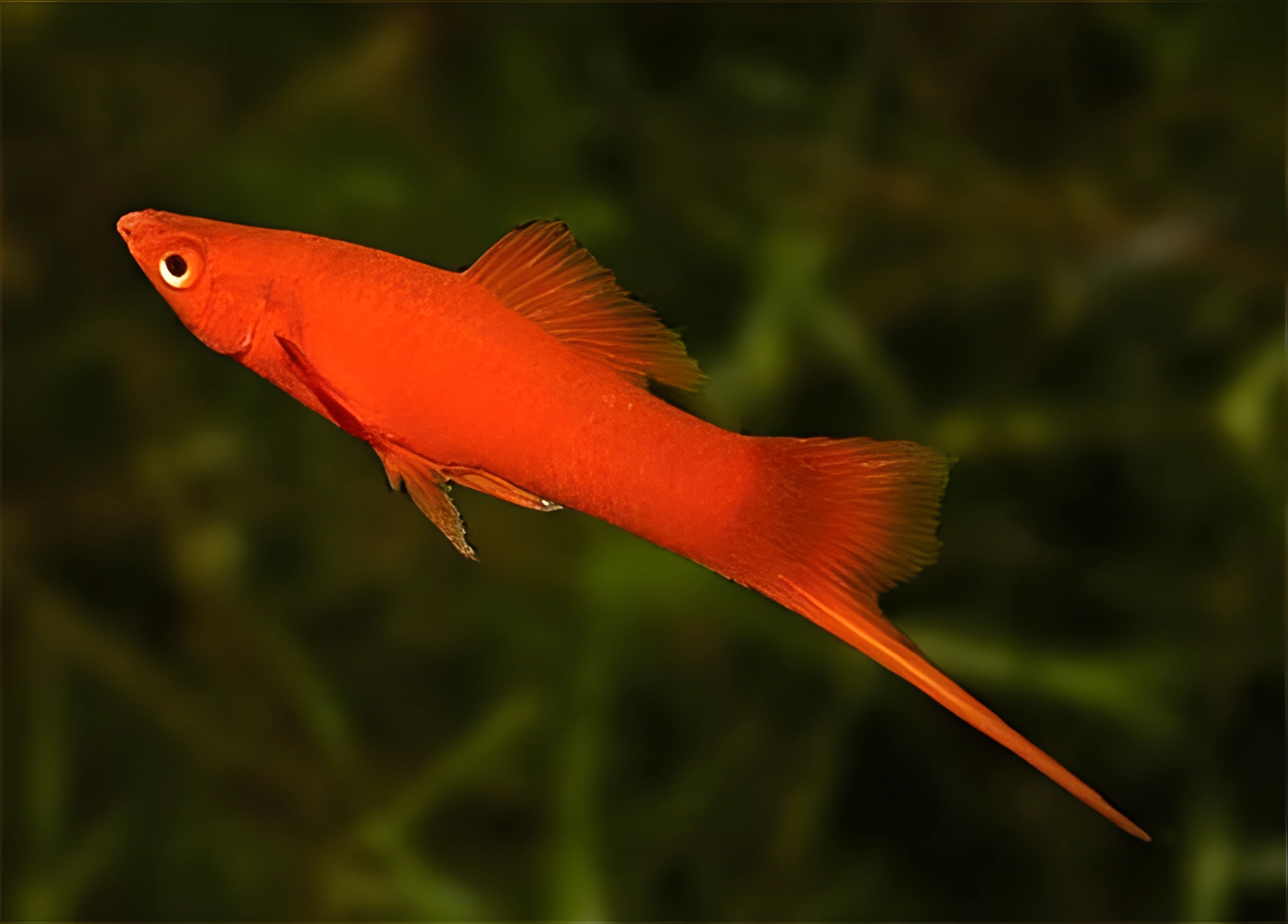
The Red Swordtail (Xiphophorus hellerii, Red variety) is a member of the Poeciliidae family. It is generally considered to be a hybrid, resulting from the crossbreeding of the Green Swordtail with the Red Platy. From the latter, it inherited its bright, solid red or orange body and fin coloration, which immediately catches the eye. Often, a thin black edging can be seen along the edge of the males' “sword.” The coloration of females is similar to that of males, but the shades are usually less intense.
- Required aquarium volume
- 100 L
- Size in aquarium
- 14 – 16 cm
- Temperature
- 16 – 28 °C
- Temperament
- Peaceful (regular)
Parameters
Water pHNeutral (7) – Slightly alkaline (8)
Water dHMedium hardness (10) – Very hard (30)
Water salinityvery low (up to ~3 g/L)
Size in aquarium14 – 16 cm
Lifespan5 years
TemperamentPeaceful (regular)
Toward small fishnot a predator
Required aquarium volume100 L
Lightingweak (low)
Substrateany (no restrictions)
Water flowweak or moderate
FeedingAny (universal)
CareMixed (solitary / pair / group)
Description
The Red Swordtail is a selective breeding form obtained by crossing the Heller's Swordtail with the Red Platy. The fish have an elongated body with the characteristic elongated lower ray of the caudal fin in males, called the sword. The coloration is uniform, varying from bright orange to rich red and burgundy. Females are larger than males, have a more rounded abdomen, and lack the elongated caudal appendage.
Habitat
In nature, the species inhabits bodies of water in Central America, including mountain rivers, lakes, and swamps in Mexico and Guatemala. They prefer areas with dense vegetation and slow currents. In aquarium conditions, this species adapts to a wide range of water parameters, which is due to its selective breeding origin and high hardiness.
Behavior and Compatibility
These are active and peaceful fish, suitable for keeping in community tanks with similarly sized neighbors. Intraspecific aggression can occur between males, so it is recommended to keep them in a ratio of one male to three females, which helps to disperse the attention of the dominant individual. Swordtails occupy the middle and upper layers of the water and are prone to jumping, so the aquarium should be covered.
Care and Maintenance
This fish inherited impressive hardiness and undemanding care requirements from its ancestors. To create a comfortable environment, the Red Swordtail will need a spacious aquarium with clean water, the company of peaceful neighbors, and regular feeding with high-quality foods. For a small group of 3–4 fish, an aquarium of 100 L or more will be optimal. The internal design of the aquarium is at the owner's discretion and can be chosen arbitrarily. There is nothing extraordinary in caring for an aquarium with these fish; it is similar to standard procedures applied to many other species. This includes regular weekly partial water changes with fresh water, timely removal of organic waste, and maintaining equipment in working order. A feature that significantly simplifies the water preparation process is the species' ability to live in a wide range of pH and GH values. Sometimes it is enough to simply let the water stand before adding it to the aquarium. If breeding is anticipated—which is quite likely to happen if both a male and a female are present at a mature age—it is recommended to plan and create shelters for the fry in advance. Dense thickets of fine-leaved plants can be an excellent option. It is important to keep in mind that the Red Swordtail can produce offspring with other varieties. To avoid unwanted hybridization, it is recommended to keep different populations separately. Since this species is a close relative of the Green Swordtail, its description can be a useful source of additional information about the care, behavior, and reproduction of the Red Swordtail.
Diet
Swordtails are omnivorous and undemanding in their diet. The diet should include high-quality dry foods, supplemented with live or frozen foods, as well as plant-based additives. The use of foods containing carotenoids helps maintain the rich red coloration of the fish. Feeding is recommended 1–2 times a day in small portions.
Breeding and Reproduction
The species is livebearing: fertilization occurs inside the female's body, after which she gives birth to fully formed fry. Sexually mature individuals breed frequently, and females can store sperm for several subsequent broods. For the survival of offspring in a community tank, dense thickets of plants are necessary, or the pregnant female should be moved to a separate tank.
Diseases
The fish have a strong immune system, but if kept in improper conditions, they can be susceptible to bacterial infections or protozoan infestations. Signs of ill health include refusal to eat, the appearance of white film or spots on the body, and unnatural behavior. Prevention involves maintaining water cleanliness, regular water changes, and mandatory quarantine of new individuals.
How to choose
When purchasing, choose active fish with clean fins, even coloration, and no visible damage or film on the scales. Avoid individuals with clamped fins, sunken bellies, or signs of lethargy. It is advisable to purchase fish from a single source to minimize the risk of introducing infections into the main aquarium.
Frequently asked questions
The essentials: size, tank volume, water parameters and care
How big does Red Swordtail get?
An adult reaches 14–16 cm in length. Plan the tank around the maximum size: the fish quickly outgrows a cramped setup.
What size aquarium does Red Swordtail need?
The minimum recommended volume is 100 L. A smaller tank speeds up nitrate build-up and raises stress levels.
What water parameters does Red Swordtail need?
Temperature 16–28 °C, pH 7–8, hardness 10–30 dGH. Stability matters more than exact values: sudden swings are harder on the fish than a small deviation from the ideal.
How long does Red Swordtail live?
Around 5 years when kept properly. Lifespan depends directly on tank volume, water quality and a varied diet.
Is Red Swordtail aggressive?
Temperament: peaceful (regular). Keep this in mind when choosing tank mates.
How many Red Swordtail should be kept together?
Recommended setup: mixed (solitary / pair / group). Ignoring this is a common cause of stress and disease.
What does Red Swordtail eat?
Diet type: any (universal). Feed small portions that are finished within a couple of minutes — overfeeding does more harm than underfeeding.
What is the scientific name of Red Swordtail?
The scientific name of the species is Xiphophorus-hellerii (порода Red), family Poeciliidae.