Temperature16 – 28 °C
Natural range
- Central America area
- Honduras area
- Guatemala area
- Mexico area
LivebearersConservation status: Least concern LC
Other scientific names: Mollienisia helleri, Poecilia helleri, Xiphophorus brevis, Xiphophorus guentheri, Xiphophorus guntheri, Xiphophorus helleri
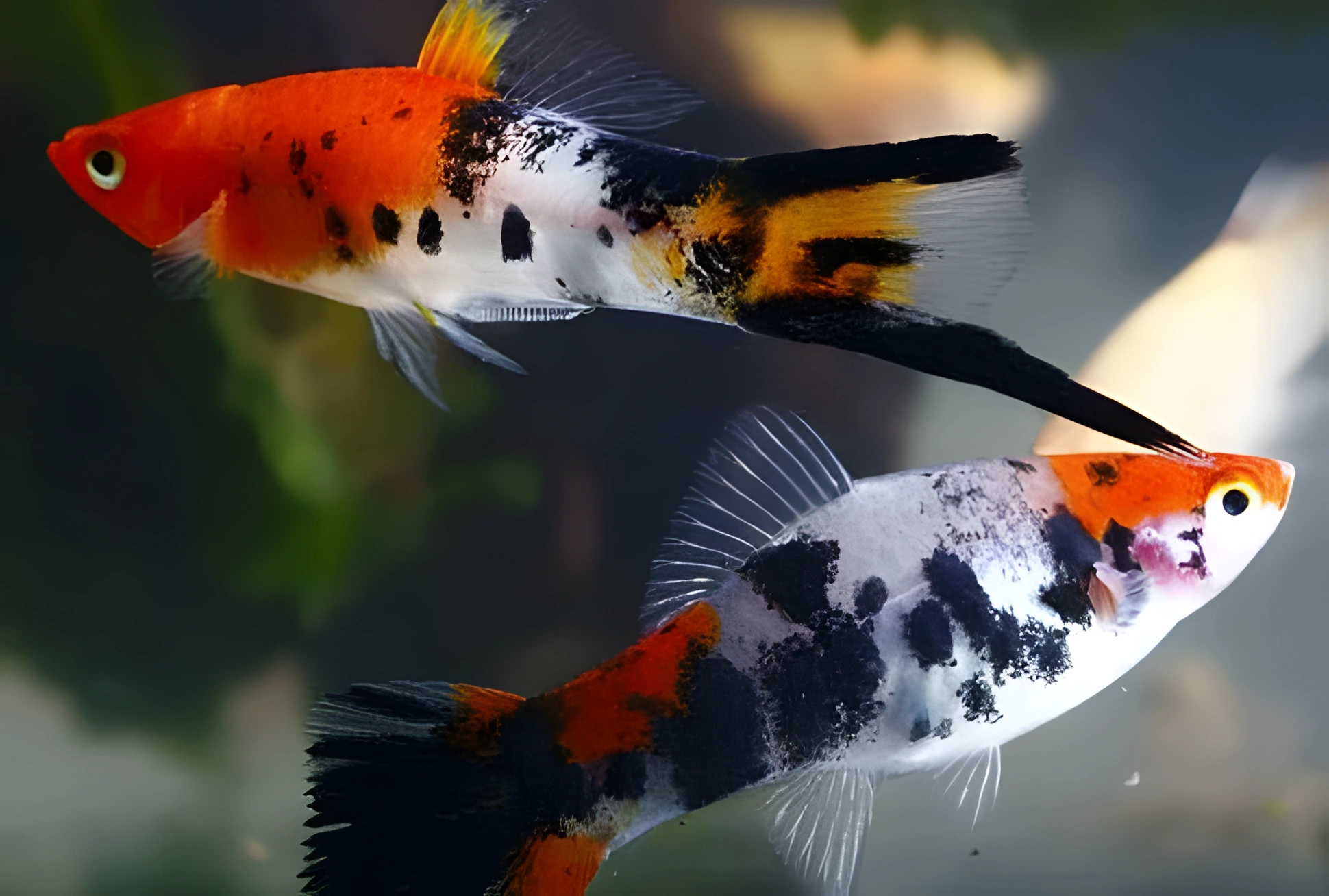
Koi Swordtails, a variety of Xiphophorus hellerii, belong to the Poeciliidae family. This common name refers to fish whose unique body coloration resembles ornamental Koi carp. Among the most sought-after strains are Kohaku, Sanke, and Showa. It is often observed that the latter two varieties are confused due to their similar appearance.
- Required aquarium volume
- 100 L
- Size in aquarium
- 7 – 10 cm
- Temperature
- 16 – 28 °C
- Temperament
- Peaceful (regular)
Parameters
Water pHNeutral (7) – Slightly alkaline (8)
Water dHMedium hardness (10) – Very hard (30)
Water salinityvery low (up to ~3 g/L)
Size in aquarium7 – 10 cm
Lifespan4 years
TemperamentPeaceful (regular)
Toward small fishnot a predator
Required aquarium volume100 L
Lightingweak (low)
Substrateany (no restrictions)
Water flowweak or moderate
FeedingAny (universal)
CareMixed (solitary / pair / group)
Description
Koi Swordtails are a selectively bred form of Xiphophorus hellerii, not found in the wild. They are distinguished by their characteristic coloration, reminiscent of Koi carp: a combination of white, red, and orange body areas, often with a red head and caudal fin. The body is elongated and laterally compressed. Males possess a gonopodium and a characteristic elongated lower ray of the caudal fin, called a sword. Females are larger than males, have a more rounded abdomen, and lack the sword.
Habitat
The wild species Xiphophorus hellerii inhabits freshwater bodies in Central America (Honduras, Guatemala, Mexico), populating both fast-flowing mountain rivers and stagnant waters of lakes, ponds, and swamps with dense vegetation. Water parameters in nature vary, but the species is highly adaptable. In aquarium conditions, they prefer a temperature of 16–28 °C, pH 7.0–8.0, and hardness of 10–30 dGH.
Behavior and Compatibility
These are active and peaceful fish, suitable for community tanks with similarly sized tankmates. Within the species, males can exhibit territoriality and compete with each other, so it is recommended to keep them in groups with a predominance of females (a ratio of 1 male to 2–3 females). To reduce aggression in the aquarium, shelters and dense plant thickets are necessary.
Care and Maintenance
These aquarium fish are rightly recognized as some of the most undemanding and easy to care for. Creating favorable conditions for them is possible even on a limited budget. For example, if there are no plans to keep other species, a minimal set of equipment will suffice: an aquarium of at least 100 liters for 3–4 fish, a standard lamp, and a simple air-driven filter. Swordtails successfully adapt to lower temperatures, tolerating down to 16°C, which means a heater may not be necessary. The choice of aquarium decor is also not critical and is left to the owner's discretion. However, it is advisable to provide shelters so that weaker individuals can find refuge from the active attention of their conspecifics. This is especially relevant when keeping two or more males together, who usually compete for hierarchical position and the female's attention. As for feeding, Koi Swordtails are omnivorous and readily accept a variety of foods widely used in aquaristics: dry, frozen, and live. Aqvium flake food for aquarium fish. Check out our new product, which has become a bestseller on Ozon with a rating of 4.9. Flake food is suitable for most aquarium fish. The raw material composition complies with the new standards of the European Union (EU 2018/848). Includes vitamins A, C, D3, E, and Omega 3-6. Available for purchase on Ozon.
Diet
An omnivorous species. In the aquarium, they accept all types of food: high-quality dry flakes and granules, frozen or live foods (brine shrimp, bloodworms, daphnia). To maintain health and vibrant coloration, it is recommended to include vegetable supplements in their diet. Feeding should be done 1–2 times a day in small portions that the fish can consume within a few minutes.
Breeding and Reproduction
A livebearing species: the female gives birth to fully formed fry. Sexual maturity is reached at 5–7 months. Pregnancy lasts 4–6 weeks, after which the female can produce 20 to 100 fry. To preserve the offspring, it is recommended to move the pregnant female to a separate aquarium with fine-leaved plants, as parents may eat the young. Fry are able to feed on small live or specialized dry foods immediately after birth.
Diseases
When kept in proper conditions, they possess strong immunity. Common problems include infections caused by protozoa or bacteria, often arising from poor water quality or stress. They are sensitive to sudden changes in environmental parameters. Prevention involves regular water changes, maintaining filter cleanliness, and quarantining new individuals.
How to choose
When purchasing, choose active fish with clean fins, smooth scales, and no visible spots or ulcers on the body. It is important to ensure that the fish show interest in food and are not gasping for air at the water's surface. Avoid individuals with clamped fins or unnaturally bloated bellies, which may indicate illness.
Frequently asked questions
The essentials: size, tank volume, water parameters and care
How big does Koi Swordtails get?
An adult reaches 7–10 cm in length. Plan the tank around the maximum size: the fish quickly outgrows a cramped setup.
What size aquarium does Koi Swordtails need?
The minimum recommended volume is 100 L. A smaller tank speeds up nitrate build-up and raises stress levels.
What water parameters does Koi Swordtails need?
Temperature 16–28 °C, pH 7–8, hardness 10–30 dGH. Stability matters more than exact values: sudden swings are harder on the fish than a small deviation from the ideal.
How long does Koi Swordtails live?
Around 4 years when kept properly. Lifespan depends directly on tank volume, water quality and a varied diet.
Is Koi Swordtails aggressive?
Temperament: peaceful (regular). Keep this in mind when choosing tank mates.
How many Koi Swordtails should be kept together?
Recommended setup: mixed (solitary / pair / group). Ignoring this is a common cause of stress and disease.
What does Koi Swordtails eat?
Diet type: any (universal). Feed small portions that are finished within a couple of minutes — overfeeding does more harm than underfeeding.
What is the scientific name of Koi Swordtails?
The scientific name of the species is Xiphophorus hellerii (разновидность Koi), family Poeciliidae. It also appears in the literature as: Mollienisia helleri, Poecilia helleri, Xiphophorus brevis.