Temperature23 – 28 °C
Natural range
- Lake Malawi area
- Likoma Island area
CichlidsConservation status: Critically endangered CR
Other scientific names: Melanochromis cyaneorhabdos
Melanochromis maingano, officially known as Pseudotropheus cyaneorhabdos, belongs to the family Cichlidae. This species is relatively new to science, having been described only in 1997. Although the fish was discovered long before that, it was for a long time mistakenly identified as a variation of Melanochromis johannii, a very similar species.
- Required aquarium volume
- 120 L
- Size in aquarium
- 10 cm
- Temperature
- 23 – 28 °C
- Temperament
- Territorial (often aggressive)
Parameters
Water pHNeutral (7) – Slightly alkaline (8)
Water dHMedium hardness (10) – Very hard (18)
Water salinityvery low (up to ~3 g/L)
Size in aquarium10 cm
Lifespan9 years
TemperamentTerritorial (often aggressive)
Toward small fishnot a predator
Required aquarium volume120 L
Lightingmoderate (regular)
Substratesand or gravel + stones/boulders
Water flowmoderate or strong
FeedingMixed diet (meat + plant-based)
CareHarem (1 male and several females)
Description
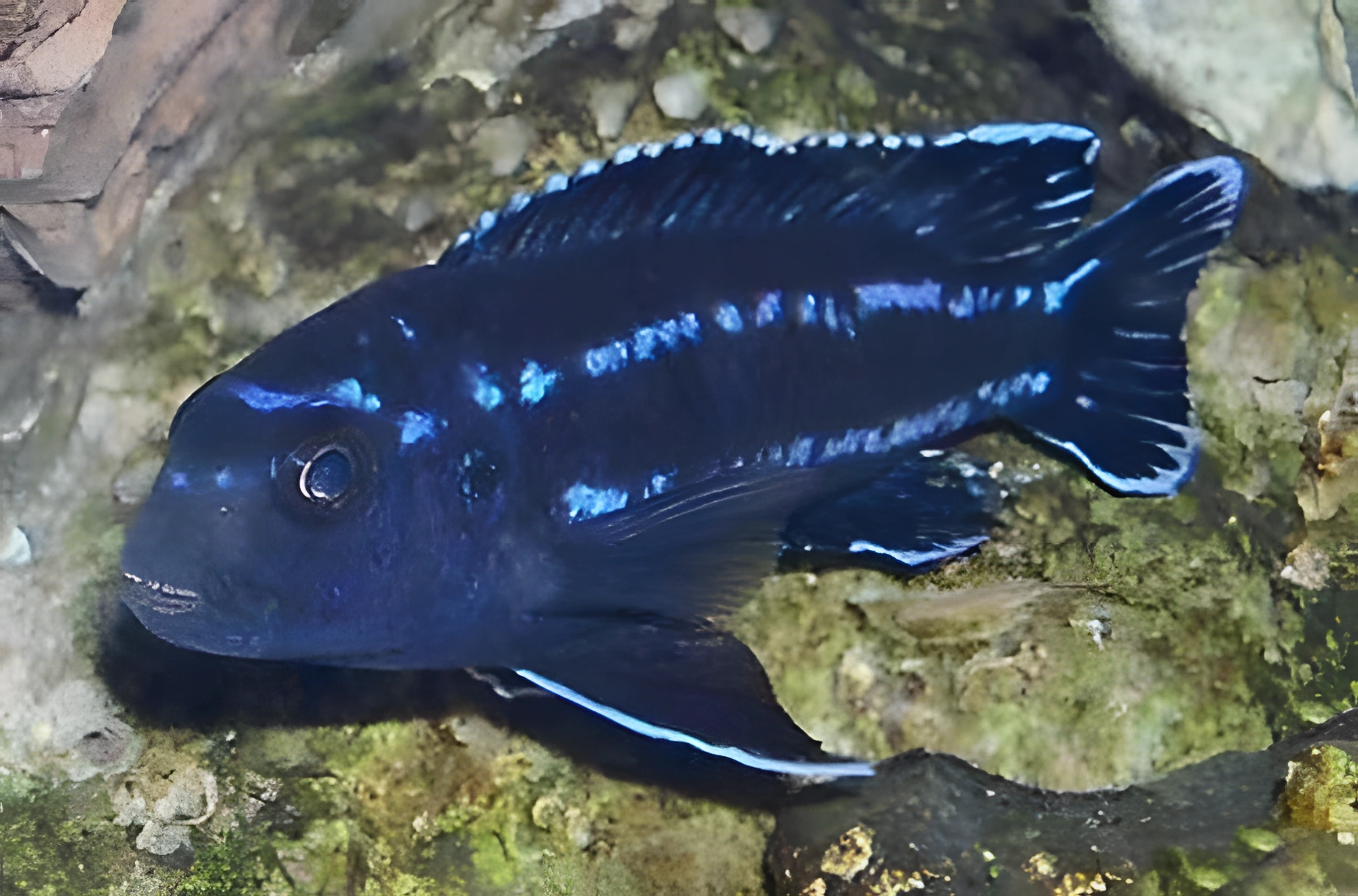
This small cichlid is characterized by an elongated body and a rounded head shape. Its oral cavity is equipped with incisors adapted for scraping tough algae from rocky surfaces. A low fin extends almost the entire length of its back. The main body color is dark blue, with two distinct bright blue horizontal stripes. The fins and tail are adorned with a thin blue edging. Due to the similarity in body shape and coloration with Melanochromis johannii, its close relative, maingano often continues to cause confusion.
Habitat
This fish is endemic to Lake Malawi, located in Africa. Its primary habitat is the rocky coastline of Likoma Island, one of the largest in the lake. Preferring to stay at depths of 3 to 10 meters, maingano feeds on algae that grow on rocks. While consuming algae, it also eats small crustaceans, snails, insect larvae, and other zooplankton hiding in the plant detritus.
Behavior and Compatibility
This fish is characterized by an unaccommodating, aggressive nature. Males show aggression both towards each other and towards outwardly similar species. If you have little experience keeping cichlids, it is preferable to set up a species tank containing one male and several females. Maingano are usually kept in a harem.
Care and Maintenance
For a group of 3–4 fish, an aquarium of at least 120 L will be required. The decor should mimic rocky shallows. It is necessary to create many grottoes and crevices using rock fragments and large stones that rise to the surface; these shelters will serve as hiding places. The substrate is recommended to be fine sand, preferably coral sand, as it helps maintain the necessary alkaline pH level. Plants are usually absent in such biotopes, but small groups of vegetation can be placed for decorative effect. Maingano requires a specific water composition: it should be slightly alkaline (pH) and of medium hardness (dH). The presence of marine salt in a concentration of about 3 grams per liter of water is permissible. More detailed information on methods for changing pH and dH parameters can be found in the section "Hydrochemical Composition of Water." Water purity is no less important. 30–40% of the water volume should be renewed weekly, while simultaneously siphoning the substrate to remove organic waste, such as food remnants and excrement. An important role is assigned to the filtration system; it is recommended to purchase the most productive equipment possible within the budget. A quality filter will reduce aquarium maintenance costs, as water changes can be performed less frequently. In addition to the filter, the minimum necessary equipment set includes a lighting system, aeration, and a heater. Due to the absence of plants, the aerator becomes the main source of dissolved oxygen in the water; it is important to ensure that the number of diffusers is sufficient and they produce fine bubbles, as the smaller the bubble, the more efficient the gas exchange.
Diet
This omnivorous species readily accepts a variety of dry and frozen foods with the obligatory addition of vegetable components. It is important to maintain a diverse diet, avoiding feeding the fish the same product repeatedly. An ideal diet could include frozen or live foods such as insect larvae, bloodworms, or small crustaceans, supplemented with vegetable flakes (e.g., with spirulina or specialized cichlid supplements). Today, specialized foods for various groups of cichlids are widely available in pet stores and online, fully covering the need for vitamins and trace elements. Feeding is recommended two to three times a day, offering a portion that the fish can eat within 5 minutes; any leftover food must be removed to avoid polluting the aquarium water.
Breeding and Reproduction
Under favorable conditions and a balanced diet, spawning is quite possible in a home aquarium. In such a case, the aquarist will not require special efforts or additional costs. When the male is ready for the breeding period, his coloration becomes more intense, and he actively invites females into his territory. The female lays 10 to 60 eggs and immediately collects them in her mouth — this is a protective mechanism formed during evolution. A less common method is used for fertilization: the male's anal fin has a pattern of several bright spots that resemble eggs in size and color. During spawning, the female mistakenly takes them for her own eggs and tries to swallow them, and at this moment, the male releases milt, which leads to fertilization. Subsequently, the entire incubation period, which lasts about 21 days depending on the temperature, takes place in the female's mouth. After the fry emerge, the female protects the offspring for several more days; in case of danger, the young quickly hide back in her mouth. Fry should be fed micro-foods. They grow quite quickly, reaching 3–4 cm within a few weeks. At this age, it is worth starting to plan their further dispersal, otherwise the male may begin to perceive them as potential competitors.
Diseases
A typical disease for all cichlids from Lake Malawi is the so-called "Malawi bloat." This condition is primarily associated with unsuitable keeping conditions and a monotonous, unbalanced diet. More detailed information on symptoms and treatment methods can be found in the section "Aquarium Fish Diseases."
How to choose
When purchasing, choose individuals with a clear, contrasting pattern of black and bright blue horizontal stripes, evenly distributed over the body. Avoid fish with signs of emaciation, sunken bellies, or fin damage, as this may indicate stress or internal parasites. It is crucial to acquire fish from reputable breeders to eliminate the risk of purchasing hybrids, which may outwardly resemble other Mbuna group species. Given the high aggressiveness of the species, observe their behavior in the aquarium: healthy fish should be active and display territoriality, but without signs of severe suppression by other individuals.
Frequently asked questions
The essentials: size, tank volume, water parameters and care
How big does Maingano get?
An adult reaches 10 cm in length. Plan the tank around the maximum size: the fish quickly outgrows a cramped setup.
What size aquarium does Maingano need?
The minimum recommended volume is 120 L. A smaller tank speeds up nitrate build-up and raises stress levels.
What water parameters does Maingano need?
Temperature 23–28 °C, pH 7–8, hardness 10–18 dGH. Stability matters more than exact values: sudden swings are harder on the fish than a small deviation from the ideal.
How long does Maingano live?
Around 9 years when kept properly. Lifespan depends directly on tank volume, water quality and a varied diet.
Is Maingano aggressive?
Temperament: territorial (often aggressive). Keep this in mind when choosing tank mates.
How many Maingano should be kept together?
Recommended setup: harem (1 male and several females). Ignoring this is a common cause of stress and disease.
What does Maingano eat?
Diet type: mixed diet (meat + plant-based). Feed small portions that are finished within a couple of minutes — overfeeding does more harm than underfeeding.
What is the scientific name of Maingano?
The scientific name of the species is Pseudotropheus cyaneorhabdos, family Cichlids (Cichlidae). It also appears in the literature as: Melanochromis cyaneorhabdos.