Temperature25 – 30 °C
Natural range
- Mekong River Basin
- Vietnam area
- Cambodia area
- Thailand area
Labyrinth fishConservation status: Least concern LC
Other scientific names: Deschauenseeia chryseus, Osphromenus microlepis, Trichogaster microlepis, Trichopus parvipinnis
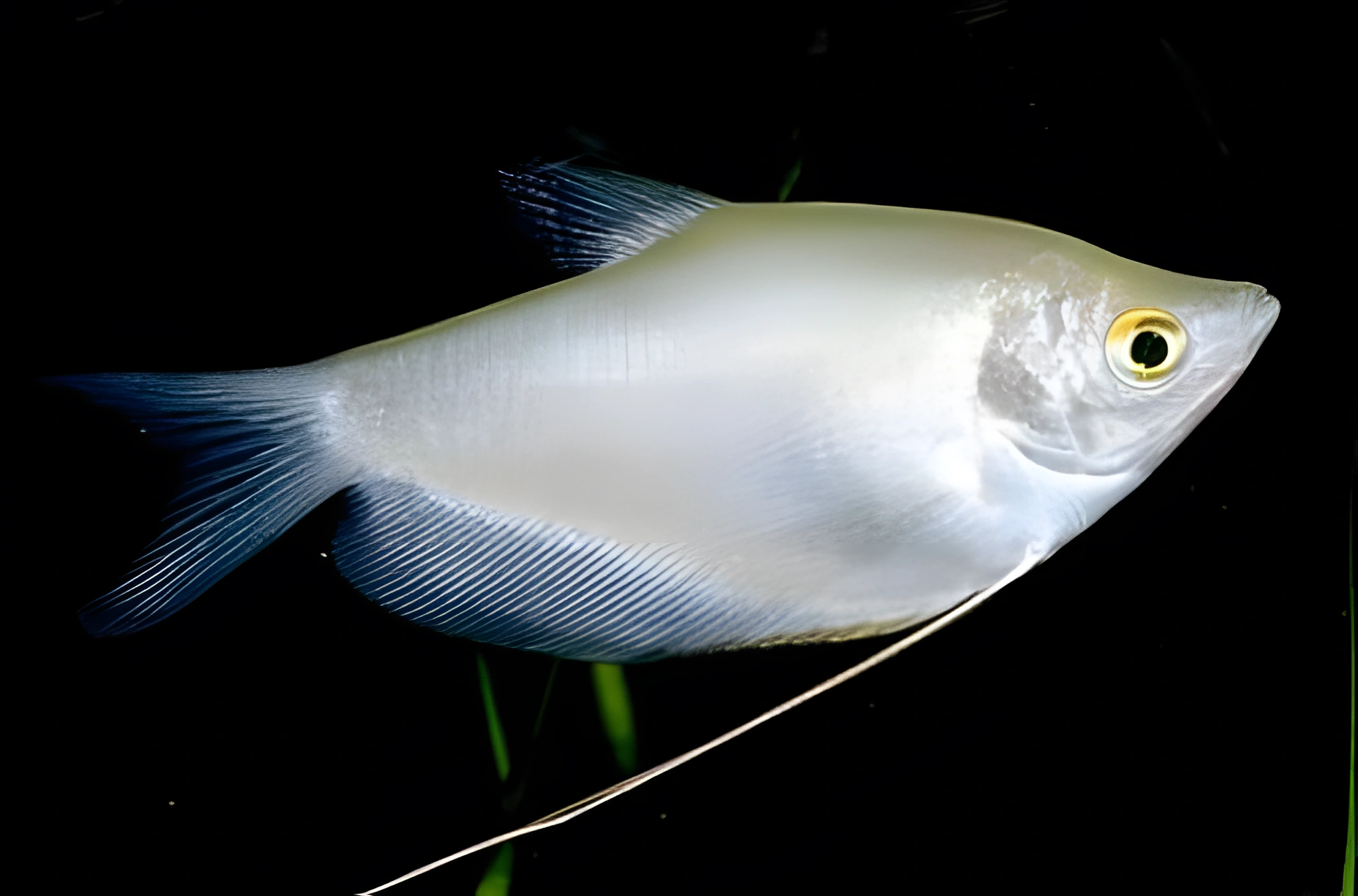
Trichopodus microlepis, known as the Moonlight Gourami, belongs to the family Osphronemidae. This fish possesses unique beauty: although its coloration is not particularly vibrant, the gourami's scales can reflect even faint rays of light, creating a shimmering effect reminiscent of moonlight, which makes it stand out among other gourami species.
- Required aquarium volume
- 150 L
- Size in aquarium
- 15 cm
- Temperature
- 25 – 30 °C
- Temperament
- Peaceful (regular)
Parameters
Water pHSlightly acidic (6) – Neutral (7)
Water dHVery soft (2) – Hard (15)
Water salinityno salt (freshwater)
Size in aquarium15 cm
Lifespan6 years
TemperamentPeaceful (regular)
Toward small fishnot a predator
Required aquarium volume150 L
Lightingmoderate (regular)
Substrateany, but dark
Water flownone or stagnant (no flow)
FeedingMeat with plant additives (omnivores)
CareMixed (solitary / pair / group)
Description
The body of the Moonlight Gourami is elongated and slightly compressed laterally, covered with small scales whose high reflectivity creates a luminous effect even in dim lighting. A distinctive feature is their very long, filamentous pectoral fins, which are longer than those of other gourami species. The body coloration is silvery; with age, a greenish tint may appear on the back. The iris of the eyes sometimes takes on a red or orange color. In males, a similar bright coloration extends to the fins, while in females, the fins are either colorless or have a pale yellow hue.
Males differ from females by having a more slender and graceful physique, as well as orange fins, which turn bright red when preparing for spawning. Additionally, in males, the dorsal and anal fins are pointed.
Habitat
Initially, these fish were discovered in Vietnam, Cambodia, and Thailand, within Southeast Asia. However, thanks to humans, the Moonlight Gourami is now found outside its natural range, with wild populations even appearing in South America. In their natural habitat, these fish prefer shallow, swampy bodies of water, lakes, and the floodplains of the Mekong River, where the water is calm and the banks are densely overgrown with vegetation. Their diet includes zooplankton, crustaceans, and various aquatic insects. An interesting feeding habit is their ability to knock small insects off the water's surface: the fish forcefully expels a stream of water from its mouth, thereby dislodging its prey.
Behavior and Compatibility
Gouramis successfully adapt to life both in pairs and in groups. It is important to remember that if a community of three or more fish is planned, a spacious tank with a sufficient number of hiding places will be required. This is because adult males tend to exhibit territorial behavior; in a small aquarium, weaker individuals may be constantly subjected to aggression. Females, as a rule, show greater tolerance. An optimal ratio is considered to be one male to several females. When choosing tank mates for Gouramis, preference should be given to peaceful, calm, and sufficiently large species, as small fish may become targets of harassment. Overly active tank mates can disturb Gouramis and provoke aggressive behavior. Catfish and some other Gourami species make excellent companions.
Care and Maintenance
For the successful keeping of a pair of Moonlight Gouramis, a spacious aquarium of at least 150 L is required. Essential equipment includes a filter, aerator, heater, and lighting system. It is important to choose the right filter to ensure effective cleaning while creating minimal water movement. Since these fish prefer stagnant waters, strong currents can cause them stress. Although the Moonlight Gourami can survive in water with low oxygen content, it is not recommended to create such conditions in an aquarium. Aeration should be continuous, preferably using fine-bubble diffusers. If the fish constantly stay at the surface, gulping air, this indicates a low oxygen level in the water, which can be caused by insufficient aeration or an excess of organic waste, the decomposition of which consumes oxygen. Weekly 25% water changes positively affect the well-being of the fish. When aquascaping, it is necessary to find a balance between open swimming areas and dense plant thickets, as well as hiding places in the form of grottoes or driftwood. It should be noted that fish tend to damage plants, so it is better to choose species with tough leaves and strong root systems, or use artificial ones. However, live plants remain preferable, as they play an important role in the biological balance of the aquarium system. A dark substrate will help to better reveal the fish's coloration; there are no special requirements for the particle size of the substrate.
Diet
In a home aquarium, these fish readily accept any food intended for aquarium inhabitants. Specialized Gourami foods, enriched with all necessary vitamins and trace elements, are available on the market. Additionally, the menu can be enriched with live foods such as bloodworms, tubifex, and mosquito larvae. They will also not refuse vegetable supplements — for example, small pieces of spinach or lettuce. Feeding is recommended once or twice a day, depending on the chosen diet. If live food is included in the diet, once a day will be quite sufficient.
Breeding and Reproduction
Breeding Moonlight Gouramis requires certain skills and can be a challenging task for beginner aquarists. If only a male/female pair is kept in the aquarium without other inhabitants, spawning can occur in the main tank. Otherwise, the pair should be moved to a separate breeding tank, recreating similar conditions there. Stimuli for spawning include increased meaty feeding, lowering the water level to 20 cm, and reducing hardness to 2–5 dGH. The female gradually swells with eggs, becoming very bloated, and the male's fins turn red. The male begins to build a nest from plant fragments and bubbles, which can reach 20 cm in diameter. After the construction is complete, the courtship ritual begins, during which the male attracts the female to the nest. Spawning lasts about two hours, during which time the female lays up to 2000 eggs, which are immediately fertilized. The male remains to guard the clutch, while the female moves away from the nest. Fry hatch on the second day, and after another two days, they are already free-swimming in the aquarium. During this period, they must be isolated from the parents, as the latter may eat their offspring. Micro-food, infusoria, and daphnia are used to feed the fry.
Diseases
In a balanced aquarium, health problems with Moonlight Gouramis usually do not arise. However, a deterioration in keeping conditions can primarily provoke bacterial infections, as well as digestive problems and constipation. More detailed information on symptoms and treatment methods can be found in the "Aquarium Fish Diseases" section.
How to choose
When purchasing, choose active fish with clean scales and no visible damage to their fins. It is important to ensure that the individuals show no signs of emaciation or body deformation, and that their eyes remain clear and transparent. Avoid fish that constantly stay at the water's surface, if there are no signs of oxygen deficiency in the tank, or that exhibit lethargic behavior, lying on the bottom.
- Examine the condition of the long ventral fin filaments, as their damage or absence may indicate poor keeping conditions or aggression from tank mates.
- Observe their behavior in the store: healthy gouramis show curiosity and explore their surroundings, rather than constantly hiding in corners.
- Ask the seller what the fish were fed to ensure a smooth transition to your usual diet.
Frequently asked questions
The essentials: size, tank volume, water parameters and care
How big does Moonlight Gourami get?
An adult reaches 15 cm in length. Plan the tank around the maximum size: the fish quickly outgrows a cramped setup.
What size aquarium does Moonlight Gourami need?
The minimum recommended volume is 150 L. A smaller tank speeds up nitrate build-up and raises stress levels.
What water parameters does Moonlight Gourami need?
Temperature 25–30 °C, pH 6–7, hardness 2–15 dGH. Stability matters more than exact values: sudden swings are harder on the fish than a small deviation from the ideal.
How long does Moonlight Gourami live?
Around 6 years when kept properly. Lifespan depends directly on tank volume, water quality and a varied diet.
Is Moonlight Gourami aggressive?
Temperament: peaceful (regular). Keep this in mind when choosing tank mates.
How many Moonlight Gourami should be kept together?
Recommended setup: mixed (solitary / pair / group). Ignoring this is a common cause of stress and disease.
What does Moonlight Gourami eat?
Diet type: meat with plant additives (omnivores). Feed small portions that are finished within a couple of minutes — overfeeding does more harm than underfeeding.
What is the scientific name of Moonlight Gourami?
The scientific name of the species is Trichopodus microlepis, family Osphronemidae. It also appears in the literature as: Deschauenseeia chryseus, Osphromenus microlepis, Trichogaster microlepis.