Temperature24 – 28 °C
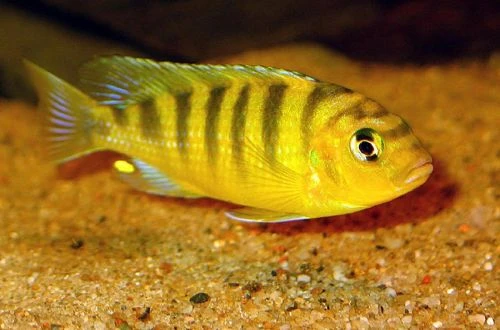
Other scientific names: Metriaclima lombardoi, Pseudotropheus lombardoi
Maylandia lombardoi, also known as Lombardo's Cichlid or Pseudotropheus lombardoi, belongs to the family Cichlidae. This bright and attractive fish is characterized by a rather belligerent disposition, which makes it not the best choice for beginner aquarists, despite its relative ease of keeping.
Adult males reach about 12 cm, while females stay noticeably smaller at around 8 cm. This species exhibits pronounced sexual dimorphism. Males are typically yellow with dark stripes, while females have a blue coloration with a similar pattern on their bodies. It is important to note that the intense yellow color is only characteristic of the alpha male, while subdominant males resemble females in appearance.
This species is endemic to Lake Malawi and is known from only two localities in the central part of the lake — Mbenji Island and Nkhomo Reef; it has been introduced to Namalenje Island. The natural environment of these fish is typical for rift lakes: stony shorelines prevail here, transitioning to sandy substrates at depth.
Lombardo's Cichlid is a territorial and rather aggressive representative of Mbuna cichlids. In small aquariums, it is recommended to keep one male with several females. Coexistence with other Mbuna species is only possible in aquariums with a volume of 400 liters or more. It is important that males of each species have enough space to establish and defend their territory on the bottom, otherwise skirmishes are inevitable due to lack of space. Aggressive behavior is predominantly exhibited by males; females are less belligerent.
For a group of these fish, the aquarium should have a volume of at least 200 liters. A sandy substrate is preferred for decoration, as well as many stones forming grottoes and shelters. It is recommended to add several natural snags; algae can grow on them under bright lighting, serving as an additional food source. For successful keeping, suitable hydrochemical water parameters and regular removal of organic waste – food remnants and excrement – are extremely important. A functioning filtration system and weekly water changes of 20–25% with fresh water are mandatory conditions.
The diet of Lombardo's Cichlids is quite varied. They readily accept all types of popular foods, including dry, frozen, and live. A key condition is the mandatory addition of plant components. These can be included in dry foods or offered separately. Spirulina flakes or pieces of nori can be an excellent option.
Breeding this species is possible even in a community tank. During the spawning period, the male chooses a suitable spot, which can be a depression in the sand or a flat stone. At this time, his behavior becomes excessively aggressive, and his courtship may seem insistent and rough, so the presence of shelters for females is very important. When the female is ready to spawn, she lays eggs, which she collects into her mouth immediately after fertilization. The offspring will develop in the female's mouth throughout the entire incubation period. This mechanism is an evolutionarily developed defense and is characteristic of many cichlids from Lake Malawi.
Most diseases of Malawian cichlids are often caused by unsuitable keeping conditions or poor-quality food, which frequently leads to the development of "Malawi Bloat. If the first symptoms are detected, it is necessary to check the water parameters for high concentrations of dangerous substances such as ammonia, nitrites, and nitrates. If necessary, all parameters should be normalized, and only then should treatment begin.
When selecting individuals, attention should be paid to overall activity and the absence of external damage, such as ulcers, spots, or fin rot. A healthy fish should show curiosity and actively respond to feeding. It is important to avoid specimens that keep to themselves, look emaciated, or have a sunken belly. — preference should be given to young individuals, as they adapt more easily to new keeping conditions — when purchasing a group, it is important to consider the high aggressiveness of the species, so it is better to acquire one male and several females simultaneously to form a stable hierarchy — it is necessary to ensure there are no signs of "Malawi bloat" (severe abdominal swelling, refusal to eat), which is often observed in cichlids from this region due to improper keeping in the store.
The essentials: size, tank volume, water parameters and care
An adult reaches 10–12 cm in length. Plan the tank around the maximum size: the fish quickly outgrows a cramped setup.
The recommended volume is 200 L. A smaller tank speeds up nitrate build-up and raises stress levels.
Temperature 24–28 °C, pH 7.6–8.8, hardness 10–25 dGH. Stability matters more than exact values: sudden swings are harder on the fish than a small deviation from the ideal.
Around 9 years when kept properly. Lifespan depends directly on tank volume, water quality and a varied diet.
Temperament: aggressive / incompatible / unfriendly. Keep this in mind when choosing tank mates.
Recommended setup: harem (1 male and several females). Ignoring this is a common cause of stress and disease.
Diet type: plant-based (algae, vegetables). Feed small portions that are finished within a couple of minutes — overfeeding does more harm than underfeeding.
The scientific name of the species is Maylandia lombardoi, family Cichlids (Cichlidae). It also appears in the literature as: Metriaclima lombardoi, Pseudotropheus lombardoi.
Matched by family, categories and overlapping keeping conditions
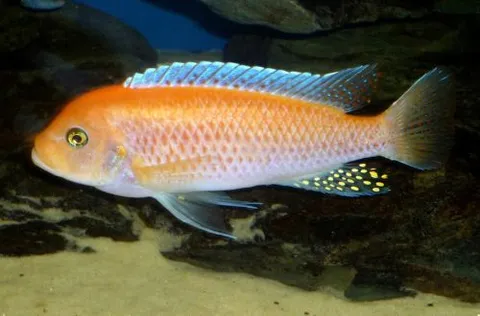
Maylandia estherae
The Red Zebra Cichlid, scientifically known as Maylandia estherae (formerly Pseudotropheus estherae), belongs to the Cichlidae family. This vibrant, beautiful, and active fish exhibits interesting behavior. It can be a…
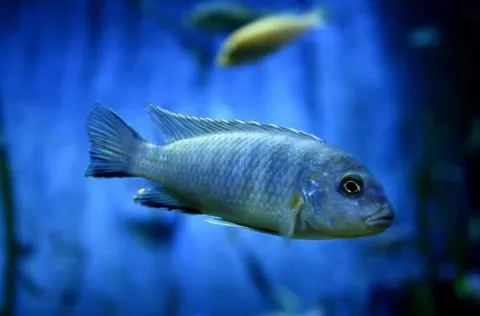
Maylandia zebra
Maylandia zebra, known as Zebra Mbuna or Blue Pseudotropheus zebra, belongs to the family Cichlidae. Although previously classified under the genus Pseudotropheus, the outdated name is still actively used. This fish is…
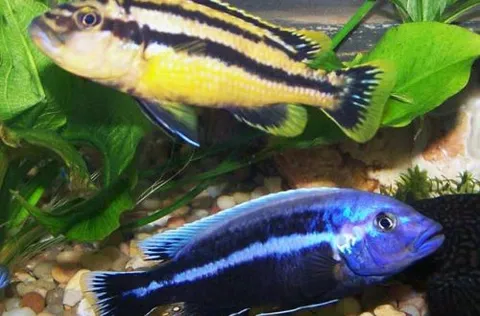
Melanochromis chipokae
Melanochromis chipokae, known scientifically as Melanochromis chipokae, belongs to the family Cichlidae. This species represents the Mbuna group of cichlids, characterized by their aggressive behavior. This particular…
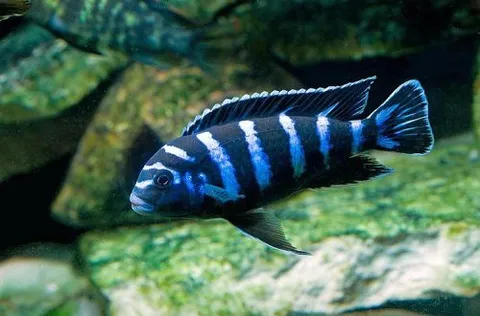
Chindongo demasoni
Pseudotropheus demasoni, known scientifically as Chindongo demasoni, belongs to the family Cichlidae. This species appeared relatively recently in aquaristics, becoming available for purchase only from 1994. Before the…