Temperature23 – 26 °C
Natural range
- Thailand area
LoachesConservation status: Data deficient DD
Other scientific names: Noemacheilus binotatus
A member of the Nemacheilidae family (stone loaches), the striped loach, known scientifically as Nemacheilus binotatus, originates from Southeast Asia. These fish are found in the waters of Thailand, particularly in the basins of the Mae Klong and Chao Phraya rivers. Their natural habitat consists of shallow, up to 1 meter deep, flowing streams and rivers where the bottom is composed of stones and sand, often mixed with organic debris such as plant remains.
- Required aquarium volume
- 50 L
- Size in aquarium
- 6 cm
- Temperature
- 23 – 26 °C
- Temperament
- Peaceful (regular)
Parameters
Water pHSlightly acidic (6) – Neutral (7.5)
Water dHVery soft (2) – Hard (12)
Water salinityno salt (freshwater)
Size in aquarium6 cm
Lifespan5 years
TemperamentPeaceful (regular)
Toward small fishnot a predator
Required aquarium volume50 L
Lightingany
Substraterocky (rock formations, boulders, etc.)
Water flowmoderate or strong
FeedingSinking (any)
CareBoth solitary and in group (flexible)
Description
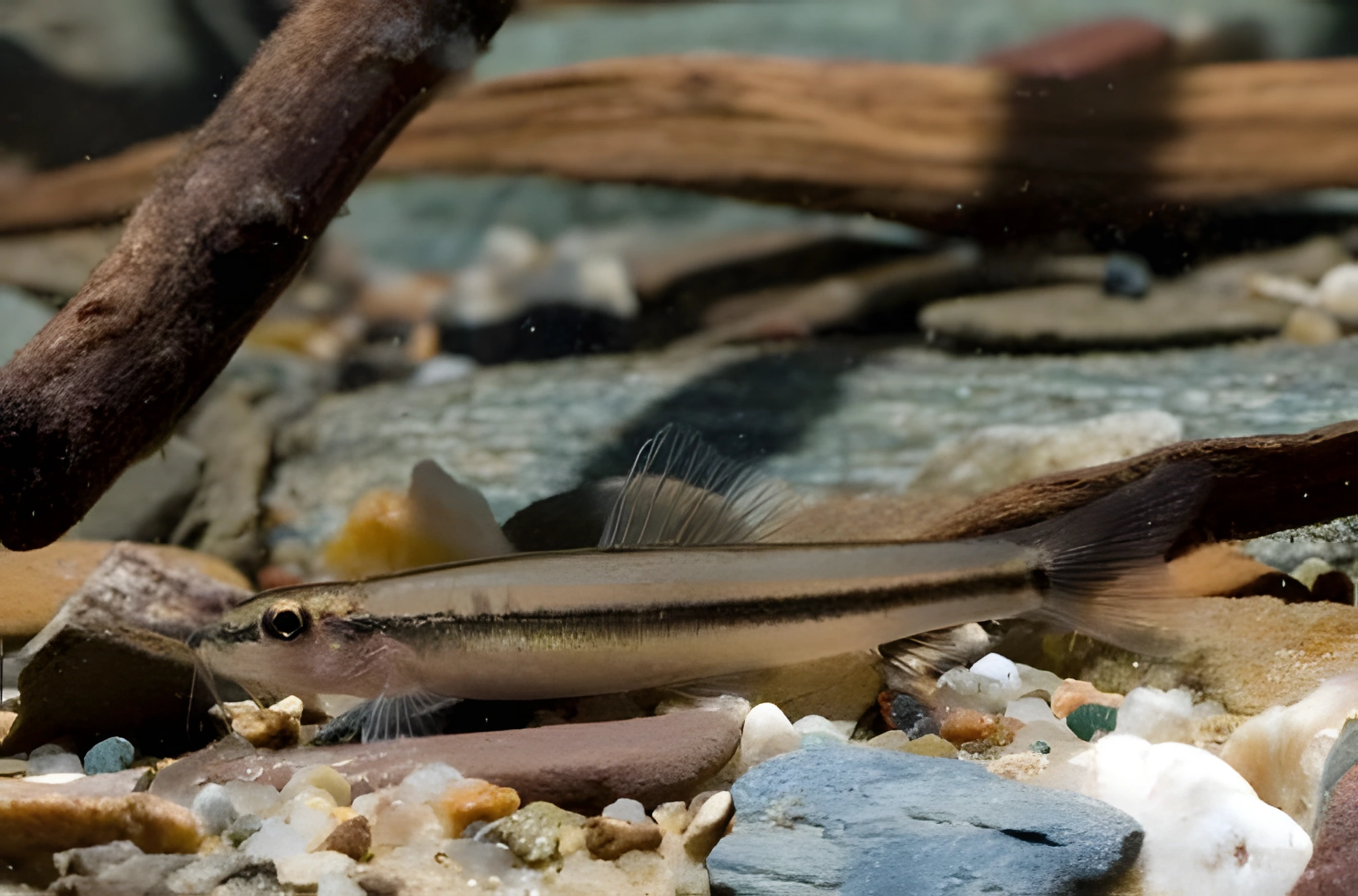
Adult specimens of this fish grow to about 6 cm in length. Their appearance is characterized by a concise pattern: three black lines run along the body from head to tail. Two of these are located on the sides, and the third extends along the back. The overall coloration is gray. Their fins are translucent. Sexual dimorphism in this species is not pronounced. However, females, when of the same age as males, may appear more massive or fuller.
Habitat
The species inhabits the Mekong, Chao Phraya, and Mae Klong river systems in Thailand. In nature, it populates shallow areas of rivers and streams less than one meter deep with moderate to strong currents. It prefers areas with a bottom of sand, gravel, pebbles, or stones, often with organic detritus such as fallen leaves.
Behavior and Compatibility
This fish prefers a solitary lifestyle, avoiding large gatherings of its kind. When choosing tank mates, it is best to opt for small species that inhabit similar biotopes in nature. Good companions can be some species of Gastromyzon, Siamese Algae Eater, as well as fish of the genus Garra, such as Garra rufa or Rainbow Garra. It is important to avoid territorial species, including closely related ones, such as the common Stone Loach or Schistura.
Care and Maintenance
For keeping a pair of striped loaches, an aquarium of at least 50 liters is recommended. Their care is straightforward, provided optimal water parameters are maintained. When setting up the aquarium, the main attention should be paid to its lower tier. Coarse sand should be used as a substrate, supplemented with stones and boulders. Aquatic plants are not mandatory; if you wish to add them, it is better to choose undemanding species that can attach to stones or driftwood – for example, all species of Anubias, aquatic mosses, and ferns. The presence of current in the aquarium will be beneficial. A powerful internal filter can provide both water circulation and the necessary mechanical filtration. Since these fish live in flowing waters, they are sensitive to water quality. Therefore, in addition to filtration, it is necessary to weekly replace 30–50% of the water volume with fresh water and regularly remove accumulated organic waste. It is also important to provide an aeration system if it is not part of the filtering equipment. This is an omnivorous species, whose diet in nature consists mainly of small insects, worms, crustaceans, and other zooplankton, supplemented by a small amount of plant material. In aquarium conditions, they readily accept most popular sinking foods in dry, frozen, and live forms.
Diet
In their natural habitat, the diet of these omnivorous fish consists of small insects, worms, crustaceans, and other zooplankton, as well as some plant matter. In aquarium conditions, they adapt well to a variety of sinking foods, whether dry pellets, frozen, or live options.
Breeding and Reproduction
Based on available sources, a separate block cannot be compiled: the data is insufficient or contradictory. The entry can be updated later when verified information becomes available.
Diseases
No specific diseases for this species have been described. Like other members of the family, the fish is sensitive to water quality and the accumulation of organic pollutants. Maintaining health requires a high concentration of dissolved oxygen and regular water changes, as the species tolerates environmental pollution poorly.
How to choose
When purchasing, choose active individuals that exhibit natural behavior and show no visible damage to their skin or fins. Healthy fish should show no signs of emaciation, and their breathing should be even. It is recommended to acquire a group of four or more individuals, as the species tends to exhibit social behavior and may experience stress if kept alone.
Frequently asked questions
The essentials: size, tank volume, water parameters and care
How big does Striped Loach get?
An adult reaches 6 cm in length. Plan the tank around the maximum size: the fish quickly outgrows a cramped setup.
What size aquarium does Striped Loach need?
The minimum recommended volume is 50 L. A smaller tank speeds up nitrate build-up and raises stress levels.
What water parameters does Striped Loach need?
Temperature 23–26 °C, pH 6–7.5, hardness 2–12 dGH. Stability matters more than exact values: sudden swings are harder on the fish than a small deviation from the ideal.
How long does Striped Loach live?
Around 5 years when kept properly. Lifespan depends directly on tank volume, water quality and a varied diet.
Is Striped Loach aggressive?
Temperament: peaceful (regular). Keep this in mind when choosing tank mates.
How many Striped Loach should be kept together?
Recommended setup: both solitary and in group (flexible). Ignoring this is a common cause of stress and disease.
What does Striped Loach eat?
Diet type: sinking (any). Feed small portions that are finished within a couple of minutes — overfeeding does more harm than underfeeding.
What is the scientific name of Striped Loach?
The scientific name of the species is Nemacheilus binotatus, family River Loaches (Nemacheilidae). It also appears in the literature as: Noemacheilus binotatus.