Temperature24 – 30 °C
Natural range
- Mekong River Basin
- Chao Phraya River Basin
- Laos area
- Cambodia area
LoachesConservation status: Least concern LC
Other scientific names: Botia helodes
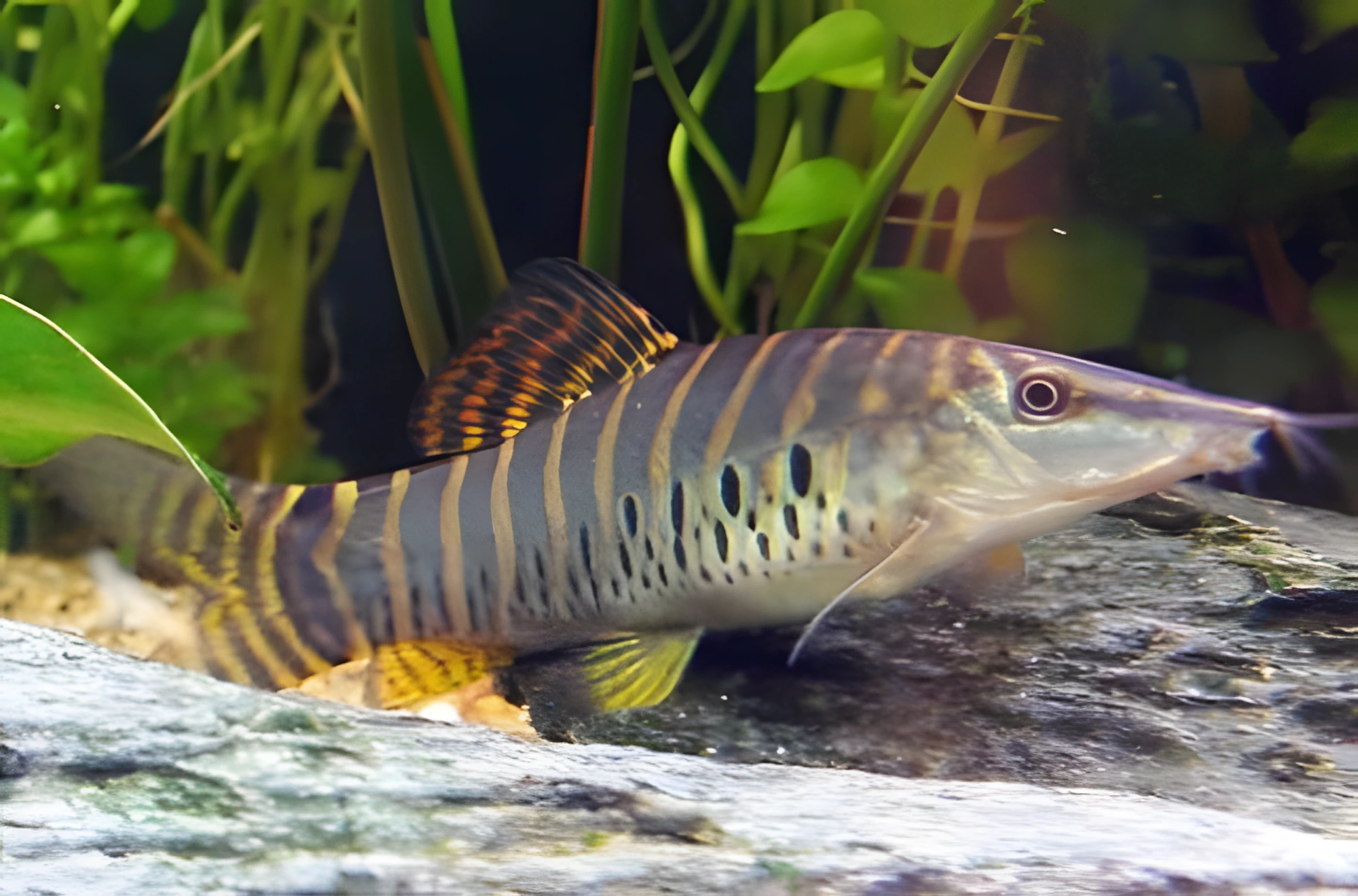
The Banded Loach, also known as the Tiger Loach, belongs to the family Cobitidae and bears the scientific name Syncrossus helodes. This large, active fish prefers to spend its time at the bottom of the aquarium. Under favorable conditions, its coloration becomes distinctly striped. Its care is not difficult and does not require significant expense, but challenges may arise when selecting tankmates due to the loaches' distinctive temperament.
- Required aquarium volume
- 350 L
- Size in aquarium
- 25 – 30 cm
- Temperature
- 24 – 30 °C
- Temperament
- Semi-peaceful (including aggression during spawning / intraspecific conflicts)
Parameters
Water pHSlightly acidic (6) – Neutral (7.5)
Water dHVery soft (2) – Hard (12)
Water salinityno salt (freshwater)
Size in aquarium25 – 30 cm
Lifespan10 years
TemperamentSemi-peaceful (including aggression during spawning / intraspecific conflicts)
Toward small fishnot a predator
Required aquarium volume350 L
Lightingdimmed
Substratefine sand
Water flowweak or moderate
FeedingSinking (any)
CareSmall group (5–6 individuals)
Description
Adults reach a length of approximately 25–30 cm. Sexual dimorphism is weakly expressed; females are generally larger than males. The fish has an elongated, oblong body with a pointed head. The mouth is surrounded by sensitive barbels. The coloration is predominantly gray, with characteristic oblique orange stripes running across the entire body. In the lower part, the pattern is complemented by dark spots or speckles. The fins and tail are adorned with alternating orange and black stripes, creating a banded pattern. Juveniles typically have duller coloration.
Habitat
Their natural habitats are in Southeast Asia, specifically the Mekong and Chao Phraya river systems, flowing through Laos, Cambodia, Thailand, and Southern Vietnam. These fish are found in both small flowing bodies of water and the main river channels. During the rainy season, they undertake long-distance migrations from their usual locations. Thus, their natural range encompasses diverse biotopes where environmental conditions, including turbidity, temperature, and water hydrochemistry, can periodically change.
Behavior and Compatibility
These fish are recommended to be kept in groups of 5–6 individuals. If their number is smaller, Tiger Loaches may display excessive aggression towards other tank inhabitants. It is also undesirable to house them with ornamental fish with long fins or very small species. Good compatibility is observed with peaceful fish of comparable size that prefer to inhabit the middle or upper water column.
Care and Maintenance
For a group of 5–6 adult individuals, the optimal aquarium volume starts from 350 liters. The choice of decor largely depends on the aquarist's preferences, as the Banded Loach thrives in almost any conditions. Nevertheless, it is advisable to consider some aspects regarding substrate, lighting, and decorative elements. It is desirable to use a substrate of fine gravel or coarse sand. Driftwood and clusters of smooth stones or boulders will serve as excellent shelters. Lighting should be subdued. Accordingly, shade-loving, hardy plants are suitable for such an aquarium; they are best planted in pots to prevent them from being accidentally dug up by the fish. Maintaining high water quality is a key factor for successful keeping. Like many fish inhabiting flowing waters, loaches are sensitive to the accumulation of organic waste. Therefore, essential conditions include weekly water changes of 30–50% of the volume with fresh water and the presence of an efficient filtration system.
Diet
The Tiger Loach is an unpretentious, omnivorous species. In its natural environment, its diet consists of everything it can find on the bottom: soft plants, aquatic insects and their larvae, various mollusks, and worms. In a home aquarium, it easily adapts to most popular sinking dry, frozen, and live foods. It is important that the diet includes vegetable supplements, otherwise delicate aquarium plants may suffer. It should also be noted that these fish can pose a threat to snails.
Breeding and Reproduction
To date, there is no reliable data on the successful breeding of the Banded Loach in home aquariums. Fry are most often obtained at specialized fish farms, where spawning is stimulated using hormonal preparations.
Diseases
Fish species that have not undergone selective breeding and are close to their wild relatives typically exhibit hardiness, strong immunity, and resistance to various diseases. Health problems most often arise due to unfavorable keeping conditions. Therefore, before proceeding with treatment, it is necessary to check the water parameters and quality. If necessary, all indicators should be brought back to normal, and only then should treatment begin, if it is still required. Detailed information on diseases, their symptoms, and treatment methods can be found in the section "Diseases of Aquarium Fish."
How to choose
When choosing a Banded Loach, pay attention to its overall activity and the condition of its skin. A healthy fish should be curious, actively explore the bottom, and show no visible damage, ulcers, or film on its body. An important indicator is plumpness: a sunken belly in young individuals may indicate emaciation or the presence of internal parasites, which is often seen in recently imported specimens.
- avoid purchasing individuals showing signs of severe stress, such as rapid breathing or constantly staying at the water surface;
- check the condition of the fins; they should be intact, without signs of splitting or redness;
- keep in mind that fish in stores are often stressed and may hide, so it's worth asking the seller to feed them to assess their appetite and coordination of movements.
Frequently asked questions
The essentials: size, tank volume, water parameters and care
How big does Banded Loach get?
An adult reaches 25–30 cm in length. Plan the tank around the maximum size: the fish quickly outgrows a cramped setup.
What size aquarium does Banded Loach need?
The minimum recommended volume is 350 L. A smaller tank speeds up nitrate build-up and raises stress levels.
What water parameters does Banded Loach need?
Temperature 24–30 °C, pH 6–7.5, hardness 2–12 dGH. Stability matters more than exact values: sudden swings are harder on the fish than a small deviation from the ideal.
How long does Banded Loach live?
Around 10 years when kept properly. Lifespan depends directly on tank volume, water quality and a varied diet.
Is Banded Loach aggressive?
Temperament: semi-peaceful (including aggression during spawning / intraspecific conflicts). Keep this in mind when choosing tank mates.
How many Banded Loach should be kept together?
Recommended setup: small group (5–6 individuals). Ignoring this is a common cause of stress and disease.
What does Banded Loach eat?
Diet type: sinking (any). Feed small portions that are finished within a couple of minutes — overfeeding does more harm than underfeeding.
What is the scientific name of Banded Loach?
The scientific name of the species is Syncrossus helodes, family True Loaches (Cobitidae). It also appears in the literature as: Botia helodes.