Temperature20 – 28 °C
Natural range
- Kerala area
- Western Ghats area
Labyrinth fishConservation status: Vulnerable VU
Other scientific names: Macropodus cupanus, Macropodus dayi, Parosphromenus dayi, Polyacanthus cupanus, Polyacanthus dayi
Day's paradise fish, or Pseudosphromenus dayi by its scientific name, belongs to the family Osphronemidae. It is characterized by a peaceful disposition, which is quite rare among its relatives. This fish is unpretentious and quite hardy, fitting perfectly into a community tank with various species of aquarium fish. However, do not expect it to be the "star" of the aquarium due to its unremarkable coloration.
- Required aquarium volume
- 60 L
- Size in aquarium
- 6 cm
- Temperature
- 20 – 28 °C
- Temperament
- Peaceful (regular)
Parameters
Water pHSlightly acidic (6) – Neutral (7.5)
Water dHVery soft (2) – Hard (15)
Water salinityno salt (freshwater)
Size in aquarium6 cm
Lifespan5 years
TemperamentPeaceful (regular)
Toward small fishnot a predator
Required aquarium volume60 L
Lightingdimmed
Substratesoft silted
Water flownone or stagnant (no flow)
FeedingMeat / protein (live, frozen, fresh)
CareMixed (solitary / pair / group)
Description
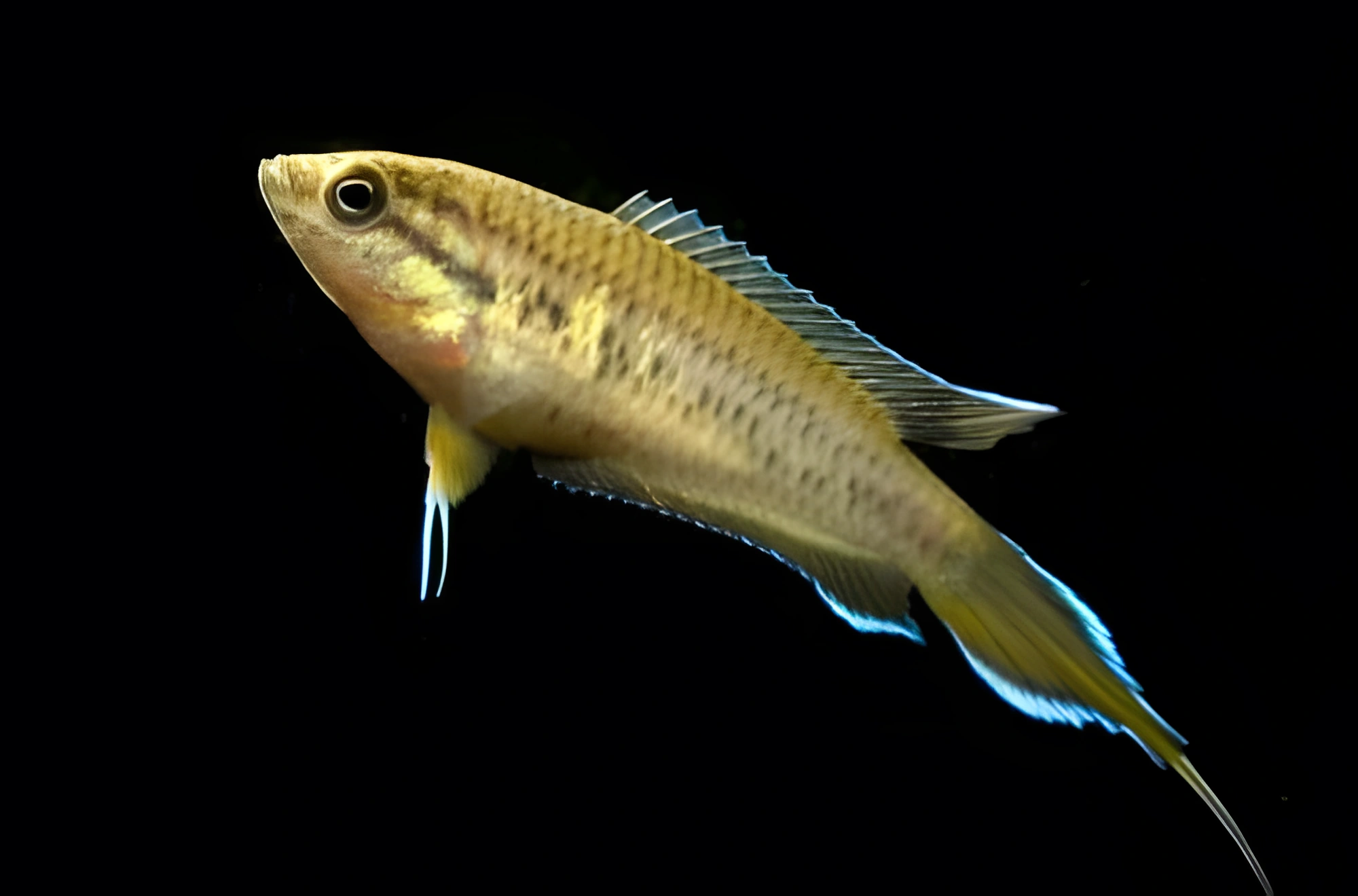
Adults reach a length of 6 centimeters or more. The body is colored copper-brown, with two dark horizontal stripes running along it from head to tail. The fins have a delicate bluish tint at the edges. Females are less vibrant than males, who display the most intense colors during the breeding season.
Habitat
The natural habitat of this species is in the foothills of the Western Ghats in the southern Indian state of Kerala. It prefers shallow waters in swampy river sections with slow currents, as well as small lakes with abundant aquatic vegetation. It can often be found in river floodplains and other low-lying areas.
Behavior and Compatibility
These fish are distinguished by their peaceful and calm nature, coexisting well with other species of similar size and temperament. Males usually do not show aggression towards each other; skirmishes between them are extremely rare. It is important to avoid keeping them with overly active or large tank mates, as these can intimidate the modest Day's paradise fish.
Care and Maintenance
For keeping a single pair of these fish, a minimum tank volume of 60 liters is recommended. The aquarium setup should meet the following conditions: subdued lighting, the presence of shelters in the form of driftwood or decorations (e.g., sunken ships, castles), and areas with dense vegetation, both rooted and floating. The aquarium should be filled with water approximately three-quarters full. The filtration system should be adjusted to minimize water movement. An essential element is a tightly fitting lid, which will not only prevent accidental jumping out (which is not a problem for Day's paradise fish) but also create a warm, humid layer of air above the surface, which is critically important for labyrinth fish respiration. Hydrochemical parameters such as pH and dGH can be quite broad. Often, simply letting tap water stand for 24 hours to remove chlorine is sufficient before adding it to the aquarium. Care includes regular cleaning of the substrate from organic debris (excrement, uneaten food) and weekly partial water changes (10–15% of the total volume) with fresh water.
Diet
The diet of these fish preferably consists of live or frozen foods, such as bloodworms, Artemia, or grindal worms. Dry foods containing plant components can only be used as supplementary feeding and should not form the basis of their diet.
Breeding and Reproduction
Unlike closely related species that build foam nests for their future offspring, this species prefers to use natural shelters. These can be dense plant thickets, driftwood with spacious cavities, and the like. Excellent spawning sites include inverted coconut shells, ceramic pots tilted on their side, or hollow tubes of suitable diameter. With the onset of the breeding season, the females' bellies become rounder, and the males' coloration intensifies significantly, after which the male begins to search for a suitable spot, often creating a rudimentary nest under the arch of the chosen shelter. Spawning itself occurs through peculiar “embraces,” during which a small portion of eggs and milt is released. After release, they are carefully placed in the nest. Upon completion of spawning, the female swims away, leaving the male to guard the clutch. Fry hatch within 24–49 hours, and after 2–3 days, they begin to move freely around the aquarium. From this moment, the male ceases to protect the offspring, and the fry can become prey for both other fish and their own parents, so it is recommended to transfer the fry to a separate tank with similar water conditions.
Diseases
Most diseases are caused by unsuitable keeping conditions and poor-quality food. Upon detecting the first signs of illness, it is necessary to immediately check the water parameters (such as pH and dGH) and ensure the absence of high concentrations of dangerous substances (ammonia, nitrites, nitrates, etc.). The parameters should be brought back to normal only after this before proceeding with treatment. More detailed information on symptoms and treatment methods can be found in the section “Diseases of Aquarium Fish.”
How to choose
When choosing Day's paradise fish, pay attention to the fish's overall activity and the condition of its fins. Healthy individuals should be active, without visible damage, sores, or white film on their scales. Since the species is prone to intraspecific aggression, specimens with nipped fins can often be found in stores, but fish with signs of tissue rot or fin edge deterioration should be avoided.
- choose individuals with bright, clear coloration and distinct longitudinal stripes on the body
- avoid sluggish fish that constantly stay at the water surface or, conversely, lie motionless at the bottom
- carefully inspect the eyes and gills for the absence of cloudy spots or unnatural redness
Frequently asked questions
The essentials: size, tank volume, water parameters and care
How big does Day's paradise fish get?
An adult reaches 6 cm in length. Plan the tank around the maximum size: the fish quickly outgrows a cramped setup.
What size aquarium does Day's paradise fish need?
The minimum recommended volume is 60 L. A smaller tank speeds up nitrate build-up and raises stress levels.
What water parameters does Day's paradise fish need?
Temperature 20–28 °C, pH 6–7.5, hardness 2–15 dGH. Stability matters more than exact values: sudden swings are harder on the fish than a small deviation from the ideal.
How long does Day's paradise fish live?
Around 5 years when kept properly. Lifespan depends directly on tank volume, water quality and a varied diet.
Is Day's paradise fish aggressive?
Temperament: peaceful (regular). Keep this in mind when choosing tank mates.
How many Day's paradise fish should be kept together?
Recommended setup: mixed (solitary / pair / group). Ignoring this is a common cause of stress and disease.
What does Day's paradise fish eat?
Diet type: meat / protein (live, frozen, fresh). Feed small portions that are finished within a couple of minutes — overfeeding does more harm than underfeeding.
What is the scientific name of Day's paradise fish?
The scientific name of the species is Pseudosphromenus dayi, family Osphronemidae. It also appears in the literature as: Macropodus cupanus, Macropodus dayi, Parosphromenus dayi.