Temperature24 – 28 °C
Natural range
- Congo River Basin
- Republic of the Congo area
- Democratic Republic of the Congo area
Labyrinth fishConservation status: Least concern LC
Other scientific names: Anabas acutirostris, Anabas ocellatus, Ctenopoma acutirostris
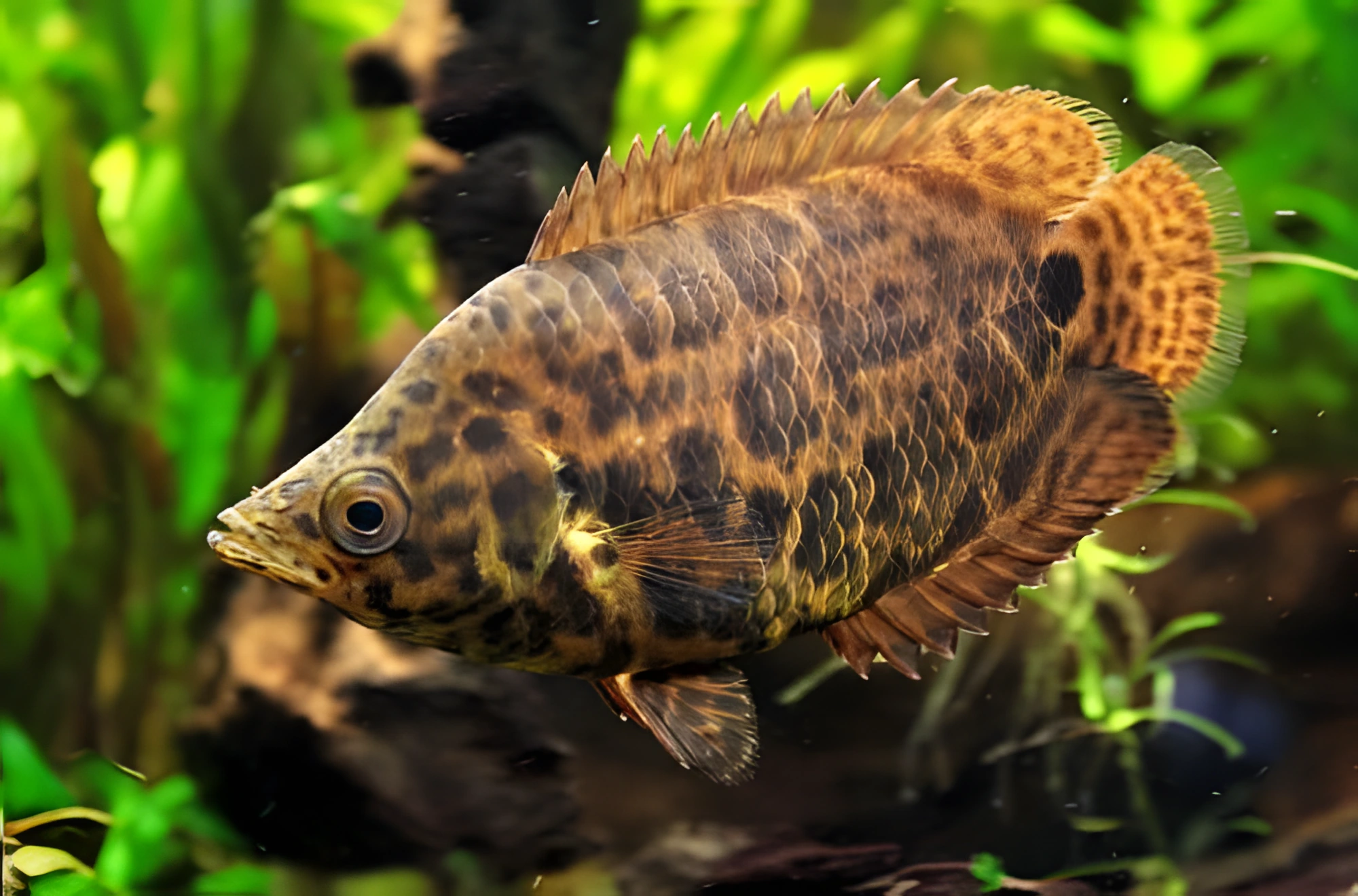
Ctenopoma acutirostre, known as the Leopard Ctenopoma, belongs to the family Anabantidae. This spotted inhabitant of African rivers, despite its predatory nature, behaves quite peacefully towards fish of comparable size. It prefers to spend the daytime hours in hiding, becoming active at night. Distinguished by its hardiness and unpretentiousness, this species is considered a long-lived fish among its relatives, capable of living up to 15 years under favorable conditions.
- Required aquarium volume
- 110 L
- Size in aquarium
- 15 cm
- Temperature
- 24 – 28 °C
- Temperament
- Semi-peaceful (including aggression during spawning / intraspecific conflicts)
Parameters
Water pHSlightly acidic (6) – Neutral (7.5)
Water dHSoft (5) – Hard (15)
Water salinityno salt (freshwater)
Size in aquarium15 cm
Lifespan15 years
TemperamentSemi-peaceful (including aggression during spawning / intraspecific conflicts)
Toward small fishnot a predator
Required aquarium volume110 L
Lightingdimmed
Substrateany, but dark
Water flowany
FeedingMeat / protein (live, frozen, fresh)
CareMixed (solitary / pair / group)
Description
In their natural environment, adult individuals can reach 20 cm, but in aquarium conditions, their size rarely exceeds 15 cm. The coloration of these fish resembles that of a leopard, with numerous dark spots on a predominantly brown background. The body, high and flattened laterally, has a pointed head, resembling a leaf shape. The tail is rounded, and the dorsal and anal fins are elongated and adorned with serrations resembling spines.
Habitat
The natural habitat of the Leopard Ctenopoma covers the vast Congo River basin in countries such as the Republic of the Congo and the Democratic Republic of the Congo. These fish have adapted to life in diverse biotopes, from fast-flowing rivers to stagnant bodies of water.
Behavior and Compatibility
Leopard Ctenopoma shows tolerance to other species of similar size and even exhibits some timidity, being easily intimidated by overly active tank mates. Despite this, it remains a predator and may eat small fish if the opportunity arises. Intraspecific relationships are characterized by the dominance of an alpha male in a certain territory. In small aquariums, this can lead to skirmishes, but if the fish grow together, forming a hierarchy as they mature, conflicts can be avoided.
Care and Maintenance
For a single fish, the minimum aquarium volume should be at least 110 L. Since Leopard Ctenopoma is nocturnal, special attention should be paid to lighting: it should be subdued or dim, which can be achieved with dense floating plants. Dark substrate is recommended for decoration, as well as branched driftwood creating secure hiding places. African plants such as Anubias and Bolbitis look great when attached to wooden elements. The presence of a tight aquarium lid is critically important for maintaining a warm and humid layer of air above the water surface, which is necessary for labyrinth fish to breathe. Overall, the species is undemanding and adapts well to a wide range of pH and dGH values, as long as they remain within acceptable limits. Care includes regular cleaning of the substrate from organic debris and weekly partial water changes (10–15% of the volume) with fresh water, provided an effective filtration system is in place.
Diet
Being a predator, in the wild, Leopard Ctenopoma feeds on small fish and large invertebrates. In a home aquarium, it easily adapts to a variety of foods, such as frozen shrimp, bloodworms, mussels, as well as shelled snails and earthworms.
Breeding and Reproduction
Breeding this species in a home aquarium is a challenging task, with successful cases being infrequent. Ctenopomas are quite selective in choosing a partner, and the likelihood of forming at least one pair significantly increases if a group of several fish of the same age is acquired. When the breeding season arrives, the fish perform special courtship dances, during which hundreds of eggs are laid. The eggs float to the water surface and from this moment are left without parental care. Adult fish do not exhibit parental instincts and do not care for their future offspring; moreover, they are capable of eating their own eggs. To preserve the offspring, the eggs are carefully moved to a separate tank where identical water conditions are maintained. The incubation period is about 48 hours, and after another 2 days, the fry begin to actively swim in search of food. They should be fed specialized microscopic food or infusoria, cultured independently.
Diseases
The main cause of most diseases is unsuitable living conditions and poor-quality food. If you notice the first symptoms, you should immediately check the water parameters and ensure there are no high concentrations of dangerous substances (ammonia, nitrites, nitrates, etc.). The parameters must be brought back to normal, and only then can treatment measures begin. Detailed information on symptoms and treatment methods is provided in the "Aquarium Fish Diseases" section.
How to choose
When choosing a Leopard Ctenopoma in a store, pay attention to the fish's activity: healthy individuals are usually cautious but should not look emaciated or apathetic. It is important to inspect the skin and fins for any damage, white film, or ulcers, as the species is susceptible to bacterial infections. It is recommended to assess the fish's plumpness — a sunken belly can be a sign of internal parasites or prolonged starvation. Since ctenopoma is a predator, it is advisable to ask the seller what specifically the particular specimen eats, as accustoming it to dry foods may take time.
Frequently asked questions
The essentials: size, tank volume, water parameters and care
How big does Leopard Ctenopoma get?
An adult reaches 15 cm in length. Plan the tank around the maximum size: the fish quickly outgrows a cramped setup.
What size aquarium does Leopard Ctenopoma need?
The minimum recommended volume is 110 L. A smaller tank speeds up nitrate build-up and raises stress levels.
What water parameters does Leopard Ctenopoma need?
Temperature 24–28 °C, pH 6–7.5, hardness 5–15 dGH. Stability matters more than exact values: sudden swings are harder on the fish than a small deviation from the ideal.
How long does Leopard Ctenopoma live?
Around 15 years when kept properly. Lifespan depends directly on tank volume, water quality and a varied diet.
Is Leopard Ctenopoma aggressive?
Temperament: semi-peaceful (including aggression during spawning / intraspecific conflicts). Keep this in mind when choosing tank mates.
How many Leopard Ctenopoma should be kept together?
Recommended setup: mixed (solitary / pair / group). Ignoring this is a common cause of stress and disease.
What does Leopard Ctenopoma eat?
Diet type: meat / protein (live, frozen, fresh). Feed small portions that are finished within a couple of minutes — overfeeding does more harm than underfeeding.
What is the scientific name of Leopard Ctenopoma?
The scientific name of the species is Ctenopoma acutirostre, family Anabantidae. It also appears in the literature as: Anabas acutirostris, Anabas ocellatus, Ctenopoma acutirostris.