Temperature15 – 30 °C
Natural range
- Mexico area
- Eastern Plateau area
LivebearersConservation status: Endangered EN
Other scientific names: Characodon eiseni
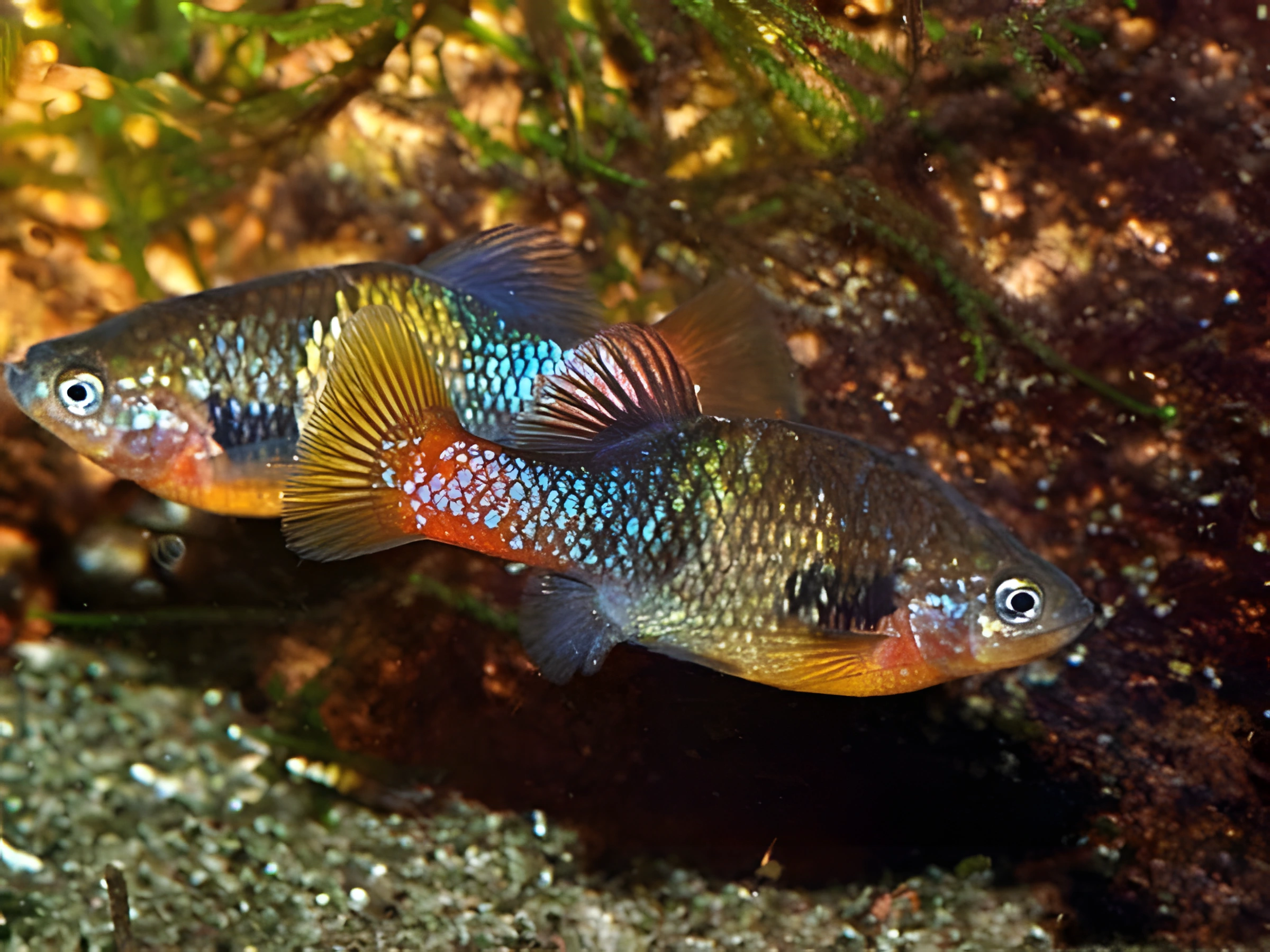
Xenotoca eiseni, known as the Redtail or Orange Xenotoca, belongs to the family Goodeidae. This livebearing fish attracts attention with its bright colors and hardiness. It could be a wonderful addition to a freshwater community aquarium, if not for its sometimes unpredictable behavior.
- Required aquarium volume
- 50 L
- Size in aquarium
- 6 – 7 cm
- Temperature
- 15 – 30 °C
- Temperament
- Semi-peaceful (including aggression during spawning / intraspecific conflicts)
Parameters
Water pHAcidic (4) – Slightly alkaline (8)
Water dHMedium hardness (10) – Very hard (25)
Water salinityno salt (freshwater)
Size in aquarium6 – 7 cm
Lifespan3 years
TemperamentSemi-peaceful (including aggression during spawning / intraspecific conflicts)
Toward small fishnot a predator
Required aquarium volume50 L
Lightingany
Substrateany, but dark
Water flownone or stagnant (no flow)
FeedingAny (universal)
CareMixed (solitary / pair / group)
Description
Males grow up to 6 cm in length and appear much brighter than females. Their coloration is a combination of yellow, red, and orange hues with iridescent blue scales. Females are somewhat larger, reaching 7 cm, but their coloring is less vibrant. When carrying offspring, they often display a dark mark in the abdominal area.
Habitat
Its natural habitat is Mexico, specifically the eastern plateau of the country. These fish are found everywhere: from clear mountain streams to roadside ditches in tropical forests.
Behavior and Compatibility
Their temperament can be quite unpredictable. Some groups of Xenotoca are completely peaceful and coexist easily with most tank mates, while others show aggression. Fish with long, flowing fins are in the "risk zone," as the Orange Xenotoca can (theoretically) damage them. Observations show that Corydoras catfish often become targets of attacks. Before acquiring these fish, it is worth carefully observing how they interact with other species.
Care and Maintenance
Considering where the Redtail Xenotoca originates, it becomes clear that this is an extremely undemanding fish, easily adapting to various conditions. It can withstand significant fluctuations in temperature and hydrochemical water parameters. Aquarium maintenance does not differ from the standard requirements for most freshwater species. It is important to weekly replace a portion of the water with fresh water and regularly remove accumulated organic waste. In summer, during warm months, they can be kept in outdoor ponds in private gardens. The aquarium decor can be anything, according to the owner's preference. However, aquariums with abundant live vegetation and dark substrate are considered more preferable.
Diet
In natural conditions, the Xenotoca's diet includes small crustaceans, various insect larvae and other invertebrates, as well as plant matter and algae. In aquarium conditions, it easily adapts to a variety of foods, consuming both dry, frozen, or live options. The daily diet can consist of flakes and granules, supplemented with bloodworms, Artemia, Daphnia, mosquito larvae, and similar foods. Aqvium Flake Food for Aquarium Fish Check out our new product, a bestseller on Ozon with a 4.9 rating. Flake food is suitable for most aquarium fish. The raw material is manufactured according to new European Union standards (EU 2018/848). Contains vitamins A, C, D3, E, and Omega 3-6 Buy on Ozon
Breeding and Reproduction
Breeding this species is not difficult; it is enough to place several males and females in one aquarium. The gestation period lasts 7–8 weeks. Fry are born fully developed, and their number in one brood ranges from 5 to 15. Since parental instincts are not developed in them, the fry should be promptly transferred to a separate tank to preserve the offspring. The fry are quite large and can feed on the same food as adult fish from birth.
Diseases
Most fish diseases are a consequence of prolonged exposure to unfavorable conditions. The Redtail Xenotoca is highly resilient, and if it shows signs of illness, it usually indicates a critical state of the aquarium environment, problems in which are already visible to the naked eye. Often, normalizing the living conditions is enough to restore health, but in some cases, medication may be required. More detailed information on symptoms and treatment methods can be found in the section "Aquarium Fish Diseases."
How to choose
When choosing an Orange Xenotoca in a store, pay attention to the overall activity of the fish: healthy individuals are constantly moving, show curiosity, and feed actively. Avoid specimens with clamped fins, film on the body, spots, or signs of scale damage. Since the species has an unpredictable temperament, it is recommended to observe the fish's behavior in a community tank beforehand to assess their level of aggression towards tank mates. It is optimal to choose young individuals, as they adapt more easily to new conditions in a home aquarium.
Frequently asked questions
The essentials: size, tank volume, water parameters and care
How big does Xenotoca eiseni get?
An adult reaches 6–7 cm in length. Plan the tank around the maximum size: the fish quickly outgrows a cramped setup.
What size aquarium does Xenotoca eiseni need?
The minimum recommended volume is 50 L. A smaller tank speeds up nitrate build-up and raises stress levels.
What water parameters does Xenotoca eiseni need?
Temperature 15–30 °C, pH 4–8, hardness 10–25 dGH. Stability matters more than exact values: sudden swings are harder on the fish than a small deviation from the ideal.
How long does Xenotoca eiseni live?
Around 3 years when kept properly. Lifespan depends directly on tank volume, water quality and a varied diet.
Is Xenotoca eiseni aggressive?
Temperament: semi-peaceful (including aggression during spawning / intraspecific conflicts). Keep this in mind when choosing tank mates.
How many Xenotoca eiseni should be kept together?
Recommended setup: mixed (solitary / pair / group). Ignoring this is a common cause of stress and disease.
What does Xenotoca eiseni eat?
Diet type: any (universal). Feed small portions that are finished within a couple of minutes — overfeeding does more harm than underfeeding.
What is the scientific name of Xenotoca eiseni?
The scientific name of the species is Xenotoca eiseni, family Goodeidae. It also appears in the literature as: Characodon eiseni.