Temperature20 – 30 °C
Natural range
- Southeast Asia area
- Laos area
- Thailand area
- Indonesia area
Predators UnusualConservation status: Least concern LC
Other scientific names: Channa micropeltis, Ophicephalus bivittatus, Ophicephalus micropeltes, Ophicephalus serpentinus, Ophicephalus stevensii, Ophiocephalus micropeltes
Channa micropeltes, also known as the Red Snakehead or Giant Snakehead, belongs to the family Channidae. This fish species has several common names. Due to its significant size, it is often called the Giant Snakehead, as well as the Indonesian Snakehead — a name associated with the region where European explorers first discovered it.
- Required aquarium volume
- 1000 L
- Size in aquarium
- 130 cm
- Temperature
- 20 – 30 °C
- Temperament
- Aggressive / incompatible / unfriendly
Parameters
Water pHSlightly acidic (6) – Slightly alkaline (8)
Water dHVery soft (3) – Very hard (20)
Water salinityno salt (freshwater)
Size in aquarium130 cm
Lifespan12 years
TemperamentAggressive / incompatible / unfriendly
Toward small fishpredator
Required aquarium volume1000 L
Lightingdimmed
Substrateany (no restrictions)
Water flowweak
FeedingMeat / protein (live, frozen, fresh)
CareSolitary + other species (large / compatible)
Description
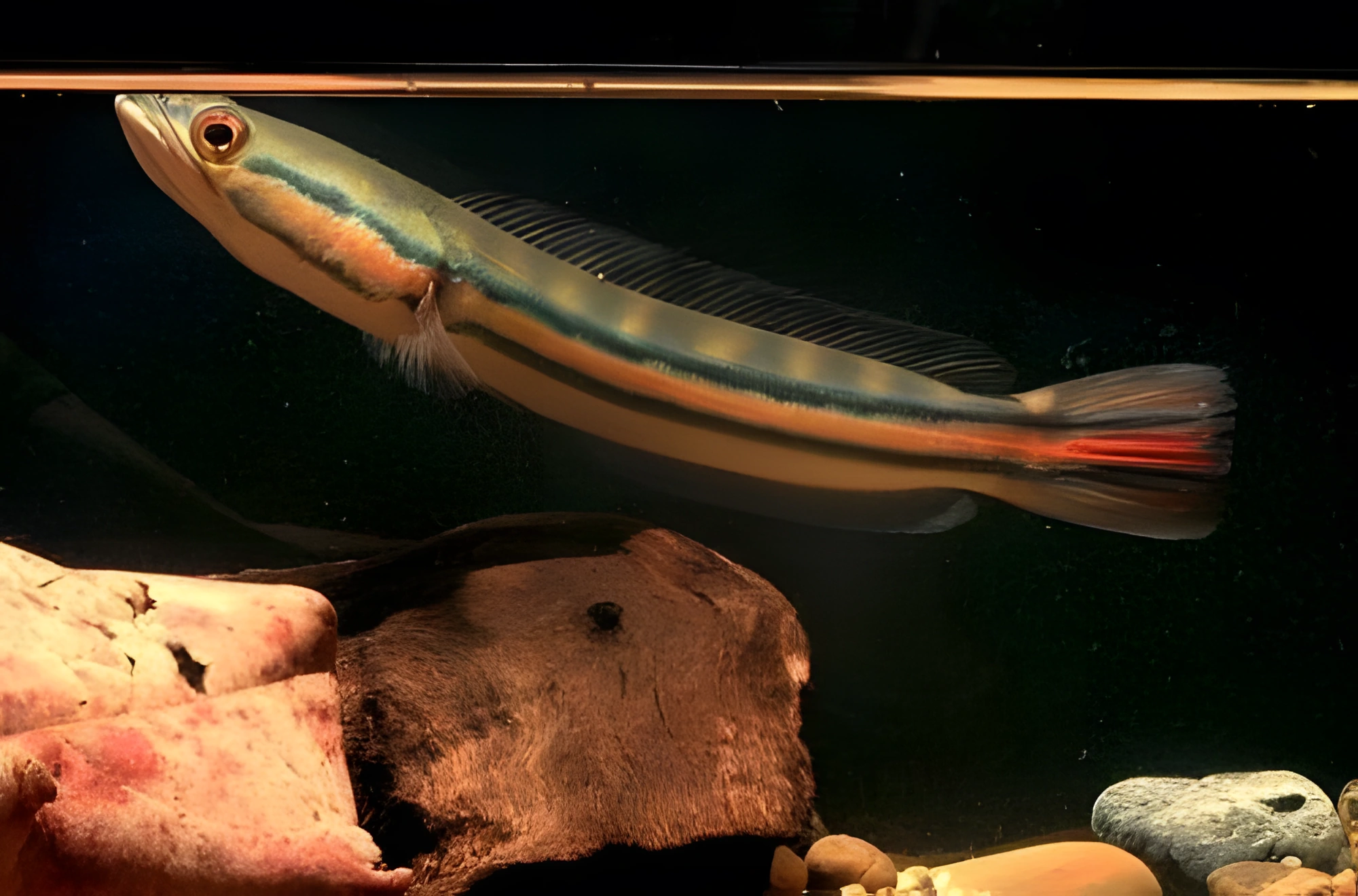
Adults of this fish impress with their size, reaching up to 130 cm in length and weighing up to 20 kg. They have an elongated, snake-like body and a large head with a wide mouth full of sharp teeth. The coloration of young fish is strikingly bright: fry are almost entirely red. As they grow, individuals acquire a pattern consisting of two narrow black stripes, between which runs a wide red stripe. Over time, as they mature, this striped pattern disappears, and the red pigment on the tail is lost last. Adult snakeheads have a brown back and sides with a greenish pattern resembling slight water ripples, while their belly is light and silvery. Members of the genus Channa have adapted to life in adverse conditions, such as drying up bodies of water or oxygen deficiency. They are capable of breathing atmospheric air and can remain out of water for extended periods if protected from direct sunlight, for example, by hiding in mud, silt, or burrows. They can also travel short distances over land, crawling from one body of water to another.
Habitat
The natural habitats of this fish cover vast areas of Southeast Asia, extending from the river systems of Laos and Thailand to the islands of Indonesia, including the Greater Sunda Islands. It is found in main river channels, swamps, lakes, and artificial bodies of water such as ponds and reservoirs. It prefers deep areas with slow currents or stagnant water.
Behavior and Compatibility
Young individuals live in large schools, but upon reaching sexual maturity, they begin to lead a solitary lifestyle and show aggression towards their conspecifics. Being a predatory species, this fish is compatible only with other fish of similar size that it will not perceive as food.
Care and Maintenance
Red Snakeheads are typically supplied at a young age, while their vibrant coloration is fully preserved. Beginner aquarists often make the mistake of placing small fish in relatively small aquariums, not considering the potential maximum size of adult individuals. When the fish grows, simultaneously losing its distinctive body pattern, and becomes cramped, the aquarist faces a problem that requires a solution. Quite often, the Snakehead is released into the wild. Such irresponsible behavior has already led to the appearance of the Red Snakehead in regions significantly distant from its natural range, including North America. Although it has not established itself everywhere due to climatic features, in some places it becomes a dominant predator, causing serious damage to the local ecosystem. If you plan to acquire this species, a spacious tank of at least 1000 L will be absolutely necessary for long-term keeping. It is recommended to create a shaded aquarium with plenty of hiding places formed by rocks, driftwood, and other decorative elements. This species is considered hardy, capable of adapting to significant changes in the environment. In aquarium conditions, it can exist in a wide range of pH and GH values, showing no sensitivity to water oxygen content and moderate levels of natural pollution. The presence of a lid or other protective device is essential when keeping the Red Snakehead to prevent its 'escape' from the aquarium. Since the fish breathes atmospheric air, it is necessary to provide air space between the lid and the water surface. Aquarium maintenance is standard: it includes regular cleaning of the substrate from organic waste (food remnants, excrement), partial water changes with fresh water, and equipment maintenance. This is a predatory fish that eats anything it can swallow. In nature, its diet consists of smaller fish, amphibians, insects, their larvae, and other invertebrates. In home conditions, they can be accustomed to alternative foods such as pieces of fish meat, mussels, shrimp, earthworms, large bloodworms, and the like. Sources: FishBase, Wikipedia, SeriouslyFish.
Diet
This species is a predator and feeds on anything it can swallow. In natural conditions, its diet consists mainly of smaller fish, amphibians, insects, as well as their larvae and other invertebrates. In home aquariums, these fish can be accustomed to alternative types of food, such as pieces of fish meat, mussels, shrimp, earthworms, or large bloodworms.
Breeding and Reproduction
Breeding in home conditions is extremely difficult due to the giant size of the fish and the need for enormous volumes of water. Individuals reach sexual maturity at about two to four years of age. Spawning is paired, often stimulated by an increase in water temperature to 27°C. In nature, fish build nests or lay eggs among vegetation, which the parents care for. Fry require abundant feeding with plankton and live foods, and the male may guard the offspring for several weeks.
Diseases
The Red Snakehead is sensitive to water quality and the accumulation of organic waste, which often leads to bacterial infections, fin damage, and skin diseases. Ectoparasite infestations, such as flukes, are common and require specific treatment. Poor filtration and high levels of nitrogenous compounds provoke stress and reduce immunity. Prevention involves maintaining stable water parameters, regular water changes, and avoiding feeding live fish from dubious sources, which are often carriers of parasites.
How to choose
When purchasing, choose active individuals with clean skin, free of visible ulcers, film, or fin damage. It is important to assess their behavior: a healthy fish shows curiosity, has a good appetite, and even breathing. Avoid specimens with sunken bellies, cloudy eyes, or unnaturally sluggish behavior. Given the aggressive nature of the species, it is advisable to ensure in advance that conditions are suitable for keeping an adult specimen, as these fish grow very quickly and require significant space.
Frequently asked questions
The essentials: size, tank volume, water parameters and care
How big does Red Snakehead get?
An adult reaches 130 cm in length. Plan the tank around the maximum size: the fish quickly outgrows a cramped setup.
What size aquarium does Red Snakehead need?
The minimum recommended volume is 1000 L. A smaller tank speeds up nitrate build-up and raises stress levels.
What water parameters does Red Snakehead need?
Temperature 20–30 °C, pH 6–8, hardness 3–20 dGH. Stability matters more than exact values: sudden swings are harder on the fish than a small deviation from the ideal.
How long does Red Snakehead live?
Around 12 years when kept properly. Lifespan depends directly on tank volume, water quality and a varied diet.
Is Red Snakehead aggressive?
Temperament: aggressive / incompatible / unfriendly. This is a predatory species — any fish small enough to fit in its mouth will eventually be eaten.
How many Red Snakehead should be kept together?
Recommended setup: solitary + other species (large / compatible). Ignoring this is a common cause of stress and disease.
What does Red Snakehead eat?
Diet type: meat / protein (live, frozen, fresh). Feed small portions that are finished within a couple of minutes — overfeeding does more harm than underfeeding.
What is the scientific name of Red Snakehead?
The scientific name of the species is Channa micropeltes, family Snakeheads (Channidae). It also appears in the literature as: Channa micropeltis, Ophicephalus bivittatus, Ophicephalus micropeltes.