Temperature21 – 26 °C
Natural range
- Lake Nicaragua area
- Lake Managua area
Cichlids
The Red Devil Cichlid, or Amphilophus labiatus, belongs to the Cichlidae family. This species attracts attention with its exotic appearance and vibrant coloration, as well as its ease of care and undemanding diet, complemented by significant hardiness. Nevertheless, its substantial drawback remains its extremely pronounced aggression, which is even reflected in its common name, "devil."
- Required aquarium volume
- 350 L
- Size in aquarium
- 30 – 35 cm
- Temperature
- 21 – 26 °C
- Temperament
- Aggressive / incompatible / unfriendly
Parameters
Water pHSlightly acidic (6) – Slightly alkaline (8)
Water dHSoft (5) – Very hard (26)
Water salinityno salt (freshwater)
Size in aquarium30 – 35 cm
Lifespan12 years
TemperamentAggressive / incompatible / unfriendly
Toward small fishnot a predator
Required aquarium volume350 L
Lightingmoderate (regular)
Substraterocky (rock formations, boulders, etc.)
Water flowweak or moderate
FeedingAny (universal)
CareSolitary
Description
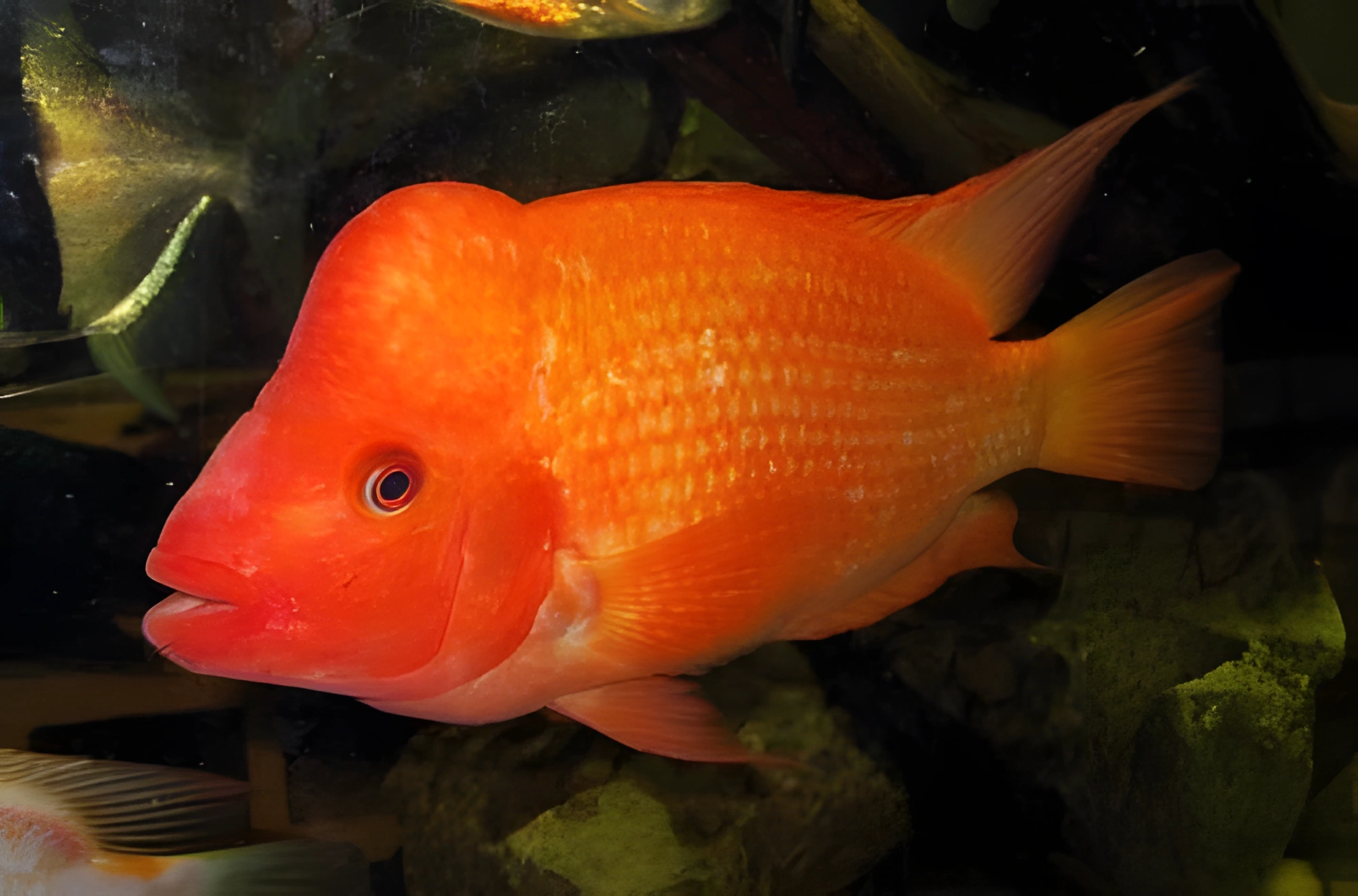
Adults of this fish can reach 35 cm in length. Males are usually larger and have a characteristic nuchal hump that distinguishes them from females. Their dorsal and anal fins are elongated and pointed. The cichlid's coloration varies from light, whitish-yellow, to bright orange.
Habitat
This species is endemic to Lake Nicaragua and Lake Managua, located in modern-day Nicaragua in Central America. These are tectonic lakes, connected by the Tipitapa River. Amphilophus labiatus prefers to inhabit rocky shores, finding shelter among crevices. It is important to note that Lake Nicaragua is the largest freshwater body in Latin America, remarkable for being the only place in the world where sharks are found.
Behavior and Compatibility
This cichlid is considered one of the most aggressive among its relatives, attacking not only representatives of other fish species but also its own kind. Such clashes often end in the death of the weaker individual. Coexistence is possible only in aquariums with a volume of 1000 L or more. As tankmates, one should choose fish significantly larger in size that will not be easily intimidated, or large, well-protected catfish. For the amateur aquarist, the optimal solution is to keep this fish species in a species-specific tank.
Care and Maintenance
For comfortable keeping of a single adult, an aquarium of at least 350 L is needed. In decorating the aquarium, preference is given to large stones, rock fragments, and gravel substrate. Live plants are not essential; artificial ones can be used if desired. All internal decor should be securely fastened, and equipment should be hidden if possible, so that the large fish does not accidentally damage it. The aquarium must be equipped with a secure lid, as despite its size, the Red Devil is capable of jumping. Water parameters such as pH and dGH have a wide acceptable range of values, which simplifies water preparation. The main difficulties are related to maintaining high water quality. Filtration and aeration systems must be powerful enough to process organic waste and ensure a high level of dissolved oxygen. Weekly water changes of 20–25% of the volume with fresh water are mandatory.
Diet
These cichlids are completely undemanding in terms of diet, eagerly consuming anything that fits into their mouths, including smaller fish. In a home aquarium, their diet should primarily consist of frozen, fresh, or live foods such as earthworms, pieces of snails and other mollusks, and shrimp. It is important to include vegetable supplements in the diet: peas, spinach, and so on. Specialized foods for large Central American cichlids offered by some manufacturers can be an excellent alternative.
Breeding and Reproduction
The breeding process of the Red Devil itself is quite simple: during the breeding season, the fish perform all necessary actions independently, without requiring special conditions or a preliminary diet. The main difficulty lies in their incompatibility with each other; it is extremely difficult to form a breeding pair in home conditions. Due to their large size and aggressive behavior, Amphilophus labiatus are often kept singly; if a male is placed in the same tank as a female, the latter may soon die. There are several ways to obtain offspring in an artificial environment, but none of them guarantee 100% success. The first method: a male and a female from different aquariums are placed in one, separated by a transparent perforated partition. There is a small chance that after several weeks the male will get used to the female and reduce his aggression, which may lead to the formation of a temporary pair. The second method: initially, about 6 young individuals are acquired and grown together. As they mature, one pair may naturally form, capable of regularly producing offspring thereafter. The chances of pair formation increase proportionally to the number of young fish kept together; however, this is not typical for amateur aquaristics. Ultimately, it is better to acquire this species from professional breeders rather than attempting to breed them independently.
Diseases
The main cause of most diseases in Leaf Fish is unsuitable keeping conditions and poor-quality nutrition. If initial symptoms are observed, it is first necessary to check water parameters and the concentration of dangerous substances such as ammonia, nitrites, and nitrates. If the indicators deviate from the norm, they should be brought back into order, and only then should treatment begin. More detailed information on symptoms and treatment methods can be found in the "Aquarium Fish Diseases" section.
How to choose
When selecting individuals, attention should be paid to activity and the absence of visible damage, such as ulcers, film, or fin erosion. Due to the species' high territoriality, fish are often kept singly in stores, so it is important to assess their reaction to a person's approach: a healthy fish shows curiosity or pronounced aggression, not apathy. It is recommended to avoid purchasing specimens with signs of emaciation or a sunken abdomen.
There is a risk of confusion with the closely related species Amphilophus citrinellus, as both species are often sold under the same name. When purchasing, it is advisable to clarify the fish's origin, as adult individuals adapt extremely poorly to changes in conditions and may show increased aggression towards new tankmates or the owner when stressed.
Frequently asked questions
The essentials: size, tank volume, water parameters and care
How big does Red Devil get?
An adult reaches 30–35 cm in length. Plan the tank around the maximum size: the fish quickly outgrows a cramped setup.
What size aquarium does Red Devil need?
The minimum recommended volume is 350 L. A smaller tank speeds up nitrate build-up and raises stress levels.
What water parameters does Red Devil need?
Temperature 21–26 °C, pH 6–8, hardness 5–26 dGH. Stability matters more than exact values: sudden swings are harder on the fish than a small deviation from the ideal.
How long does Red Devil live?
Around 12 years when kept properly. Lifespan depends directly on tank volume, water quality and a varied diet.
Is Red Devil aggressive?
Temperament: aggressive / incompatible / unfriendly. Keep this in mind when choosing tank mates.
How many Red Devil should be kept together?
Recommended setup: solitary. Ignoring this is a common cause of stress and disease.
What does Red Devil eat?
Diet type: any (universal). Feed small portions that are finished within a couple of minutes — overfeeding does more harm than underfeeding.
What is the scientific name of Red Devil?
The scientific name of the species is Amphilophus labiatus, family Cichlids.