Temperature18 – 23 °C
Natural range
- Northern India area
- Bangladesh area
CyprinidsConservation status: Least concern LC
Other scientific names: Barbus conchonius, Barbus conchonlus, Barbus pyrhopterus, Cyprinus conchonius, Puntius conchonius, Systomus conchonius
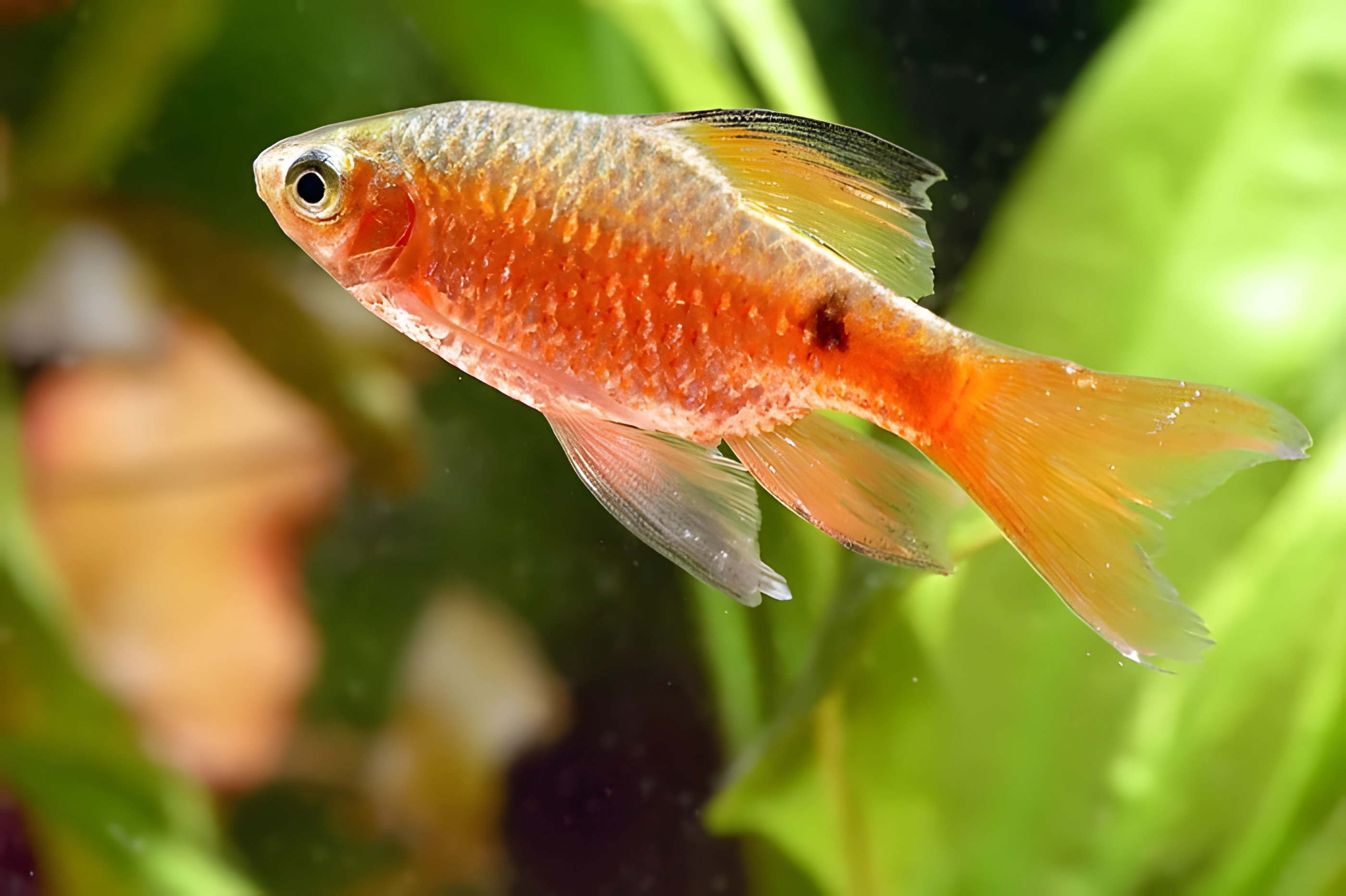
The Rosy Barb, scientifically known as Pethia conchonius, is a member of the Cyprinidae family. Its vibrant appearance is sure to catch the eye, and its high activity makes observing these fish a captivating experience, especially when kept in a large school.
- Required aquarium volume
- 80 L
- Size in aquarium
- 10 cm
- Temperature
- 18 – 23 °C
- Temperament
- Peaceful, active/mobile
Parameters
Water pHSlightly acidic (6) – Slightly alkaline (8)
Water dHSoft (5) – Very hard (19)
Water salinityno salt (freshwater)
Size in aquarium10 cm
Lifespan5 years
TemperamentPeaceful, active/mobile
Toward small fishnot a predator
Required aquarium volume80 L
Lightingmoderate (regular)
Substratesandy (regular, light)
Water flowmoderate
FeedingAny (universal)
CareSchooling (usually from 5–6 individuals and more)
Description
This fish has a large, robust body, ending in a forked caudal fin. A large dorsal fin is located on its back. The color palette depends heavily on the specific selective variety and can range from rich orange or red to delicate pale pink hues. The only constant feature is a black spot located near the tail, as well as a dark edging on the fins, the intensity of which increases during spawning.
Habitat
The Rosy Barb was first described in 1822 during the study of fauna in European colonies located in Southeast Asia. Today, populations of this species can be found in northern India and Bangladesh. Notably, the fish has successfully adapted after introduction to Australia, New Zealand, and some regions of South America, such as Puerto Rico and Colombia.
Behavior and Compatibility
Rosy Barbs are active schooling fish, requiring a group of at least 6 individuals. Males often engage in sparring, swimming close to each other with raised fins, displaying their coloration. However, they pose a threat to fish with long fins, as they instinctively try to nip them, as well as to slower-moving species. Therefore, suitable tank mates should be similarly sized and active fish with short fins.
Care and Maintenance
For successful keeping of these fish, high water quality and the presence of current are important conditions. These are provided by a productive filter and an aerator placed in the aquarium. Their operation creates the necessary water movement, and artificial current additionally stimulates the brightness of coloration in males. A heater is usually not needed, as room temperature is quite sufficient if it does not drop below 20°C. These active fish swim throughout the entire volume of the aquarium and can jump out during play, so a lid is essential. For decor, it is recommended to use a sandy substrate and create dense thickets of vegetation along the sides of the tank. Bogwood, specially prepared roots, and branches are excellent additional hiding places.
Diet
The Rosy Barb is an omnivorous species. Its diet can include live foods such as bloodworms or tubifex, as well as specialized dry mixes. There are many foods for barbs, including those that can enhance their coloration. These foods contain all the necessary trace elements, so additional feeding with live food is generally not required.
Breeding and Reproduction
The fish reaches sexual maturity at a length of 6 cm. The onset of the courtship period can be noticed by the bright coloration of the males and the rounded abdomen of the females, who appear noticeably paler than the males during this period. For spawning, one male and two females should be transferred to a separate tank. After a courtship ritual resembling a dance, the fish begin to lay eggs; one female can lay at least 100 eggs. After spawning, the parents are returned to the main aquarium. Fry hatch after just 30 hours. The separate spawning tank should have a minimum volume of 30 L with a water level of only 10–15 cm. The hydrochemical composition of the water should match the main aquarium, but the temperature should be slightly higher — 22–25°C. A substrate of coarse gravel will allow the eggs to fall between the particles, preventing them from being eaten. Both live and artificial plants can be used for decor. An aerator and a heater will be essential equipment.
Diseases
The Rosy Barb is highly resilient, so diseases are extremely rare when kept in optimal conditions. More detailed information on symptoms and treatment methods for diseases is presented in the "Aquarium Fish Diseases" section.
How to choose
When choosing Rosy Barbs, opt for active individuals that stay in a school and show interest in their surroundings. Avoid fish with signs of emaciation, damaged fins, whitish spots or film on the body, or individuals that isolate themselves at the surface or bottom.
- Check the condition of the scales: they should lie flat against the body without signs of ruffling.
- Ensure there are no visible parasites or ulcers on the skin and fins.
- Observe their behavior: healthy fish should be active and react to a person approaching the aquarium.
Frequently asked questions
The essentials: size, tank volume, water parameters and care
How big does Rosy Barb get?
An adult reaches 10 cm in length. Plan the tank around the maximum size: the fish quickly outgrows a cramped setup.
What size aquarium does Rosy Barb need?
The minimum recommended volume is 80 L. A smaller tank speeds up nitrate build-up and raises stress levels.
What water parameters does Rosy Barb need?
Temperature 18–23 °C, pH 6–8, hardness 5–19 dGH. Stability matters more than exact values: sudden swings are harder on the fish than a small deviation from the ideal.
How long does Rosy Barb live?
Around 5 years when kept properly. Lifespan depends directly on tank volume, water quality and a varied diet.
Is Rosy Barb aggressive?
Temperament: peaceful, active/mobile. Keep this in mind when choosing tank mates.
How many Rosy Barb should be kept together?
Recommended setup: schooling (usually from 5–6 individuals and more). Ignoring this is a common cause of stress and disease.
What does Rosy Barb eat?
Diet type: any (universal). Feed small portions that are finished within a couple of minutes — overfeeding does more harm than underfeeding.
What is the scientific name of Rosy Barb?
The scientific name of the species is Pethia conchonius, family Cyprinids (Cyprinidae). It also appears in the literature as: Barbus conchonius, Barbus conchonlus, Barbus pyrhopterus.