Temperature23 – 28 °C
Natural range
- Upper Amazon Basin
- Amazon rainforest area
- Brazil area
- Colombia area
CharacinsConservation status: Least concern LC
Other scientific names: Hemigrammus erythrostigma, Hyphessobrycon rubrostigma
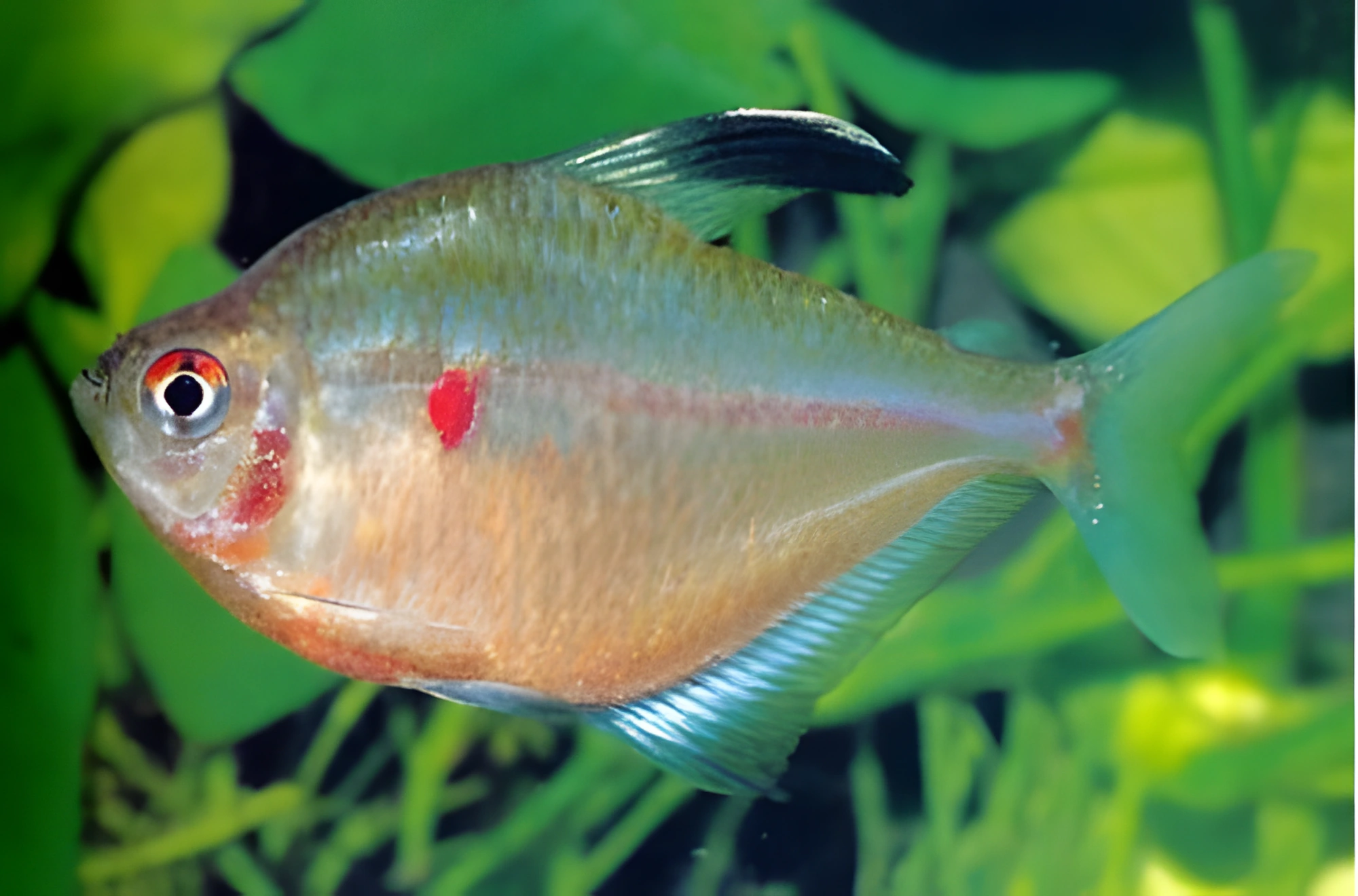
The Red-Spotted Tetra, also known as Rubrostigma or Ornate Red-Spotted Tetra (scientific name Hyphessobrycon erythrostigma), belongs to the Characidae family. This active, peaceful fish, distinguished by its unusual body pattern, is known as the "Bleeding Heart Tetra" in English-speaking countries due to its unique appearance.
- Required aquarium volume
- 60 L
- Size in aquarium
- 7 cm
- Temperature
- 23 – 28 °C
- Temperament
- Peaceful, active/mobile
Parameters
Water pHSlightly acidic (5.6) – Neutral (7.2)
Water dHSoft (5) – Hard (12)
Water salinityno salt (freshwater)
Size in aquarium7 cm
Lifespan10 years
TemperamentPeaceful, active/mobile
Toward small fishnot a predator
Required aquarium volume60 L
Lightingdimmed
Substratedark river sand and/or fine pebbles
Water flownone or stagnant (no flow)
FeedingAny (universal)
CareMedium group (6–8 individuals)
Description
The Red-Spotted Tetra has a high body, flattened laterally. Its appearance is notable for a long dorsal fin and a wide anal fin that extends from the middle of the belly to the base of the tail. The body coloration of this fish can vary from a delicate beige-orange to silvery. However, its most recognizable feature is a bright red spot on the body, resembling a small heart in shape. There is also a characteristic dark streak on the dorsal fin.
The male can be distinguished by wider dorsal and anal fins. His dorsal fin is slightly curved, resembling a sickle or an arch bending towards the tail, while in the female, this fin is noticeably shorter.
Habitat
The history of this fish's scientific description begins in 1943 when American zoologist Henry Fowler, while studying the fauna of the Amazon rainforest, first documented it. In their natural habitat, these fish can be found in the upper Amazon, in shallow streams and rivers where dense vegetation predominates. The water in such bodies of water usually has a dark brown tint, which is due to the decomposition of organic matter such as grass, fallen leaves, and other plant debris.
Behavior and Compatibility
These active and peaceful schooling fish prefer to be in the company of their own kind or with other Tetra species. It is recommended to keep them in a school consisting of at least 6 individuals. With fewer numbers, their activity may be directed towards other aquarium inhabitants, which can sometimes lead to fin damage to tank mates.
Care and Maintenance
These fish are highly resilient and successfully adapt to home aquarium conditions if the necessary water parameters are maintained. It is crucial to maintain stable water quality, as any sharp changes in its hydrochemical composition can negatively affect the Red-Spotted Tetra. It is recommended to refresh 25–50% of the water volume every two weeks, while carefully ensuring that the differences in temperature, pH, and dH levels between the old and new water match to within tenths of a degree. For example, water with a pH of 7.0 should not be added if the aquarium's pH is 5.0 or 6.0. Aquarium equipment will require a heater, a low-power lighting fixture, an aerator, and an efficient filter that returns water via a spray bar or another method that prevents excessive water movement. The fish prefer aquariums with dense plant thickets, dark river sand substrate, and various decorative elements such as driftwood, roots, and branches. Floating plants help create additional shade, as Tetras do not like bright lighting.
Diet
These fish readily accept all types of dry commercial foods, as well as both plant-based and meaty products. To ensure a balanced diet, it is recommended to use high-quality dry food (e.g., flakes, pellets), which should be supplemented with live or freeze-dried bloodworms. The inclusion of finely chopped spinach or lettuce in their diet is also welcome.
Breeding and Reproduction
Breeding this fish at home, although possible, is associated with certain difficulties. For this purpose, a separate spawning aquarium of at least 30 L should be prepared. Equipment will include a filter, an aerator, a heater, and low-power lighting. Water parameters in the spawning tank should be identical to those in the main aquarium. The decor should include dense plant thickets, including essential floating species, as well as dark sandy substrate. Increased feeding with meaty products stimulates the onset of courtship by males towards females, which can last from several days to several weeks, as females often ignore male attention. Do not wait for reciprocity from the female; the pair should be moved to a separate aquarium, and intensive feeding should continue while awaiting spawning. Females lay eggs on floating plants, where fertilization occurs, after which the parents are immediately returned to the main aquarium. Fry appear within five days and should be fed micro-food or finely crushed dry food (flakes, pellets). The greatest difficulty lies in daily water changes of 1/3 of the volume (maintaining identical composition of new and old water to within tenths of a degree) and careful removal of all uneaten food residues. This procedure must be repeated for two weeks until the fry reach a more mature age. However, even with optimal conditions, high survival is not guaranteed, and the vast majority of fry do not survive to adulthood.
Diseases
This fish is very sensitive to fluctuations in water parameters, and even insignificant changes can provoke the development of diseases such as Ichthyophthiriasis and "Velvet Disease." When favorable conditions are maintained, health problems usually do not arise.
How to choose
When choosing a Red-Spotted Tetra, carefully inspect the skin and fins for the absence of white film, ulcers, or signs of damage, as the species can be susceptible to fungal diseases. A healthy fish is active, stays in a school, and displays characteristic bright coloration, especially a pronounced red spot in the chest area and intensely colored eyes. Avoid individuals with clamped fins, rapid breathing, or an unnaturally swollen abdomen, which may indicate infections or internal organ problems. In the store, fish should be kept in clean water with good aeration; the presence of sick or deceased individuals in the aquarium is a strong reason to refuse to purchase the entire batch. If possible, clarify the keeping conditions at the point of sale, as a sharp change in water parameters during transfer can cause severe stress to the fish. Buy a school of 6–8 individuals, as solitary keeping negatively affects the behavior and overall health of this species.
Frequently asked questions
The essentials: size, tank volume, water parameters and care
How big does Rubrostigma get?
An adult reaches 7 cm in length. Plan the tank around the maximum size: the fish quickly outgrows a cramped setup.
What size aquarium does Rubrostigma need?
The minimum recommended volume is 60 L. A smaller tank speeds up nitrate build-up and raises stress levels.
What water parameters does Rubrostigma need?
Temperature 23–28 °C, pH 5.6–7.2, hardness 5–12 dGH. Stability matters more than exact values: sudden swings are harder on the fish than a small deviation from the ideal.
How long does Rubrostigma live?
Around 10 years when kept properly. Lifespan depends directly on tank volume, water quality and a varied diet.
Is Rubrostigma aggressive?
Temperament: peaceful, active/mobile. Keep this in mind when choosing tank mates.
How many Rubrostigma should be kept together?
Recommended setup: medium group (6–8 individuals). Ignoring this is a common cause of stress and disease.
What does Rubrostigma eat?
Diet type: any (universal). Feed small portions that are finished within a couple of minutes — overfeeding does more harm than underfeeding.
What is the scientific name of Rubrostigma?
The scientific name of the species is Hyphessobrycon erythrostigma, family Characidae. It also appears in the literature as: Hemigrammus erythrostigma, Hyphessobrycon rubrostigma.