Temperature20 – 27 °C
Natural range
- Southern Brazil area
- Paraguay area
CharacinsConservation status: Least concern LC
Other scientific names: Aphyocharax affinis, Aphyocharax ipacarayensis, Aphyocharax rubropinnis, Phoxinopsis typicus
The Red-Fin Tetra, also known as Aphyocharax with the scientific name Aphyocharax anisitsi, belongs to the family Characidae. Its first description was made by Eigenmann and Kennedy in 1903, following an expedition to South America. This fish has earned recognition from many aquarists not only for its attractive appearance but also for its amazing qualities — increased hardiness and unpretentiousness. It does not require meticulous care, making it an ideal choice for beginner aquarists.
- Required aquarium volume
- 80 L
- Size in aquarium
- 6 cm
- Temperature
- 20 – 27 °C
- Temperament
- Peaceful, active/mobile
Parameters
Water pHNeutral (7) – Slightly alkaline (8)
Water dHSoft (5) – Hard (15)
Water salinityno salt (freshwater)
Size in aquarium6 cm
Lifespan8 years
TemperamentPeaceful, active/mobile
Toward small fishnot a predator
Required aquarium volume80 L
Lightingdimmed or moderate
Substrateany, but dark
Water flowweak
FeedingAny (universal)
CareMedium group (6–8 individuals)
Description
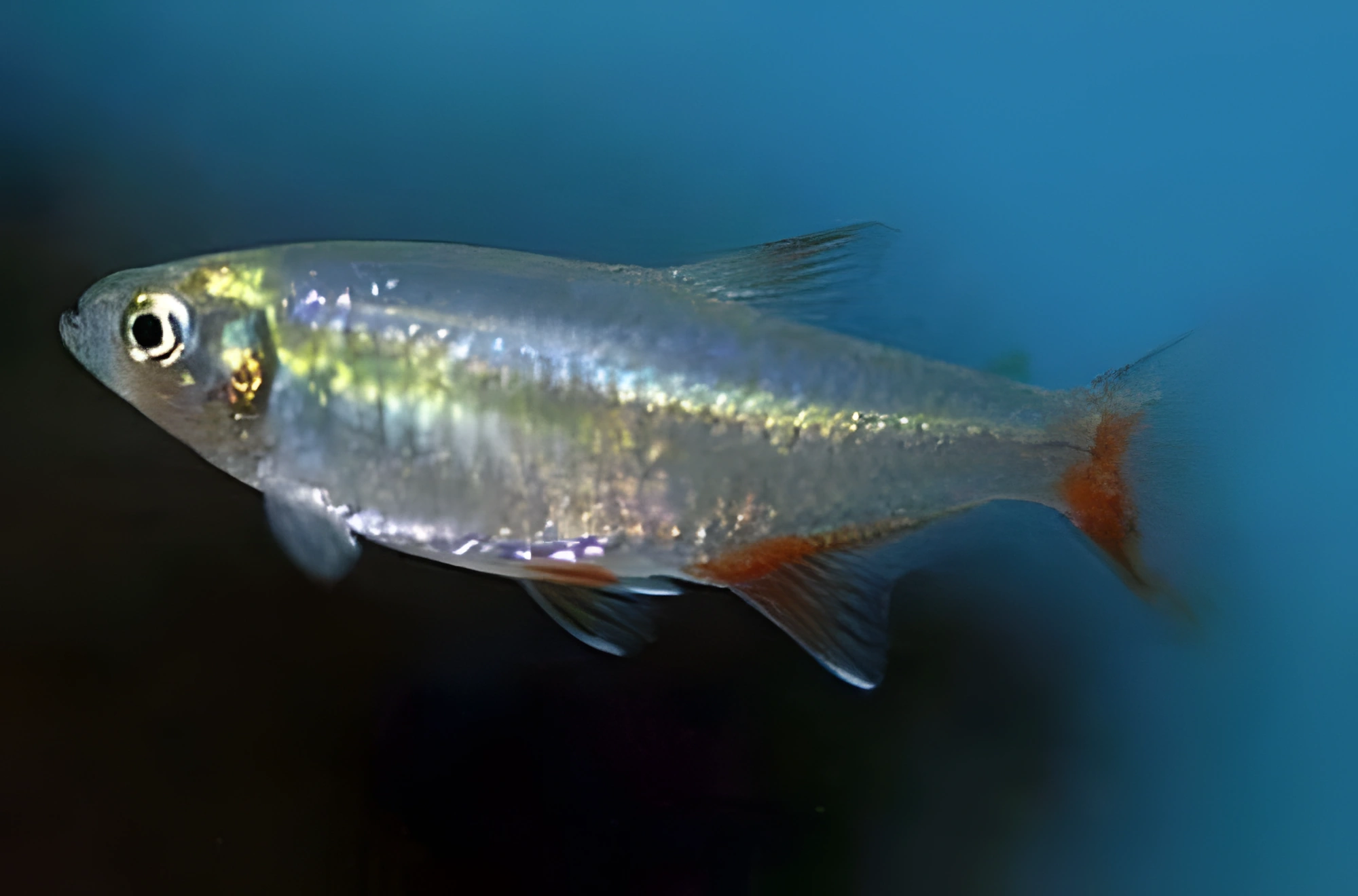
Adult specimens of this fish grow to almost 6 cm in length. Their coloration can vary from beige to silvery, often with a slight turquoise sheen. The most striking distinguishing feature of the species is its red fins and tail. A related species, Aphyocharax alburnus, has a similar body shape and coloration, but its fins are typically devoid of red hues, which nevertheless does not prevent them from often being confused.
Habitat
The natural habitat for this species is the Paraná River basin, extending through the southern regions of Brazil, Paraguay, and northern Argentina. In nature, the Red-Fin Tetra is found everywhere in various biotopes, but it particularly prefers areas with calm water, rich in dense aquatic vegetation.
Behavior and Compatibility
Representatives of this species are peaceful schooling fish, and it is recommended to keep them in groups of at least 6 individuals. With fewer numbers, they may become timid. During the breeding season, males show increased activity, chasing each other to establish a dominant position in the group. However, such activity remains within normal limits and does not escalate into true aggression. They coexist peacefully with other species of comparable size. Good compatibility is observed with other Tetras, small catfish, Corydoras, and Danios, among others.
Care and Maintenance
For a small school of 6–8 Red-Fin Tetras, an aquarium of 80 liters or more will be optimal. It is important to note that for the comfort of the fish, the width and length of the tank are more important than its depth. The decor can be anything, provided there is sufficient swimming space. These fish are known for their hardiness and unpretentiousness. In certain cases, they can even be kept in an unheated aquarium if the room temperature consistently stays above 22–23°C. They adapt well to a wide range of hydrochemical water parameters. Despite their general hardiness, it is important to remember that clean water is vital for all fish, so regular aquarium maintenance and an effective filtration system are essential conditions for their successful keeping.
Diet
In a home aquarium, the daily diet will consist of popular types of live, frozen, and dry foods of appropriate sizes. It is recommended to feed the fish several times a day, offering portions that will be completely eaten in approximately 3 minutes.
Breeding and Reproduction
For successful breeding, it is recommended to use a separate spawning tank of at least 40 liters, with water parameters identical to the main tank. The decor should include low-growing, fine-leaved plants evenly distributed across the substrate surface. An important feature is a high-domed aquarium lid – at least 20 centimeters above the water level. This is because fish may jump out of the water during spawning, but the eggs must fall back in. Fish can breed year-round. Increased feeding with high-protein foods signals the start of spawning. After just one week of such a diet, females become noticeably rounded with eggs. This is the ideal moment to move the females along with the strongest male partner into the prepared spawning tank. After spawning, the adult fish are returned to the community tank.
Diseases
Health problems in these fish are usually associated with physical injuries or keeping them in unsuitable conditions, which weakens their immune system and, as a result, contributes to the development of various diseases. At the first signs of symptoms, it is necessary first to test the water to rule out exceeding certain parameters or the presence of dangerous concentrations of toxic substances (such as nitrites, nitrates, ammonia). If deviations are found, all parameters should be brought back to normal, and only then should treatment begin. More detailed information on symptoms and therapy methods is available in the “Aquarium Fish Diseases” section.
How to choose
When purchasing, choose active, mobile individuals with clean scales and no visible fin damage. Avoid fish with pale coloration, signs of emaciation, or unnatural behavior, such as apathy or attempts to stay separate from the group. Note that males have hooks on their anal fin, which can get caught in a net when caught; to avoid injury, the net should be lowered into the water, and the fish allowed to free itself without force.
Frequently asked questions
The essentials: size, tank volume, water parameters and care
How big does Aphyocharax get?
An adult reaches 6 cm in length. Plan the tank around the maximum size: the fish quickly outgrows a cramped setup.
What size aquarium does Aphyocharax need?
The minimum recommended volume is 80 L. A smaller tank speeds up nitrate build-up and raises stress levels.
What water parameters does Aphyocharax need?
Temperature 20–27 °C, pH 7–8, hardness 5–15 dGH. Stability matters more than exact values: sudden swings are harder on the fish than a small deviation from the ideal.
How long does Aphyocharax live?
Around 8 years when kept properly. Lifespan depends directly on tank volume, water quality and a varied diet.
Is Aphyocharax aggressive?
Temperament: peaceful, active/mobile. Keep this in mind when choosing tank mates.
How many Aphyocharax should be kept together?
Recommended setup: medium group (6–8 individuals). Ignoring this is a common cause of stress and disease.
What does Aphyocharax eat?
Diet type: any (universal). Feed small portions that are finished within a couple of minutes — overfeeding does more harm than underfeeding.
What is the scientific name of Aphyocharax?
The scientific name of the species is Aphyocharax anisitsi, family Characidae. It also appears in the literature as: Aphyocharax affinis, Aphyocharax ipacarayensis, Aphyocharax rubropinnis.