Temperature24 – 28 °C
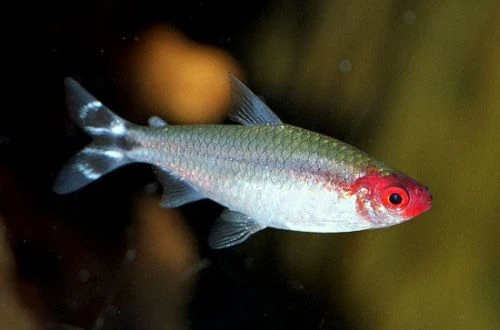
formerly Hemigrammus bleheri
Other scientific names: Petitella bleheri
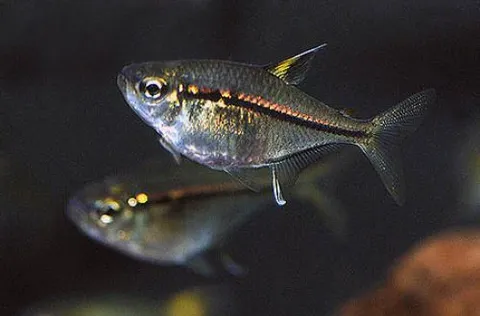
The Bleeding Heart Tetra, also known as the Rummy-nose Tetra (Petitella bleheri), belongs to the family Acestrorhamphidae. Its peaceful nature and availability have made it extremely popular among aquarists worldwide. This species is widely available in both large specialized stores and from private breeders.
This is a slender, miniature fish with expressive scales, whose length usually does not exceed 5 cm. A characteristic feature is the red pigmentation of the head, while the fish's body has a silvery hue, transitioning to a lighter shade on the belly. The caudal fin is adorned with alternating horizontal black and white stripes. Outwardly, it resembles its close relative, the True Rummy-nose Tetra (Petitella georgiae), with which it shares a similar coloration. However, the True Rummy-nose Tetra has less red pigment, which is limited to the head area and does not extend beyond the gill cover. The existence of the False Rummy-nose Tetra (Petitella bleheri), another distinct species, also similar in body coloration but distinguished by an elongated black stripe on the caudal peduncle, adds to the confusion.
The natural habitat of these fish is the upper tributaries of the Amazon River in South America, where the water often has a dark brownish tint due to high organic matter content. They prefer to stay in dimly lit areas of water bodies rich in natural shelters. Today, all specimens offered in pet stores are captive-bred, which eliminates adaptation problems.
These are peaceful, timid, and friendly schooling fish that are best suited to tank mates of similar temperament and small size. For comfortable existence, they should be kept in a school of at least 7–10 individuals. Exposure to external factors such as noise, loud sounds outside the aquarium, and the presence of overly active or restless tank mates can cause stress in Tetras. This manifests as a desire to hide or flee from potential threats, which can ultimately weaken their immune system.
The Bleeding Heart Tetra requires specific conditions for water purity and quality: it must be soft and acidic, with a minimal amount of pollutants. An optimal solution would be to install a filter with alder cone media, as they help to acidify the water. In addition, good aeration must be provided by placing several air stones in the aquarium. Other required equipment includes a heater and a low-power lighting system, as the fish are more comfortable in subdued light. For aquascaping, dense groups of plants are used, planted along the aquarium walls, while maintaining an open space in the central part for free swimming. River sand is suitable as a substrate, and decorative elements may include driftwood and roots. Adding a few dry leaves to the bottom helps to give the water a soft brownish tint; these should be replaced every two weeks.
The species is omnivorous, readily consuming both dry and frozen or live foods. To ensure a balanced diet, in addition to dry foods (granules or flakes), it is recommended to include protein-rich foods such as bloodworms or daphnia in their menu. It is important to ensure that the size of the food particles is small enough for the fish to easily ingest them.
Successful breeding is only possible using a separate tank, which will protect the fry, as adult fish are prone to eating their own eggs. A 40-liter tank is sufficient for a breeding aquarium. The equipment in it should preferably be similar to the main aquarium. For decoration, sandy substrate and fine-leaved plants are chosen. The onset of the breeding period can be stimulated by including protein-rich foods in the daily diet, as in the wild, an abundance of food signals the start of the breeding season. After two weeks of intensified feeding, the fish will be ready for transfer to a separate tank, but favorable conditions for this should be created in advance. During routine cleaning of the main aquarium, when some water is drained and replaced with fresh, the "old" water can be used to fill the breeding aquarium, supplemented with fresh water. This will ensure almost identical water parameters in both tanks, minimizing stress for the fish during transfer. When the male and female (the female will be noticeably larger due to an enlarged abdomen) are placed in a separate breeding tank, the female will eventually lay eggs either directly on the substrate or attach them to plant leaves. The male immediately fertilizes the eggs. Upon completion of spawning, the parents are returned to the main aquarium. Fry will appear on the second day and will begin free-swimming after 4 days, after which they should be fed micro-foods or Artemia nauplii.
Rummy-nose Tetras are susceptible to skin diseases if water parameters do not meet the necessary conditions. Hard water is extremely contraindicated, as it can provoke osmotic shock and rapid death.
When purchasing, choose active individuals that stay in a school and demonstrate synchronized movements. A healthy fish should have clean fins, no white spots or film on the body, and clear eyes. Avoid specimens with sunken bellies or signs of scale damage. Note that this species is extremely sensitive to transport and changes in water parameters. Transportation often causes severe stress to fish, so it is recommended to check with the seller in advance how long the fish has been in the store after arrival. Purchase specimens only for aquariums with an established biological balance, as the risk of death is extremely high in new systems.
The essentials: size, tank volume, water parameters and care
An adult reaches 5 cm in length. Plan the tank around the maximum size: the fish quickly outgrows a cramped setup.
The recommended volume is 70 L. A smaller tank speeds up nitrate build-up and raises stress levels.
Temperature 24–28 °C, pH 5–7, hardness 1–12 dGH. Stability matters more than exact values: sudden swings are harder on the fish than a small deviation from the ideal.
Around 5 years when kept properly. Lifespan depends directly on tank volume, water quality and a varied diet.
Temperament: peaceful (regular). Keep this in mind when choosing tank mates.
Recommended setup: group (8–10 individuals). Ignoring this is a common cause of stress and disease.
Diet type: any (universal). Feed small portions that are finished within a couple of minutes — overfeeding does more harm than underfeeding.
The scientific name of the species is Petitella bleheri, family Acestrorhamphidae. It also appears in the literature as: Petitella bleheri.
Matched by family, categories and overlapping keeping conditions
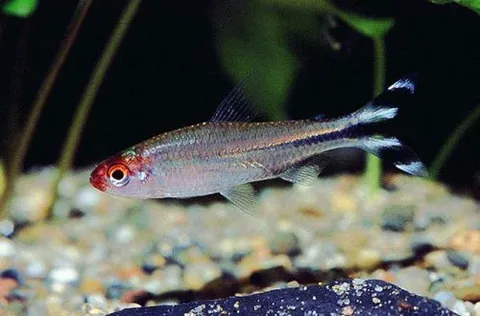
Petitella georgiae
A member of the Acestrorhamphidae family, Petitella georgiae, is scientifically known as the “False Rummy-Nose Tetra” or “False Rummy-Nose.” As its name suggests, this fish bears a striking resemblance to two closely…
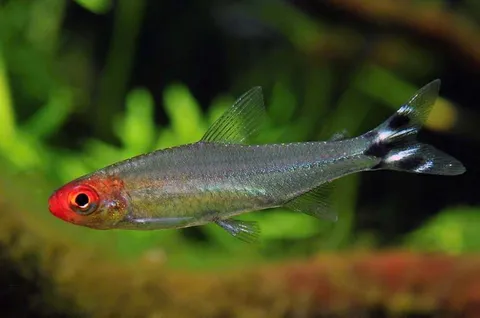
Petitella rhodostoma
The Rummy-nose Tetra, also known by its scientific name Petitella rhodostoma, belongs to the family Acestrorhamphidae. This fish deservedly enjoys popularity because it is quite undemanding, easily coexists with many…
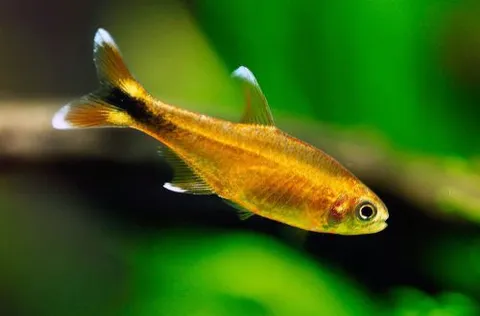
Hasemania nana
The Copper Tetra, also known as Hasemania (scientific name — Hasemania nana), belongs to the family Acestrorhamphidae. This fish is considered an excellent choice for a community tank. Its popularity is due to its…
Hemigrammus ulreyi
Hemigrammus ulreyi, known as Ulrey's Tetra, belongs to the family Acestrorhamphidae. This species is an unpretentious and peaceful fish that easily adapts to a community of other aquarium inhabitants of similar size and…