Temperature22 – 24 °C
Natural range
- Inle Lake area
- Shan State
CyprinidsConservation status: Endangered EN
The Red-Nosed Rasbora, also known as Sawbwa (scientific name Sawbwa resplendens), belongs to the family Cyprinidae. This unique species inhabits only one mountain lake in eastern Burma, Southeast Asia. High demand in the tropical fish market has led to this species being on the verge of extinction in its natural habitat and listed in the Red Book. Fish entering the retail network are typically descendants of several aquarium generations, while some individuals may be caught directly from the wild. Due to this, they have specific requirements for keeping conditions and feeding, and are therefore not recommended for beginner aquarists.
- Required aquarium volume
- 70 L
- Size in aquarium
- 2.5 – 5 cm
- Temperature
- 22 – 24 °C
- Temperament
- Peaceful, active/mobile
Parameters
Water pHNeutral (7) – Slightly alkaline (8)
Water dHMedium hardness (9) – Very hard (19)
Water salinityno salt (freshwater)
Size in aquarium2.5 – 5 cm
Lifespan5 years
TemperamentPeaceful, active/mobile
Toward small fishnot a predator
Required aquarium volume70 L
Lightingmoderate (regular)
Substrateany, but dark
Water flowvery weak
FeedingMixed diet (meat + plant-based)
CareSchooling (usually from 5–6 individuals and more)
Description
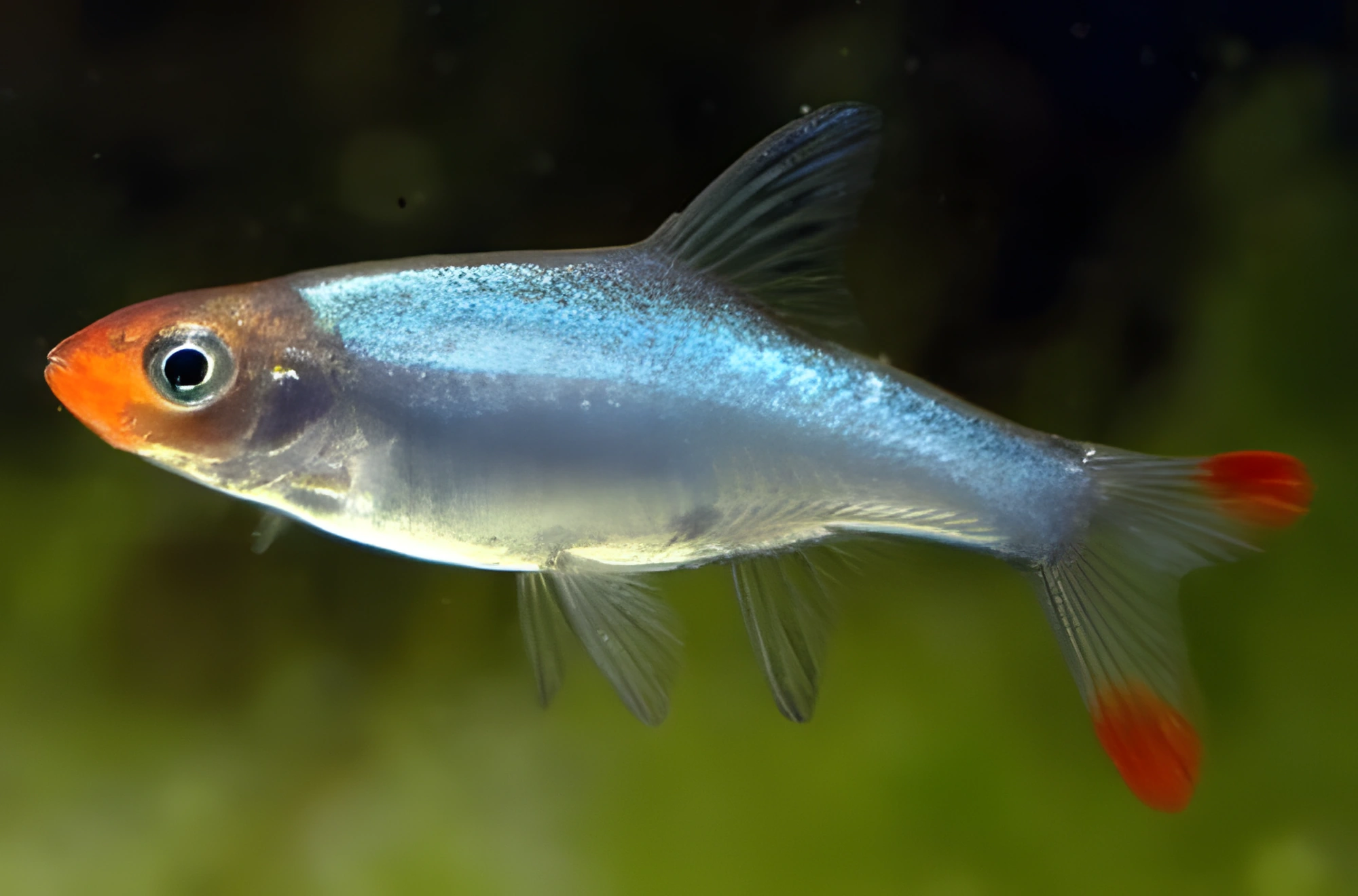
This very small fish has a graceful, slender body, usually not exceeding 2.5 cm in length. Males are distinguished by the bright orange or red coloration of their head and tail, while their body has a milky-blue hue. In contrast, females are more monochromatic, lacking bright colors; their color varies from silvery to light olive, and their fins are transparent. It is worth noting that the Red-Nosed Tetra from South America has a similar coloration, but these are completely different species that evolved independently on different continents.
Males differ from females in head coloration — it is orange or red — and are also typically larger in size.
Habitat
In 1918, researchers discovered the Red-Nosed Rasbora in Southeast Asia, in the territory of modern Shan State in Burma. In the wild, this fish inhabits the unique mountain Lake Inle and its adjacent swamps, located at an altitude of over 900 meters above sea level. The lake is shallow — only 2–3 meters deep, its surface adorned with “islands” formed by dense intertwining vegetation. These islands serve as shelter and a food source for the fish, which gather in small schools and prefer to stay near such “islands” or along the shoreline, where there is abundant submerged vegetation, such as grass or reeds. During the wet season, the water level in the lake rises, and the fish migrate to nearby bodies of water. Their diet consists of small invertebrates, algae, and various types of zooplankton.
Behavior and Compatibility
This peaceful species will never be a source of problems in the aquarium. Only other miniature fish are allowed as tank mates. Even calm species larger than 4 cm can cause stress to Rasboras. It is essential to keep them in a school of at least 8 individuals, with the number of males being significantly less than females; an optimal ratio is considered to be 4 females per 1 male to avoid intraspecific skirmishes.
Care and Maintenance
Fish are sensitive to water pollution, so an effective filtration system and regular substrate cleaning are essential. It is recommended to change at least half of the water volume monthly. It is advisable to use two heaters — a primary and a backup — to prevent sharp fluctuations in water temperature in case one fails. Rasbora has a narrow temperature range, outside of which it quickly perishes. The aquarium design should mimic its natural habitat: fine sand as a substrate, dense groups of broad-leaved plants arranged to leave enough open swimming space. Floating plants create additional hiding places and dim the light. It is important to avoid using wooden elements, such as snags or branches, as they can release tannins, which these fish do not tolerate.
Diet
Breeding Sawbwa in captivity has only recently been successfully mastered; previously, these fish were predominantly caught in the wild. For this reason, they are still poorly acclimated to aquarium conditions and do not always readily accept dry commercial foods, although these can provide a balanced diet. It is recommended to offer live foods, such as daphnia, cyclops, or small bloodworms, in combination with a small amount of high-quality dry food containing vegetable additives (e.g., crushed flakes or pellets).
Breeding and Reproduction
For breeding, a separate tank will be required, where the future parents will be transferred. A tank of at least 10 liters in volume is suitable, with marbles at least 1 cm in diameter or similar gravel laid on the bottom. Dense thickets of fine-leaved plants are necessary; artificial plants are acceptable, as the water temperature significantly drops during spawning, which not all plants can survive. Equipment needed includes a filter, aerator, and thermometer; a heater will not be necessary. Spawning occurs in February, so in late January, the fish should be fed heavily with meaty food. The male with the brightest coloration and several females with noticeably swollen bellies are transferred to a separate tank, where over 2–3 days, the water temperature is gradually lowered to 15–18°C, and the water hardness should be at least 20 dH (medium hardness). If the room temperature exceeds 18°C, the water can be cooled using a bag of cold tap water, which, tightly tied, is submerged in the tank to gradually lower the temperature. This way, the necessary temperature can be maintained. Spawning will begin within two weeks: the female will start laying eggs in the plant thickets, and the male will fertilize them. It is important that the fish are well-fed so that they do not eat their eggs. After spawning is complete, the fish are returned to the main aquarium. To avoid temperature shock, they should be placed in a plastic bag filled with water from the spawning tank, tied, and placed in the main aquarium to equalize the temperature, and only then can they be released. Fry appear after one day; for the first week, they feed on the remnants of the yolk sac, and then they are able to consume micro-food.
Diseases
Red-Nosed Rasbora quickly falls ill if water quality deteriorates; various diseases are possible, as described in detail in the section "Diseases of Aquarium Fish." However, with optimal keeping conditions and good nutrition, health problems generally do not arise.
How to choose
When selecting individuals, attention should be paid to their activity and the integrity of their skin, as this species lacks scales, making them vulnerable to mechanical damage and infections. A healthy fish should exhibit natural schooling activity for the species, rather than hiding in a corner or near the surface. Avoid purchasing fish with signs of emaciation, sunken bellies, or cloudy spots on the body, which may indicate bacterial diseases or protozoan infections. An important indicator of condition is the brightness of their coloration: males should have clearly defined red noses and tail tips, and paleness often indicates severe stress or improper keeping conditions in the store.
Frequently asked questions
The essentials: size, tank volume, water parameters and care
How big does Red-Nosed Rasbora get?
An adult reaches 2.5–5 cm in length. Plan the tank around the maximum size: the fish quickly outgrows a cramped setup.
What size aquarium does Red-Nosed Rasbora need?
The minimum recommended volume is 70 L. A smaller tank speeds up nitrate build-up and raises stress levels.
What water parameters does Red-Nosed Rasbora need?
Temperature 22–24 °C, pH 7–8, hardness 9–19 dGH. Stability matters more than exact values: sudden swings are harder on the fish than a small deviation from the ideal.
How long does Red-Nosed Rasbora live?
Around 5 years when kept properly. Lifespan depends directly on tank volume, water quality and a varied diet.
Is Red-Nosed Rasbora aggressive?
Temperament: peaceful, active/mobile. Keep this in mind when choosing tank mates.
How many Red-Nosed Rasbora should be kept together?
Recommended setup: schooling (usually from 5–6 individuals and more). Ignoring this is a common cause of stress and disease.
What does Red-Nosed Rasbora eat?
Diet type: mixed diet (meat + plant-based). Feed small portions that are finished within a couple of minutes — overfeeding does more harm than underfeeding.
What is the scientific name of Red-Nosed Rasbora?
The scientific name of the species is Sawbwa resplendens, family Cyprinids (Cyprinidae).