Temperature22 – 27 °C
Natural range
- Mekong River Basin
- Chao Phraya River Basin
- Mun River Basin
- Thailand area
CyprinidsConservation status: Least concern LC
Other scientific names: Barbodes altus, Barbodes foxi, Barbus altus, Barbus foxi, Puntius altus, Puntius bocourti
The Red-tailed Barb, scientifically known as Barbonymus altus, is a member of the Cyprinidae family. This hardy fish, capable of reaching 20 cm in length, fits perfectly into large aquariums. It is often chosen for office and business interiors because it is highly visible and does not require complex care, becoming a harmonious element of the decor.
- Required aquarium volume
- 380 L
- Size in aquarium
- 20 cm
- Temperature
- 22 – 27 °C
- Temperament
- Peaceful, active/mobile
Parameters
Water pHSlightly acidic (6) – Neutral (7)
Water dHVery soft (2) – Medium hardness (10)
Water salinityno salt (freshwater)
Size in aquarium20 cm
Lifespan10 years
TemperamentPeaceful, active/mobile
Toward small fishnot a predator
Required aquarium volume380 L
Lightingmoderate or bright
Substratesandy (regular, light)
Water flowmoderate
FeedingAny (universal)
CareSmall group (5–6 individuals)
Description
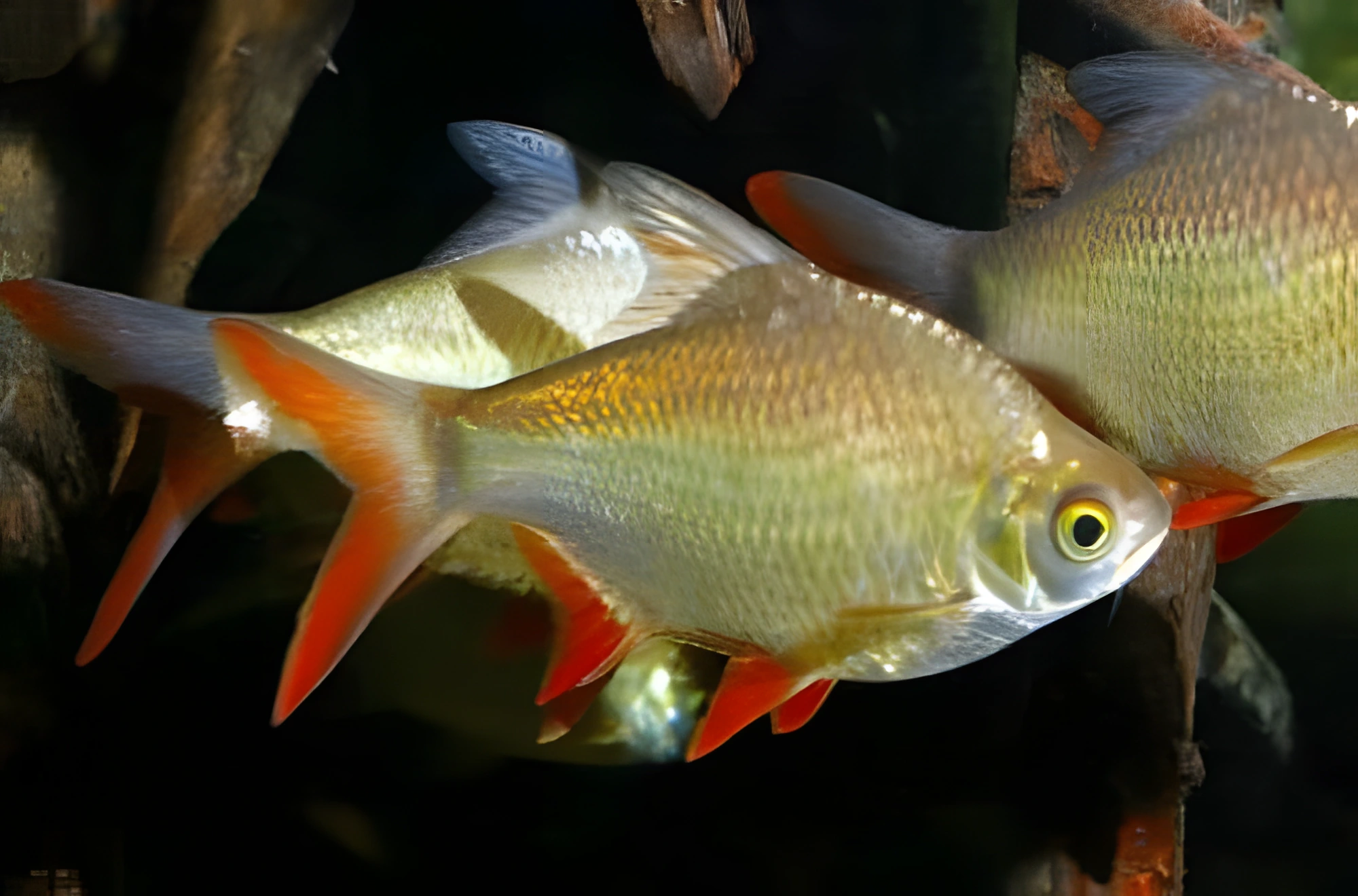
The barb has a large body, up to 20 cm, compressed laterally, with a rather high back and a distinct forked caudal fin. The main natural coloration is usually silvery or golden-yellow. All fins, including the caudal fin, are characterized by a distinctive red color. Adult specimens often have a black mark on the dorsal fin in the form of a line or spot along the edges.
Habitat
The origin of the Red-tailed Barb is associated with Southeast Asia, where it inhabits the basins of rivers such as the Mekong, Chao Phraya, and Mun, flowing through modern-day Thailand, Vietnam, Laos, and other countries. These cyprinid fish prefer medium and large rivers, moving in the water column, but they can also be found in streams and drainage ditches near human settlements. During the rainy season, individuals migrate to flooded forests and fields, where they actively feed and spawn, after which they return to the rivers. As water levels decrease, the newly hatched fry also join the rivers. In its natural habitat, the barb is omnivorous, consuming almost anything that can fit into its mouth: algae, plant debris, insects, invertebrates, and small fish. Near human habitation, their diet is supplemented by waste entering the water.
Behavior and Compatibility
The Red-tailed Barb is an active fish that thrives in the company of its own kind. Although it does not exhibit aggressive behavior, it should be noted that the barb may perceive smaller tank mates as a food source, so they should be avoided. It is also not recommended to keep them with slow-moving or timid fish, as the constant activity of barbs can cause them excessive stress. It is best to choose tank mates of similar size and temperament. It is recommended to keep these fish in a group of at least 5 individuals, otherwise their behavior may change: they may either become aggressive or become shy and timid.
Care and Maintenance
For successful keeping of this fish, a spacious aquarium of at least 400 liters is required. Given the significant amount of waste produced by these inhabitants, it is necessary to provide a powerful filtration system, for example, using an external canister filter, as internal filters may not be effective enough. Regular water changes are desirable – at least twice a month, changing at least a quarter of the volume at a time. In the aquarium decor, preference should be given to strong and stable decorations to exclude the possibility of damage by the fish. Large plant species with strong root systems and stiff leaves are suitable. Sand, supplemented with smooth stones and pebbles, is recommended as a substrate, and various snags or pieces of wood are perfect for creating a natural environment.
Diet
These fish are omnivorous and readily accept a variety of foods: live, frozen, vegetable, and commercial dry foods. For the best diet, it is recommended to combine dry foods with meaty products such as bloodworms, tubifex, earthworms, or pieces of shrimp. It is important to include vegetable supplements in the diet at least three times a week; these can be chopped lettuce or spinach leaves, as well as dry vegetable pellets. It is sufficient to feed the fish once a day, but it is necessary to ensure that all food is eaten within five minutes and any leftovers are removed.
Breeding and Reproduction
Breeding fish of this size at home is quite problematic, and, as a rule, aquarists rarely attempt such endeavors. Successful rearing of these fish is carried out in specialized commercial nurseries, from which the fry are then supplied to retail networks.
Diseases
These fish are highly resilient, and under favorable conditions, disease outbreaks are very rare. More detailed information on symptoms and treatment methods can be found in the "Diseases of Aquarium Fish" section.
How to choose
When choosing a Red-tailed Barb, it is important to exercise caution, as juveniles of this species are often sold together with the closely related Tinfoil Barb (Barbonymus schwanefeldii). The latter grows significantly larger, making its keeping in most home aquariums impossible. The main difference lies in the fin coloration: a healthy Red-tailed Barb has uniformly red fins without dark streaks or stripes, while the Tinfoil Barb has a distinct black edge on its caudal fin lobes.
When inspecting in the store, prefer active specimens with clean scales and no visible damage or signs of emaciation. Since fish of this species tend to be timid when changing environments, avoid individuals that appear overly lethargic or have head injuries, which often occur from hitting the aquarium glass when stressed. It is recommended to purchase a group of 5–6 individuals, as solitary keeping negatively affects the fish's behavior and overall health.
Frequently asked questions
The essentials: size, tank volume, water parameters and care
How big does Red-tailed Barb get?
An adult reaches 20 cm in length. Plan the tank around the maximum size: the fish quickly outgrows a cramped setup.
What size aquarium does Red-tailed Barb need?
The minimum recommended volume is 380 L. A smaller tank speeds up nitrate build-up and raises stress levels.
What water parameters does Red-tailed Barb need?
Temperature 22–27 °C, pH 6–7, hardness 2–10 dGH. Stability matters more than exact values: sudden swings are harder on the fish than a small deviation from the ideal.
How long does Red-tailed Barb live?
Around 10 years when kept properly. Lifespan depends directly on tank volume, water quality and a varied diet.
Is Red-tailed Barb aggressive?
Temperament: peaceful, active/mobile. Keep this in mind when choosing tank mates.
How many Red-tailed Barb should be kept together?
Recommended setup: small group (5–6 individuals). Ignoring this is a common cause of stress and disease.
What does Red-tailed Barb eat?
Diet type: any (universal). Feed small portions that are finished within a couple of minutes — overfeeding does more harm than underfeeding.
What is the scientific name of Red-tailed Barb?
The scientific name of the species is Barbonymus altus, family Cyprinids (Cyprinidae). It also appears in the literature as: Barbodes altus, Barbodes foxi, Barbus altus.