Temperature20 – 28 °C
Natural range
- Bolivia area
- Western Brazil area
CichlidsConservation status: Least concern LC
Other scientific names: Acara dorsiger, Aequidens dorsiger, Aequidens dorsigera, Astronotus dorsigera, Laetacara dorsiger, Parvacara dorsigera
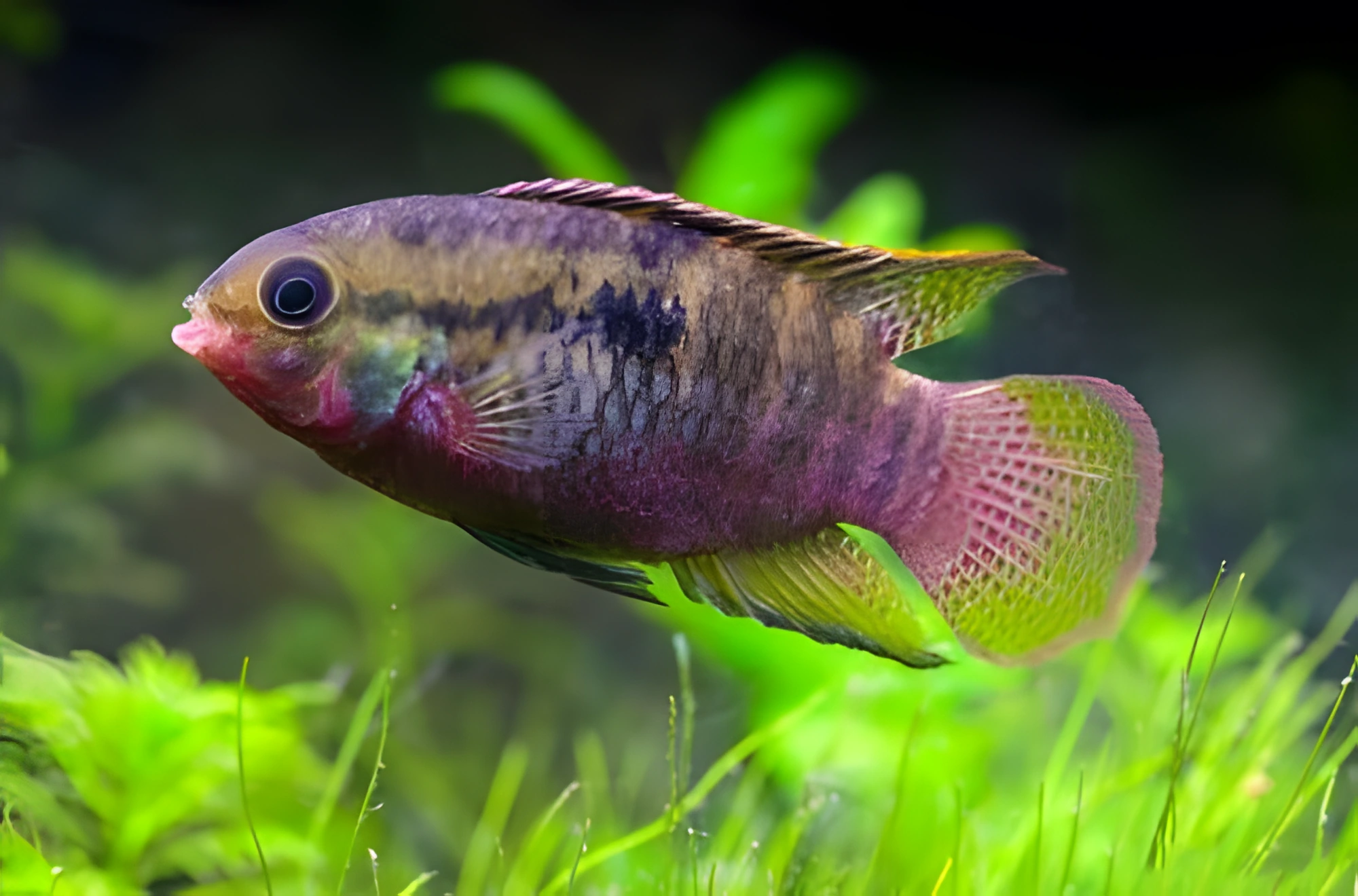
The Laetacara dorsigera, otherwise known as the Red-breasted Acara (scientific name Laetacara dorsigera), belongs to the family Cichlidae. This American cichlid is characterized by its peaceful disposition. It does not have high demands for keeping conditions and successfully coexists with many other species of freshwater fish, making it an excellent choice for a home aquarium.
- Required aquarium volume
- 80 L
- Size in aquarium
- 5 cm
- Temperature
- 20 – 28 °C
- Temperament
- Peaceful (regular)
Parameters
Water pHSlightly acidic (5) – Neutral (7.5)
Water dHVery soft (2) – Hard (15)
Water salinityno salt (freshwater)
Size in aquarium5 cm
Lifespan10 years
TemperamentPeaceful (regular)
Toward small fishnot a predator
Required aquarium volume80 L
Lightingdimmed or moderate
Substratesandy (regular, light)
Water flownone or stagnant (no flow)
FeedingAny (universal)
CareMixed (solitary / pair / group)
Description
These fish grow up to 5 cm in length. Their coloration is a combination of gray and red-blue hues. Their back is dark, while the belly has a rich red color, which served as the basis for one of the species' names. The fins and tail are adorned with blue speckles. Sexual dimorphism is not pronounced: males can be distinguished by a slightly more elongated and pointed anal fin. Otherwise, there are practically no visible differences between the sexes.
Habitat
Its natural habitat is in South America, covering territories in Bolivia and western Brazil. In particular, this fish inhabits the Guaporé River basin, which serves as a natural border between these countries. In rivers, Laetacara dorsigera prefers areas with slow currents or calm backwaters. The bottom in its habitats is usually sandy, covered with fallen tree leaves, and abundant with snags.
Behavior and Compatibility
This fish is characterized by a peaceful and calm disposition. It successfully coexists with other non-aggressive species of similar size. Excellent tankmates for it can be fish from the same habitat region, for example, many species of Characins. They prefer to be in a small group or, at least, in a pair.
Care and Maintenance
For a small group consisting of 5–6 fish, the optimal aquarium volume starts from 80 liters. The setup can be quite simple: sandy substrate, several snags, and densely planted areas. Placing fallen tree leaves on the bottom will give the setup a natural look and tint the water with a natural brownish hue. This effect arises from the release of tannins as the leaves decompose. You can learn more about this in the article “What tree leaves can be used in an aquarium.” Keeping Red-breasted Acara is accessible even to beginners in aquaristics. It is only important to ensure suitable water parameters (temperature and hydrochemical composition) and regularly maintain the aquarium. In most cases, this includes weekly partial water changes, removal of organic waste, and equipment prophylaxis.
Diet
Being an omnivorous species, this fish will readily accept most common foods in a home aquarium. These include dry flakes, granules, as well as live or frozen Artemia, Daphnia, and bloodworms. To maintain health, the diet should be varied and include several types of food, supplemented with plant additives, such as spirulina flakes.
Breeding and Reproduction
Under favorable conditions, such as high water quality and varied nutrition, as well as the presence of suitable partners, Laetacara dorsigera regularly produces offspring. When the breeding season arrives, the male and female form a pair and choose a spawning site. This can be any smooth and clean surface, such as a flat stone. The female lays several dozen eggs. Both parents remain near the clutch, guarding it from any potential threat. Parental care continues even after the fry hatch.
Diseases
The main cause of diseases often lies in the keeping conditions: if they go beyond acceptable limits, immunity decreases, making the fish vulnerable to various infections inevitably present in the environment. At the first suspicion of illness, it is important first of all to check the water parameters and ensure there are no dangerous concentrations of nitrogen cycle products. Often, restoring normal, suitable conditions promotes recovery. However, in some cases, medication may be required. Detailed information on symptoms and treatment methods is presented in the "Aquarium Fish Diseases" section.
How to choose
When choosing individuals, attention should be paid to their activity and the absence of visible damage: scales should be tightly pressed, fins — intact, without signs of destruction or white plaque. A healthy fish shows curiosity towards surrounding objects and actively responds to food. Avoid specimens with sunken bellies, signs of emaciation or unnaturally bloated abdomens, as well as fish that constantly hide in the corners of the aquarium or stay near the water surface, which may indicate stress or diseases. Given the external similarity with closely related species, such as Laetacara curviceps, it is recommended to carefully examine the coloration and fin shape, as misidentification is common in trade.
Frequently asked questions
The essentials: size, tank volume, water parameters and care
How big does Red-breasted Acara get?
An adult reaches 5 cm in length. Plan the tank around the maximum size: the fish quickly outgrows a cramped setup.
What size aquarium does Red-breasted Acara need?
The minimum recommended volume is 80 L. A smaller tank speeds up nitrate build-up and raises stress levels.
What water parameters does Red-breasted Acara need?
Temperature 20–28 °C, pH 5–7.5, hardness 2–15 dGH. Stability matters more than exact values: sudden swings are harder on the fish than a small deviation from the ideal.
How long does Red-breasted Acara live?
Around 10 years when kept properly. Lifespan depends directly on tank volume, water quality and a varied diet.
Is Red-breasted Acara aggressive?
Temperament: peaceful (regular). Keep this in mind when choosing tank mates.
How many Red-breasted Acara should be kept together?
Recommended setup: mixed (solitary / pair / group). Ignoring this is a common cause of stress and disease.
What does Red-breasted Acara eat?
Diet type: any (universal). Feed small portions that are finished within a couple of minutes — overfeeding does more harm than underfeeding.
What is the scientific name of Red-breasted Acara?
The scientific name of the species is Laetacara dorsigera, family Cichlids (Cichlidae). It also appears in the literature as: Acara dorsiger, Aequidens dorsiger, Aequidens dorsigera.