Temperature23 – 28 °C
Natural range
- Amazon River Basin
- Bolivia area
- Brazil area
- Venezuela area
CharacinsConservation status: Least concern LC
Other scientific names: Colossoma bidens, Colossoma brachypomum, Colossoma branchypomus, Colossoma paco, Myletes bidens, Myletes brachypomus
The Red-bellied Pacu, scientifically known as Piaractus brachypomus, belongs to the subfamily Serrasalminae. This fish rarely becomes a resident of home aquariums, mainly due to its impressive size and rather modest coloration. However, it is in demand among certain (wealthy) enthusiasts who are looking for a safe alternative to the Piranha, which the Pacu closely resembles in appearance. In many tropical and subtropical countries, the sale of this species is prohibited. The reason for this is aquarists who release the fish into natural bodies of water when they tire of them. The Pacu successfully adapts to the new environment, disrupting the ecological balance and displacing local species.
- Required aquarium volume
- 1000 L
- Size in aquarium
- 60 – 88 cm
- Temperature
- 23 – 28 °C
- Temperament
- Peaceful (regular)
Parameters
Water pHAcidic (4.8) – Neutral (7.5)
Water dHVery soft (1) – Hard (15)
Water salinityno salt (freshwater)
Size in aquarium60 – 88 cm
Lifespan28 years
TemperamentPeaceful (regular)
Toward small fishnot a predator
Required aquarium volume1000 L
Lightingdimmed or moderate
Substratesoft peat-based
Water flowweak or moderate
FeedingPlant-based (algae, vegetables)
CareBoth solitary and in group (flexible)
Description
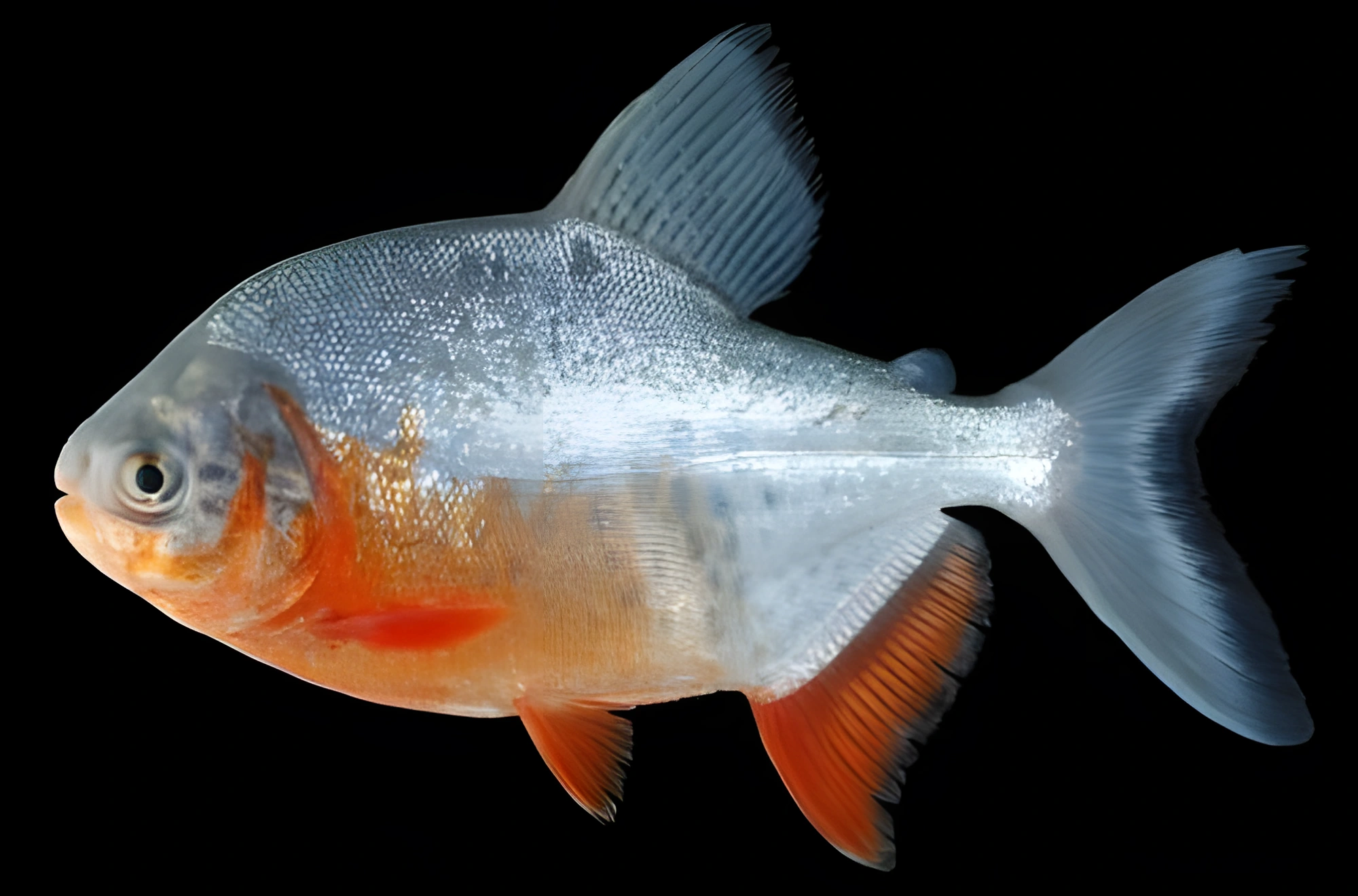
The maximum recorded length of an adult specimen reached 88 cm, although fish usually do not exceed 60 cm. Sexual dimorphism in this species is weakly expressed, making it difficult to distinguish males and females. The Red-bellied Pacu is often sold under the name "Vegetarian Piranha" due to its external resemblance to this formidable Amazonian predator. The fish has a laterally compressed body and relatively small fins. The coloration is dark gray, and in young individuals, the belly has a characteristic red color, which fades and is lost with age.
Habitat
Its origin is associated with the extensive Amazon River basin in South America. Its range covers the territories of Bolivia, Brazil, Venezuela, Colombia, and Peru. This species has also been successfully introduced to Asia, where it is used as a commercial fish. Its natural habitat includes river channels and tropical forest floodplains, which are regularly flooded during the rainy season. The Red-bellied Pacu prefers shallow sections of rivers with slow currents, where there is floating or low-hanging vegetation. Young fish spend the first months of their lives in floodplains, where an abundance of food and a minimal number of predators are available to them.
Behavior and Compatibility
This fish is distinguished by its peaceful, calm, and even somewhat shy disposition. It is well compatible with many species, with the exception of very small inhabitants. Large, adult individuals can coexist even with aggressive and predatory fish. The Red-bellied Pacu can live both alone and in a group.
Care and Maintenance
The significant size of the Red-bellied Pacu requires an aquarium with a volume of thousands of liters. When keeping it, equipment plays a much more important role than decoration. The fish feels quite comfortable even in a completely empty tank, adorned with a couple of large stones. Plants are not needed in such an aquarium, as they will inevitably be eaten. Maintaining a stable biological system in aquariums with large fish involves serious expenditures of effort, knowledge, and experience. Therefore, it is recommended to involve professionals in the selection of equipment, installation of the aquarium, and its subsequent maintenance. For this reason, the details of keeping this species are beyond the scope of this article.
Diet
The diet of this fish is very diverse and includes almost everything that can fit into its mouth: nuts, fruits, seeds, as well as insects and their larvae, crustaceans, worms, and small fish. However, the basis of the diet is still plant-based food. In a home aquarium, you can offer pieces of apples, bananas, peaches, carrots, zucchini, as well as peas and grapes.
Breeding and Reproduction
No successful breeding cases of this species have been recorded in aquarium conditions. Offspring are obtained at large fish farms in South America and the Far East using hormonal methods.
Diseases
This fish is noted for its high endurance and unpretentiousness. Health problems only arise when kept in unsuitable conditions or with poor-quality feeding. More detailed information on disease symptoms and treatment methods can be found in the "Aquarium Fish Diseases" section.
How to choose
When purchasing, choose active fry without visible damage, ulcers, or film on the scales. It is important to note that in pet stores, juveniles are often sold under the name "herbivorous piranha" due to the bright coloration of their chest and belly, which disappears as they mature. It is highly recommended to clarify the actual growth rate of the species with the seller, as the fish quickly increases in size and requires an aquarium of 1000 liters or more. Avoid individuals with signs of emaciation, sluggish behavior, or fin deformities.
Frequently asked questions
The essentials: size, tank volume, water parameters and care
How big does Red-bellied Pacu get?
An adult reaches 60–88 cm in length. Plan the tank around the maximum size: the fish quickly outgrows a cramped setup.
What size aquarium does Red-bellied Pacu need?
The minimum recommended volume is 1000 L. A smaller tank speeds up nitrate build-up and raises stress levels.
What water parameters does Red-bellied Pacu need?
Temperature 23–28 °C, pH 4.8–7.5, hardness 1–15 dGH. Stability matters more than exact values: sudden swings are harder on the fish than a small deviation from the ideal.
How long does Red-bellied Pacu live?
Around 28 years when kept properly. Lifespan depends directly on tank volume, water quality and a varied diet.
Is Red-bellied Pacu aggressive?
Temperament: peaceful (regular). Keep this in mind when choosing tank mates.
How many Red-bellied Pacu should be kept together?
Recommended setup: both solitary and in group (flexible). Ignoring this is a common cause of stress and disease.
What does Red-bellied Pacu eat?
Diet type: plant-based (algae, vegetables). Feed small portions that are finished within a couple of minutes — overfeeding does more harm than underfeeding.
What is the scientific name of Red-bellied Pacu?
The scientific name of the species is Piaractus brachypomus, family Serrasalmidae. It also appears in the literature as: Colossoma bidens, Colossoma brachypomum, Colossoma branchypomus.