Temperature23 – 28 °C
Natural range
- South America area
- Brazil area
Predators CharacinsConservation status: Least concern LC
Other scientific names: Pygocentrus altus, Pygocentrus natterei, Pygocentrus ternetzi, Rooseveltiella nattereri, Serrasalmo ternetzi, Serrasalmus natterei
The Red-bellied Piranha, scientifically known as Pygocentrus nattereri, belongs to the family Serrasalmidae. This fish is frequently mentioned, and its notoriety has been significantly cemented by numerous Hollywood films, where the Piranha is depicted as a very bloodthirsty predator, which has extended its popularity beyond the aquarium hobby.
- Required aquarium volume
- 200 L
- Size in aquarium
- 30 cm
- Temperature
- 23 – 28 °C
- Temperament
- Territorial (often aggressive)
Parameters
Water pHSlightly acidic (5.5) – Neutral (7.5)
Water dHSoft (4) – Hard (15)
Water salinityno salt (freshwater)
Size in aquarium30 cm
Lifespan10 years
TemperamentTerritorial (often aggressive)
Toward small fishpredator
Required aquarium volume200 L
Lightingdimmed
Substratesandy (regular, light)
Water flowmoderate
FeedingFor carnivores (live fish, insects, etc.)
CareLarge group (10+ individuals)
Description
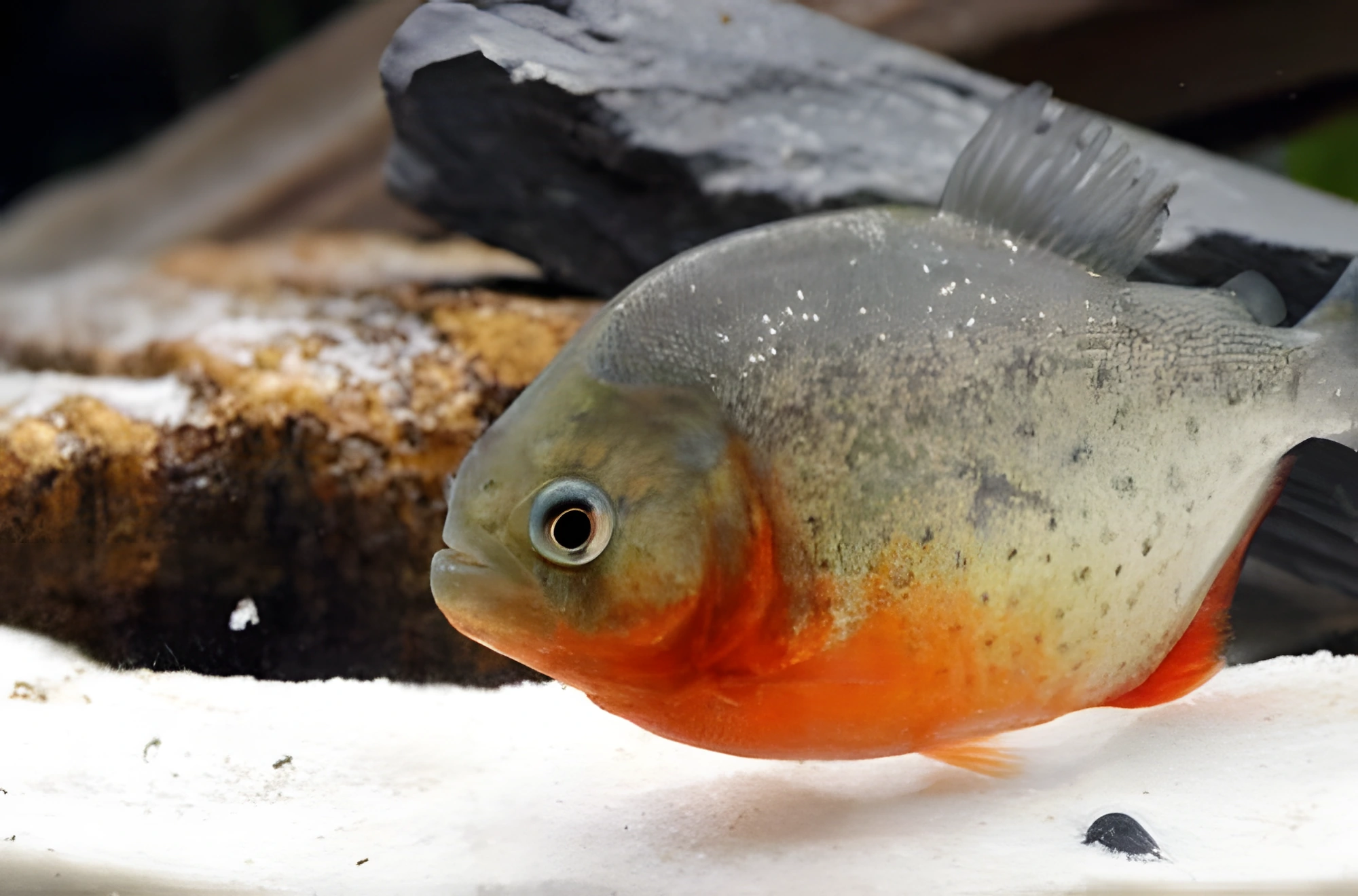
The fish has a powerful and deep body, flattened laterally. It has a large head with a jaw that protrudes forward and is lined with rows of sharp teeth. The tail is large and powerful, providing instant acceleration and allowing it to tear off pieces of prey even in skirmishes with its kin. The main body color is light gray, with a metallic sheen and silvery glow, creating the impression that the fish is covered in many sparkling dots. The belly has a bright red hue.
Habitat
The natural habitat of this species covers the entire tropical belt of South America. It is found throughout the Amazon River basin, including its tributaries, and also inhabits lakes and marshy bodies of water in the southwestern part of Brazil. These fish prefer to live in schools numbering several dozen individuals. Their diet consists of both already deceased animals and live prey.
Behavior and Compatibility
Despite its aggressiveness and ferocity, this species is excessively timid, especially when kept alone or in pairs. Any knock or loud sound causes the Piranha to immediately seek cover. This species is incompatible with other fish, so only a species-specific aquarium is suitable for it. It is recommended to keep them in a school consisting of at least 10 individuals, with the optimal number ranging from 20 to 30 fish. Within the group, a hierarchy is established, where the largest and strongest individual will dominate, claiming the best pieces of food and driving away weaker ones. Cannibalism is also common among Piranhas: weak and sick fish can be eaten by their kin. Therefore, it is important to acquire only healthy individuals without visible signs of damage.
Care and Maintenance
The feeding habits of Piranhas place a significant load on the aquarium's bio-system. Therefore, essential conditions include the use of high-performance filters and regular water changes of 30–50% every two weeks. Do not skimp on filtration equipment: it is recommended to purchase several canister filters, with one of them operating at less than full capacity, serving as a backup in case one of the main units fails. Other necessary equipment includes an aerator, a heater, and a lighting system, which should be of low power. The aquarium design should provide a spacious open area in the center for swimming, with dense thickets of aquatic plants along the sides. It is also important to include several hiding places, which can be created from snags, roots, or artificial elements such as ships or castles. Sand or fine gravel is suitable as a substrate.
Diet
As a carnivorous species, these fish in a home aquarium can feed not only on live fish, but also on pieces of meat, mollusks, river shrimp, insects, and earthworms. It is worth noting that dry commercial foods are unacceptable for them, as Piranhas do not consume them.
Breeding and Reproduction
Although breeding Piranhas is possible in a home aquarium, it is a very challenging task. There is no clear, guaranteed algorithm that always leads to a successful outcome, as there are always important nuances that require special attention.
Diseases
In their natural habitat, Piranhas often feed on dead animals, acting as scavengers in river ecosystems. As a result, their immune system demonstrates high resistance to various diseases.
How to choose
When choosing Red-bellied Piranhas, prioritize individuals from the same group, as they are accustomed to coexisting. It is important to ensure there are no external injuries, such as torn fins or body wounds, as even minor injuries can provoke cannibalism from tankmates. A healthy fish should be active, have clear eyes without cloudiness, and an even coloration appropriate for its age.
Avoid purchasing individuals that appear emaciated or exhibit apathetic behavior, constantly hiding in the corners of the aquarium. Ask the seller what the fish are fed: it is preferable to choose those that are already accustomed to a variety of frozen foods, not just live fish. Given the high risk of injury during transport, use sturdy nets with metal mesh or a rigid frame for moving them, as ordinary fabric or plastic materials can be easily damaged by their powerful jaws.
Frequently asked questions
The essentials: size, tank volume, water parameters and care
How big does Red-bellied Piranha get?
An adult reaches 30 cm in length. Plan the tank around the maximum size: the fish quickly outgrows a cramped setup.
What size aquarium does Red-bellied Piranha need?
The minimum recommended volume is 200 L. A smaller tank speeds up nitrate build-up and raises stress levels.
What water parameters does Red-bellied Piranha need?
Temperature 23–28 °C, pH 5.5–7.5, hardness 4–15 dGH. Stability matters more than exact values: sudden swings are harder on the fish than a small deviation from the ideal.
How long does Red-bellied Piranha live?
Around 10 years when kept properly. Lifespan depends directly on tank volume, water quality and a varied diet.
Is Red-bellied Piranha aggressive?
Temperament: territorial (often aggressive). This is a predatory species — any fish small enough to fit in its mouth will eventually be eaten.
How many Red-bellied Piranha should be kept together?
Recommended setup: large group (10+ individuals). Ignoring this is a common cause of stress and disease.
What does Red-bellied Piranha eat?
Diet type: for carnivores (live fish, insects, etc.). Feed small portions that are finished within a couple of minutes — overfeeding does more harm than underfeeding.
What is the scientific name of Red-bellied Piranha?
The scientific name of the species is Pygocentrus nattereri, family Piranhas (Serrasalmidae). It also appears in the literature as: Pygocentrus altus, Pygocentrus natterei, Pygocentrus ternetzi.