Temperature21 – 26 °C
Natural range
- Mexico area
- Colombia area
- Venezuela area
- Central America area
LivebearersConservation status: Least concern LC
Other scientific names: Gambusia modesta, Gambusia plumbea, Lembesseia parvianalis, Mollienesia altissima, Mollienesia macrura, Mollienesia pallida
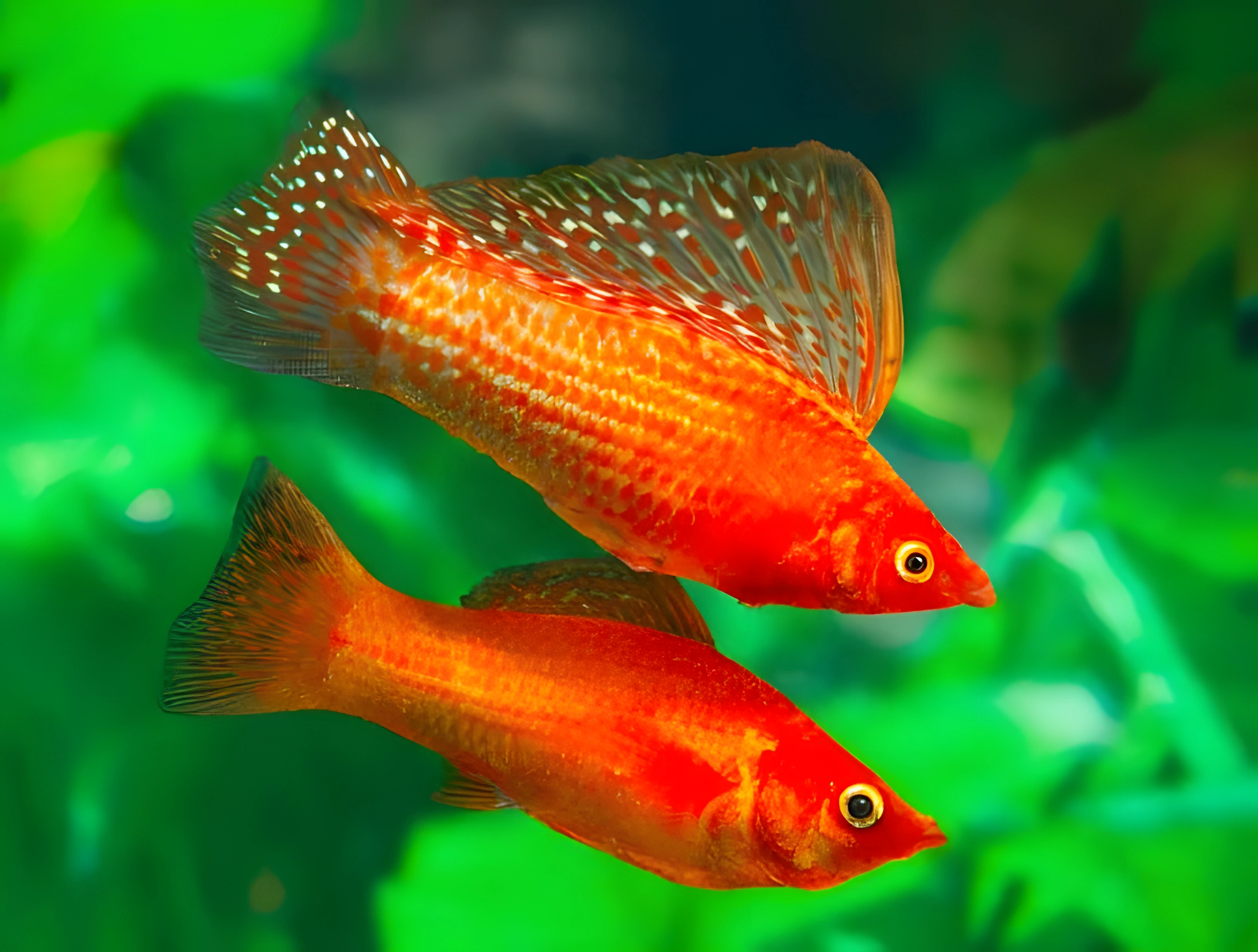
The Blood Red Molly, often called Blood Red Molly in English-speaking countries, is a vibrant color variation developed through selective breeding of certain Molly species. Its distinguishing feature is its intense red body and fin coloration.
- Required aquarium volume
- 150 L
- Size in aquarium
- 12 – 18 cm
- Temperature
- 21 – 26 °C
- Temperament
- Peaceful (regular)
Parameters
Water pHNeutral (7) – Slightly alkaline (8.5)
Water dHMedium hardness (11) – Very hard (30)
Water salinitymoderate (5–10 g/L)
Size in aquarium12 – 18 cm
Lifespan4 years
TemperamentPeaceful (regular)
Toward small fishnot a predator
Required aquarium volume150 L
Lightingany
Substrateany (no restrictions)
Water flowweak
FeedingMixed diet (meat + plant-based)
CareMixed (solitary / pair / group)
Description
The Blood Red Molly is a selectively bred color variation of the species Poecilia sphenops. The fish's body is elongated, laterally compressed, with fin structures characteristic of poeciliids. Its coloration ranges from bright orange to deep red. Depending on the breeding line, the caudal fin can be rounded or lyre-shaped. Sexual dimorphism is clearly expressed: males are typically smaller than females, and their anal fin is modified into a specialized organ — the gonopodium. Females are larger, have a more rounded abdomen, and a fan-shaped anal fin.
Habitat
In nature, the original species inhabits waters of Central and South America, including Mexico, Colombia, and Venezuela. These fish live in both fresh and brackish waters, often found in coastal lagoons and river estuaries where currents mix. In their natural environment, they prefer areas with dense aquatic vegetation. Modern red forms are the result of long-term selective breeding and do not occur in the wild.
Behavior and Compatibility
These fish are peaceful and coexist well with most other aquarium fish species of comparable size and temperament. If veiled forms are kept, it's important to avoid cohabitation with fin-nipping species, such as some types of barbs. In smaller aquariums, it's recommended to maintain a group where females outnumber males to prevent excessive harassment of females by males in confined spaces and without sufficient hiding spots.
Care and Maintenance
The size of adult individuals of this fish can vary significantly, ranging from 12 to over 18 cm, which directly depends on their original breed. For example, Poecilia sphenops representatives are usually relatively small, while lyretail varieties, descended from Poecilia velifera, sometimes reach 20 cm. Given this, when choosing the aquarium volume, one should base it on the maximum possible size of the fish: for a group of 3–4 individuals, an aquarium of 100–150 liters or more is recommended. An important part of aquarium decor is the presence of dense thickets of aquatic plants, which create shelters for smaller or weaker fish, as well as for fry. Additionally, some plant species can serve as an extra food source, so it is advisable to choose fast-growing and undemanding varieties. Optimal conditions for keeping Mollies include warm, slightly alkaline water with high general hardness. Although selectively bred forms have adapted to softer water, such an environment is not the most favorable, especially during breeding. It should be noted that Mollies are naturally adapted to living in brackish water, as their wild ancestors are often found in river estuaries – zones where fresh and saltwater mix. However, in a home aquarium, caution should be exercised when adding marine salt, especially for beginners, as there is a risk of exceeding the concentration, and other inhabitants may not be prepared for increased salinity.
Diet
As previously mentioned, plant components are very important in the diet of these fish. If there is not enough in their main food, aquarium plants may suffer. Specialized commercial Molly foods, produced by many companies and available in flake or pellet form, are an excellent solution. We offer Aqvium flake food for aquarium fish, which is a bestseller on Ozon with a rating of 4.9. This food is suitable for most aquarium fish species, is produced from raw materials compliant with new European Union standards (EU 2018/848), and is enriched with vitamins A, C, D3, E, as well as Omega 3-6. It can be purchased on Ozon.
Breeding and Reproduction
Breeding these fish is not difficult even for beginner aquarists, as Mollies regularly produce offspring. Fry are born fully formed and capable of feeding independently. The same products (flakes, pellets) consumed by adult fish can be used as starter food, after crushing them. It is important to note that parents generally do not care for their offspring and may eat the fry. Therefore, it is advisable to transfer the young to a separate tank with identical water conditions. However, if the aquarium is spacious enough and has dense plant thickets serving as hiding places, then isolation is not necessary.
Diseases
Blood Red Mollies are sensitive to water quality and sudden parameter changes. The most common problems include ichthyophthiriasis, appearing as white spots on the body, as well as fungal infections, often occurring after mechanical injuries or with low immunity. Digestive disorders caused by overfeeding or a lack of plant fiber are also common. Prevention involves maintaining stable hardness and alkaline pH, regular water changes, and adding a small amount of aquarium salt.
How to choose
When purchasing, choose active fish with clean fins and no film on their scales. It is important to pay attention to behavior: healthy individuals are constantly moving and show interest in food. Avoid specimens with clamped fins, white spots, or an unnaturally bloated abdomen, which may indicate infectious diseases. It is recommended to purchase fish from the same batch to minimize stress during adaptation to new aquarium conditions.
Frequently asked questions
The essentials: size, tank volume, water parameters and care
How big does Blood Red Molly get?
An adult reaches 12–18 cm in length. Plan the tank around the maximum size: the fish quickly outgrows a cramped setup.
What size aquarium does Blood Red Molly need?
The minimum recommended volume is 150 L. A smaller tank speeds up nitrate build-up and raises stress levels.
What water parameters does Blood Red Molly need?
Temperature 21–26 °C, pH 7–8.5, hardness 11–30 dGH. Stability matters more than exact values: sudden swings are harder on the fish than a small deviation from the ideal.
How long does Blood Red Molly live?
Around 4 years when kept properly. Lifespan depends directly on tank volume, water quality and a varied diet.
Is Blood Red Molly aggressive?
Temperament: peaceful (regular). Keep this in mind when choosing tank mates.
How many Blood Red Molly should be kept together?
Recommended setup: mixed (solitary / pair / group). Ignoring this is a common cause of stress and disease.
What does Blood Red Molly eat?
Diet type: mixed diet (meat + plant-based). Feed small portions that are finished within a couple of minutes — overfeeding does more harm than underfeeding.
What is the scientific name of Blood Red Molly?
The scientific name of the species is Poecilia sphenops, family Poeciliidae. It also appears in the literature as: Gambusia modesta, Gambusia plumbea, Lembesseia parvianalis.