Temperature22 – 26 °C
Natural range
- Brazil area
- South America area
CorydorasConservation status: Least concern LC
Other scientific names: Callichthys paleatus, Corydoras maculatus, Corydoras marmoratus, Corydoras punctatus, Silurus quadricostatus, Silurus septemradiatus
The Peppered Corydoras, scientifically known as Corydoras paleatus, belongs to the extensive Callichthyidae family. This fish will harmoniously fit into almost any freshwater aquarium environment and, thanks to its lifestyle and dietary preferences, will help maintain cleanliness at the bottom of the aquarium by consuming leftover food.
- Required aquarium volume
- 40 L
- Size in aquarium
- 6 cm
- Temperature
- 22 – 26 °C
- Temperament
- Peaceful (regular)
Parameters
Water pHSlightly acidic (6) – Slightly alkaline (8)
Water dHVery soft (2) – Hard (15)
Water salinityincreased (10–15 g/L)
Size in aquarium6 cm
Lifespan8 years
TemperamentPeaceful (regular)
Toward small fishnot a predator
Required aquarium volume40 L
Lightingmoderate or bright
Substratesoft peat-based
Water flownone or stagnant (no flow)
FeedingMeat with plant additives (omnivores)
CareSmall group (3–4 individuals)
Description
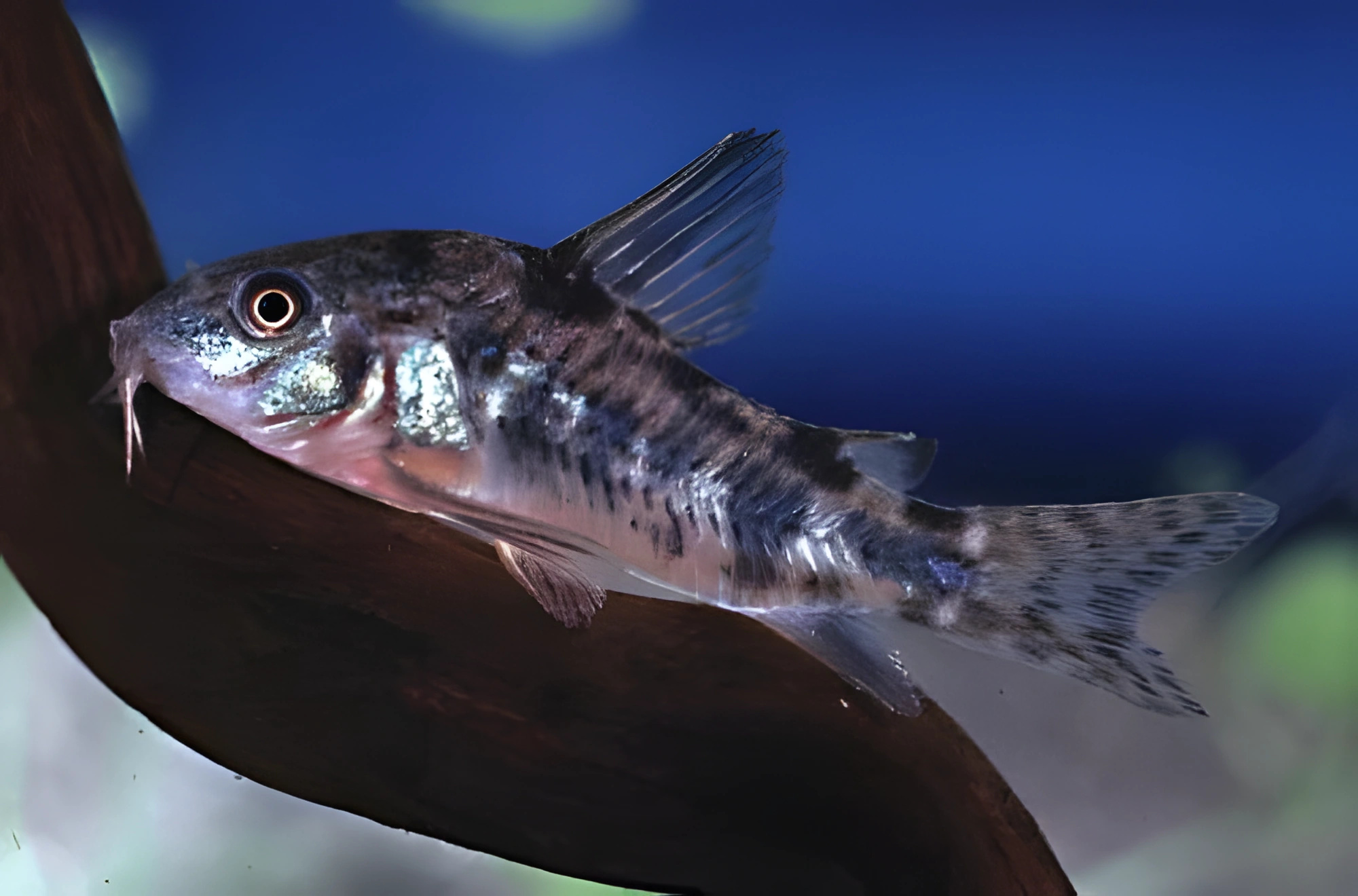
Peppered Corydoras reach a length of 5–6 cm. Their coloration can vary depending on their region of origin, but characteristic shades range from light brown to bronze with gray or dark spots distributed over the entire body. An artificially bred albino form of the corydoras is also available for sale. Like other members of the Callichthyidae family, these fish have two rows of bony plates, called scutes, which extend along the entire length of the body. The corydoras also has characteristic pairs of barbels around its mouth and strong, rigid spines on its dorsal and pectoral fins. When courting or in danger, the corydoras can make sounds using the spines of its pectoral fins.
Female Peppered Corydoras are usually larger and fuller than males, while males may have somewhat sharper pectoral fins. Nevertheless, sex determination is difficult, and the best breeding results are achieved through natural pairing.
Habitat
Corydoras paleatus was first described by researcher Jenyns in 1842. This species inhabits the waters of South America, specifically the Amazon basin and the La Plata River in southeastern Brazil. In their natural habitat, corydoras prefer still or slow-moving waters: they can be found in small river tributaries, along the edges of larger bodies of water, as well as in ponds and swamps. Their diet consists of worms, crustaceans, insects, and plant matter.
Behavior and Compatibility
This peaceful fish coexists well with other small and peaceful species. Peppered Corydoras are schooling fish, so they should be kept in groups of at least three individuals. It is advisable to avoid keeping them with aggressive or predatory species.
Care and Maintenance
For the comfortable existence of these inhabitants, an aquarium of at least 40 liters is desirable. It is important to provide an abundance of vegetation, including floating species, which will create the necessary shading. The internal decor of the aquarium should be as close as possible to their natural environment: shelters made of driftwood or artificial grottoes are essential. Coarse sand or fine gravel is recommended as a substrate, as corydoras have a tendency to constantly dig in the substrate, and larger particles can damage their sensitive barbels. It is extremely important to regularly clean the gravel to remove accumulated waste. As for water parameters, at least 25% of the total tank volume should be changed weekly, and a single 80% water change is recommended once a month.
Diet
This corydoras is an omnivorous aquarium inhabitant and readily accepts a varied diet. It eagerly consumes both dry commercial foods — granulated or flaked — and live or frozen options. The main requirement for food is related to the fish's bottom-dwelling lifestyle: the food must sink to the bottom. It is recommended to feed your pet twice a day, daily, offering an amount of food that will be completely eaten within three to five minutes.
Breeding and Reproduction
The Peppered Corydoras is quite easy to breed and does not require special equipment in the aquarium. During courtship, the male begins to chase the female throughout the aquarium. When the female is ready to spawn, the pair presses against each other. After mating, the female begins to lay eggs throughout the aquarium — on the glass, filter surface, plants, and other elements. Spawning lasts about an hour, and during this time, 250 to 400 eggs can be laid. Fry hatch 4–6 days after spawning. It is important to note that adult fish may eat their fry, so it is recommended to move the young to a separate tank for their further development. Fry are fed micro-food, where food particles are ground to a flour-like consistency. Such food can be purchased at pet stores or prepared independently, for example, by grinding flakes or granules intended for adult fish.
Diseases
The corydoras is susceptible to the same diseases as most freshwater aquarium inhabitants. The fish tolerates high nitrate levels poorly, which can lead to damage to its barbels. The barbels are also sensitive to damage that can be caused by sharp or abrasive edges of aquarium decorations.
How to choose
When choosing Peppered Corydoras, attention should be paid to the overall activity of the fish: healthy individuals constantly explore the bottom in search of food. It is important to carefully inspect the integrity of the barbels — their absence or damage often indicates poor living conditions and high nitrate levels in the aquarium. The fish's body should be clean, without whitish plaque, ulcers, or visible parasites, and the fins should be spread out and show no signs of deterioration. Avoid purchasing individuals that appear emaciated, sluggish, or constantly stay near the water surface when aeration is normal. Since corydoras have sharp spines on their fins, care should be taken during inspection and transport to prevent the fish from getting entangled in the net.
Frequently asked questions
The essentials: size, tank volume, water parameters and care
How big does Peppered Corydoras get?
An adult reaches 6 cm in length. Plan the tank around the maximum size: the fish quickly outgrows a cramped setup.
What size aquarium does Peppered Corydoras need?
The minimum recommended volume is 40 L. A smaller tank speeds up nitrate build-up and raises stress levels.
What water parameters does Peppered Corydoras need?
Temperature 22–26 °C, pH 6–8, hardness 2–15 dGH. Stability matters more than exact values: sudden swings are harder on the fish than a small deviation from the ideal.
How long does Peppered Corydoras live?
Around 8 years when kept properly. Lifespan depends directly on tank volume, water quality and a varied diet.
Is Peppered Corydoras aggressive?
Temperament: peaceful (regular). Keep this in mind when choosing tank mates.
How many Peppered Corydoras should be kept together?
Recommended setup: small group (3–4 individuals). Ignoring this is a common cause of stress and disease.
What does Peppered Corydoras eat?
Diet type: meat with plant additives (omnivores). Feed small portions that are finished within a couple of minutes — overfeeding does more harm than underfeeding.
What is the scientific name of Peppered Corydoras?
The scientific name of the species is Corydoras paleatus, family Callichthyidae. It also appears in the literature as: Callichthys paleatus, Corydoras maculatus, Corydoras marmoratus.