Temperature23 – 27 °C
Natural range
- Chocó Department area
- Colombia area
CharacinsConservation status: Data deficient DD
Other scientific names: Nematobrycon amphiloxus
Nematobrycon palmeri, known as the Emperor or Royal Tetra, belongs to the family Characidae. Its popularity is due to its striking coloration, peaceful disposition, ease of care, and relatively high hardiness. This makes it an accessible and attractive choice for many aquarists.
- Required aquarium volume
- 60 L
- Size in aquarium
- 4 – 4.2 cm
- Temperature
- 23 – 27 °C
- Temperament
- Peaceful (regular)
Parameters
Water pHSlightly acidic (5) – Neutral (7.5)
Water dHVery soft (1) – Hard (12)
Water salinityno salt (freshwater)
Size in aquarium4 – 4.2 cm
Lifespan5 years
TemperamentPeaceful (regular)
Toward small fishnot a predator
Required aquarium volume60 L
Lightingdimmed
Substratecoarse sand / gravel / pebbles
Water flowweak
FeedingAny (universal)
CareLarge group (10+ individuals)
Description
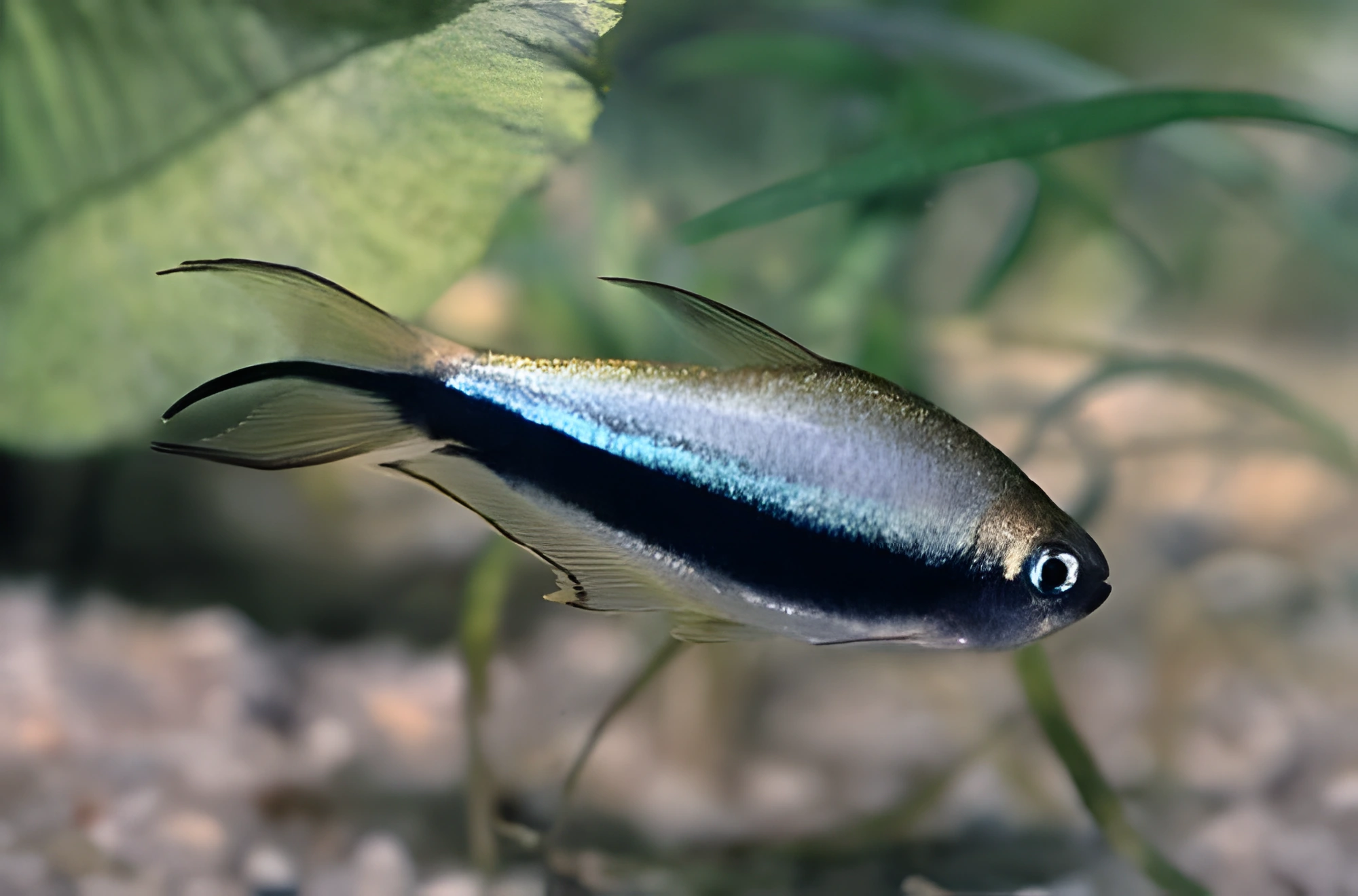
Adult Emperor Tetras typically reach only 4 cm in length. Males are easily distinguished: they are larger and their coloration is more vibrant. In conditions close to natural (dim lighting and the presence of floating plants), their coloration is dominated by purple and blue tones, and the caudal and anal fins of males are noticeably larger compared to females. It should be noted that under bright lighting, their coloration may fade, acquiring a more yellowish hue.
Habitat
This species is endemic to the San Juan and Atrato river basins, located in northwestern Colombia, South America. The fish prefer to inhabit numerous streams, small tributaries, and quiet backwaters where the current is slow and dense tropical forests provide shade. Although it was previously common to breed individuals caught from the wild, in recent years, thanks to successful commercial breeding, they are encountered much less frequently. Brief information about this species is provided below:
Behavior and Compatibility
This peaceful and calm species coexists well with many other aquarium inhabitants of similar size and temperament. They should be kept in a school, optimally with at least 10 individuals, represented by both sexes. Males compete for the attention of females, using their coloration as the primary means of attraction, which prevents aggressive skirmishes within the species. However, it is important to be cautious when choosing tank mates, avoiding species significantly larger than the Emperor Tetra to prevent risks to their safety.
Care and Maintenance
For a small school of these fish, an aquarium of at least 60 liters is required. Sand is recommended as substrate, supplemented with shelters made of driftwood, roots, or tree branches. It is also beneficial to add several shade-loving plants, both rooted and floating. Equipment should be set up to provide diffused, subdued light and a very gentle current. Water parameters are quite variable: they can range from slightly acidic to neutral pH values, with soft to medium carbonate hardness (dGH). It is recommended to use a filter with peat media, which, in addition to its primary cleaning function, enriches the water with elements characteristic of the fish's natural habitat. Aquarium care includes weekly water changes of 15–20% with fresh water and regular cleaning of the substrate from organic debris, such as excrement and food remnants.
Diet
These fish readily accept various types of food: be it dry, frozen, or live. To maintain vibrant coloration and high vitality, it is highly recommended to offer them a varied diet, including, for example, flakes combined with bloodworms or daphnia. Conversely, constant feeding with monotonous, budget-packaged foods can negatively affect both the appearance and overall well-being of your aquatic pets.
Breeding and Reproduction
Breeding Emperor Tetra at home is not very difficult. Although fry may appear in the community tank, their chances of survival will be minimal, as adults tend to eat their own offspring. Therefore, for breeding, it is recommended to use a separate tank of at least 20 liters with very dim lighting. This aquarium is filled with water taken from the community tank. To protect the eggs, dense thickets of fine-leaved, low-growing plants, such as mosses or ferns, are placed on the bottom, or a fine mesh or a layer of marbles with a diameter of 1 cm or more is used. For equipment, a heater and a simple air-driven filter will suffice. Gradually changing water parameters serves as a stimulus for the onset of the spawning period. pH values are set in the range of 6.0–7.0, dGH should not exceed 10, and the temperature is raised to the maximum permissible 26–27°C. During this period, the diet is abundantly supplemented with live food, such as small crustaceans and insect larvae. After some time, the females noticeably round out, and the males become brighter and begin to actively court the chosen females. Several of the largest and strongest males and females are placed in a separate breeding tank. After spawning, the breeders are returned to the community tank. Fry appear after 24–36 hours, and by the 4th–5th day, they begin to swim freely in search of food. Young fish should be fed specialized food intended for aquarium fish fry. Professional breeders use a slightly different method: during the breeding period, females and males are temporarily kept in separate aquariums. For spawning, one pair of the healthiest and largest fish is selected and placed together in a separate breeding tank. If eggs are not obtained, another pair is tried. This approach allows for controlling the origin of the offspring, ensuring effective selection and preventing inbreeding.
Diseases
The best guarantee of fish health from any disease is a balanced aquarium biosystem with optimal keeping conditions. Therefore, if you notice changes in behavior, fish coloration, the appearance of uncharacteristic spots, or other symptoms, you should first check the water parameters, and only after that proceed with treatment measures.
How to choose
When purchasing, choose active fish that stay in the middle water column and show interest in their surroundings. Avoid individuals with damaged fins, signs of emaciation, whitish patches on the body, or an unnaturally swollen abdomen. A healthy Emperor Tetra should have a clear pattern and vibrant coloration appropriate for its sex, without signs of apathy or constant presence at the water surface. Given the schooling nature of the species, it is recommended to acquire a group of 6–10 individuals at once to reduce stress during adaptation. In the store, pay attention to the keeping conditions: there should be no dead fish in the aquarium, and the water should be clear, without a strong odor.
Frequently asked questions
The essentials: size, tank volume, water parameters and care
How big does Emperor Tetra get?
An adult reaches 4–4.2 cm in length. Plan the tank around the maximum size: the fish quickly outgrows a cramped setup.
What size aquarium does Emperor Tetra need?
The minimum recommended volume is 60 L. A smaller tank speeds up nitrate build-up and raises stress levels.
What water parameters does Emperor Tetra need?
Temperature 23–27 °C, pH 5–7.5, hardness 1–12 dGH. Stability matters more than exact values: sudden swings are harder on the fish than a small deviation from the ideal.
How long does Emperor Tetra live?
Around 5 years when kept properly. Lifespan depends directly on tank volume, water quality and a varied diet.
Is Emperor Tetra aggressive?
Temperament: peaceful (regular). Keep this in mind when choosing tank mates.
How many Emperor Tetra should be kept together?
Recommended setup: large group (10+ individuals). Ignoring this is a common cause of stress and disease.
What does Emperor Tetra eat?
Diet type: any (universal). Feed small portions that are finished within a couple of minutes — overfeeding does more harm than underfeeding.
What is the scientific name of Emperor Tetra?
The scientific name of the species is Nematobrycon palmeri, family Characidae. It also appears in the literature as: Nematobrycon amphiloxus.