Temperature22 – 26 °C
Natural range
- Rio de Janeiro area
- Minas Gerais area
CorydorasConservation status: Least concern LC
Other scientific names: Corydoras prionotos, Corydoras prionotus
Scleromystax prionotos, known as the Scleromystax catfish, belongs to the family Callichthyidae, which unites armored or callichthyid catfishes. Its scientific and common names reflect a characteristic feature of the fish's structure: the presence of a noticeably serrated medial border of the spine in the pectoral region.
- Required aquarium volume
- 100 L
- Size in aquarium
- 5 – 6 cm
- Temperature
- 22 – 26 °C
- Temperament
- Peaceful (regular)
Parameters
Water pHSlightly acidic (6) – Slightly alkaline (8)
Water dHVery soft (2) – Very hard (22)
Water salinityno salt (freshwater)
Size in aquarium5 – 6 cm
Lifespan5 years
TemperamentPeaceful (regular)
Toward small fishnot a predator
Required aquarium volume100 L
Lightingdimmed
Substrateany (no restrictions)
Water flowweak or moderate
FeedingSmall / appropriate size / pieces
CareSmall group (5–6 individuals)
Description
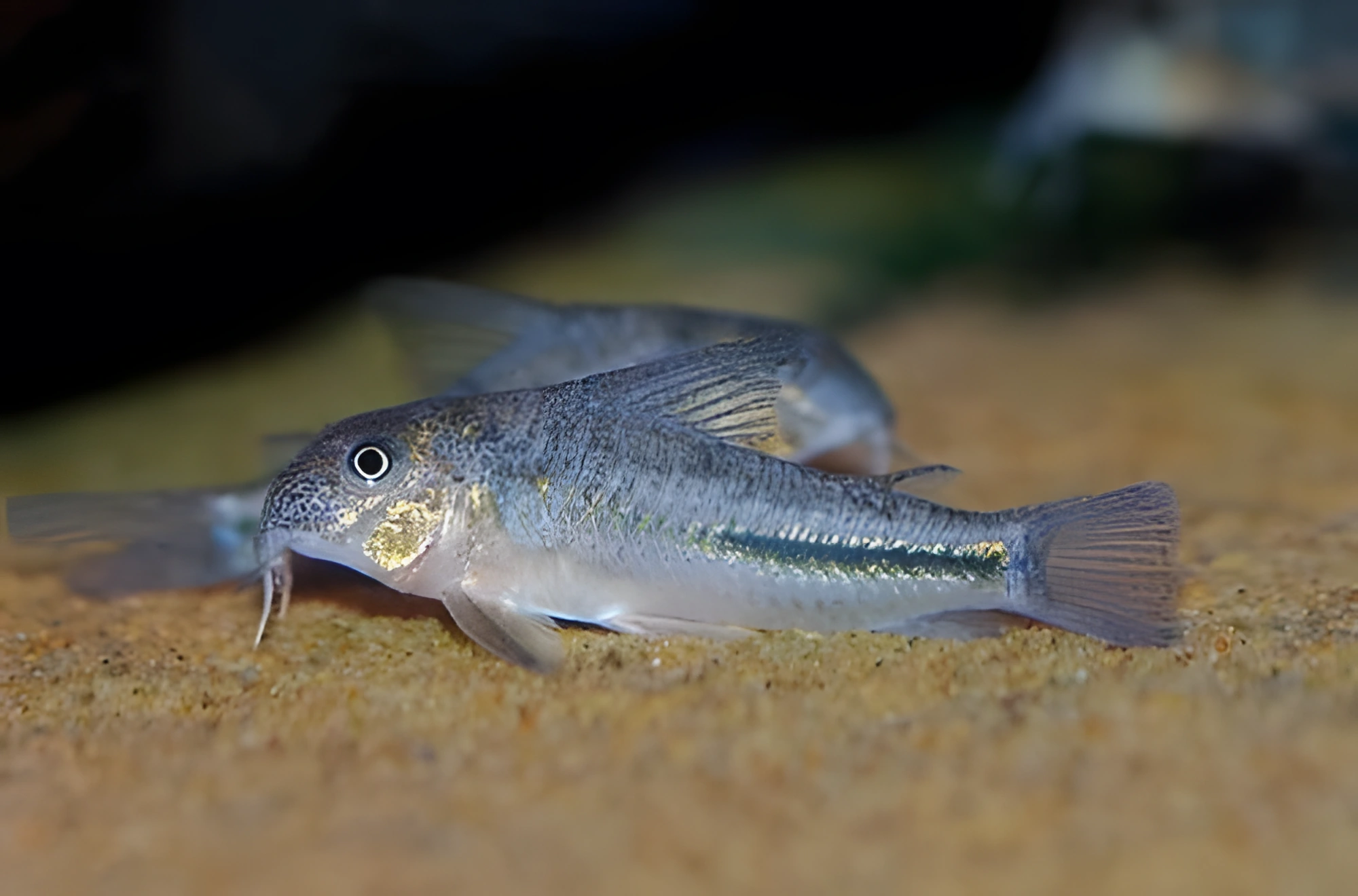
These fish reach a length of 5–6 cm when adult, possessing an elongated but rather stocky body. Their fins are notably large, with the first ray of the dorsal and pectoral fins being modified into a spine, serving as a defense mechanism against predators. Additional protection is provided by their external coverings: instead of typical scales, they have hard bony plates. Their coloration is predominantly gray, with a characteristic black stripe running along the lateral line.
Habitat
Its homeland is South America. This species is found in the Brazilian states of Rio de Janeiro, Minas Gerais, Espírito Santo, and São Paulo, inhabiting numerous rivers that flow into the Atlantic Ocean.
Behavior and Compatibility
Males exhibit some territorial behavior, competing with each other, especially intensifying during the breeding season. In a small aquarium, the number of males should be limited; for example, one male for several females is sufficient. With regard to other fish species, they are peaceful and get along well with many popular aquarium fish of comparable size.
Care and Maintenance
For a group of 4–6 individuals, the aquarium should have a volume of at least 100 liters. When setting up the tank, special attention should be paid to the bottom layer: it is important to provide a soft substrate and several shelters. Keeping Scleromystax prionotos does not require special effort. To maintain optimal living conditions, it is sufficient to replace 15–20% of the water volume weekly with fresh water, combining this with substrate cleaning using a siphon. It is also necessary to perform preventive maintenance of equipment, promptly remove food residues and dead plant parts, if any. When performing partial water changes, it should be noted that the new water should be identical or very close in temperature and hydrochemical parameters to the water in the aquarium.
Diet
The diet of these fish can be very diverse, including dry flakes and granules, as well as freeze-dried insect larvae. They also readily accept live and frozen foods, such as bloodworms, Daphnia, and Artemia.
Breeding and Reproduction
The breeding process of Scleromystax prionotos is similar to that of other Corydoras catfishes. Under favorable conditions, the fish will lay eggs, attaching them to various surfaces—be it plants, stones, driftwood, or even the aquarium wall. They do not have parental instincts, so it is recommended to move the eggs to a separate tank with identical water parameters. The incubation period lasts several days. The fry initially use the reserves of their yolk sac, and then, after approximately one week, begin to accept specialized foods for aquarium fish fry in the form of powders or suspensions.
Diseases
The well-being of fish is largely determined by the state of their environment. If the catfish lives in comfortable conditions, receives quality food, and does not experience aggression from tank mates, then instances of illness are extremely rare. If signs of illness appear in the catfish, such as lethargy, changes in body shape or color, or refusal to eat, the first step is to check the hydrochemical composition of the water. It is important to ensure there are no deviations in pH and dGH, as well as high concentrations of nitrogen cycle products. Often, restoring the normal water composition leads to recovery. However, in advanced situations, medication may be required. More detailed information can be found in the "Aquarium Fish Diseases" section.
How to choose
When selecting individuals, attention should be paid to the appearance and activity of the fish. A healthy specimen should be active, with clean skin free of white film, sores, or visible damage. Fins should be spread, without signs of deterioration or redness at the base. Avoid purchasing fish that appear emaciated, have sunken bellies, or show signs of apathy, constantly lying on the bottom without attempting to search for food.
Before purchasing, it is recommended to carefully inspect the entire aquarium in the store for dead or obviously sick fish, as this may indicate an unhealthy condition of the entire batch. It is advisable to ask the seller how long the fish have been in the store, as the adaptation period after transportation is the most stressful and risky for the health of the catfishes.
Frequently asked questions
The essentials: size, tank volume, water parameters and care
How big does Scleromystax prionotos get?
An adult reaches 5–6 cm in length. Plan the tank around the maximum size: the fish quickly outgrows a cramped setup.
What size aquarium does Scleromystax prionotos need?
The minimum recommended volume is 100 L. A smaller tank speeds up nitrate build-up and raises stress levels.
What water parameters does Scleromystax prionotos need?
Temperature 22–26 °C, pH 6–8, hardness 2–22 dGH. Stability matters more than exact values: sudden swings are harder on the fish than a small deviation from the ideal.
How long does Scleromystax prionotos live?
Around 5 years when kept properly. Lifespan depends directly on tank volume, water quality and a varied diet.
Is Scleromystax prionotos aggressive?
Temperament: peaceful (regular). Keep this in mind when choosing tank mates.
How many Scleromystax prionotos should be kept together?
Recommended setup: small group (5–6 individuals). Ignoring this is a common cause of stress and disease.
What does Scleromystax prionotos eat?
Diet type: small / appropriate size / pieces. Feed small portions that are finished within a couple of minutes — overfeeding does more harm than underfeeding.
What is the scientific name of Scleromystax prionotos?
The scientific name of the species is Scleromystax prionotos, family Armored or Callichthyid Catfish (Callichthyidae). It also appears in the literature as: Corydoras prionotos, Corydoras prionotus.