Temperature22 – 26 °C
Natural range
- Colombia area
CorydorasConservation status: Data deficient DD
Corydoras reynoldsi, also known as the Bumblebee Corydoras, or by its scientific name Corydoras reynoldsi, belongs to the armored catfish family (Callichthyidae). The homeland of this catfish is South America, where it is found in the Japurá River basin, a left tributary of the Amazon, flowing through Colombia and Brazil. It prefers to inhabit shallow waters, in backwaters with sandy bottoms, where the current is not too strong.
- Required aquarium volume
- 40 L
- Size in aquarium
- 3 cm
- Temperature
- 22 – 26 °C
- Temperament
- Peaceful (regular)
Parameters
Water pHSlightly acidic (6) – Slightly alkaline (8)
Water dHSoft (5) – Very hard (25)
Water salinityno salt (freshwater)
Size in aquarium3 cm
Lifespan8 years
TemperamentPeaceful (regular)
Toward small fishnot a predator
Required aquarium volume40 L
Lightingweak (low)
Substratesoft silted
Water flowweak
FeedingAny (universal)
CareSmall group (3–4 individuals)
Description
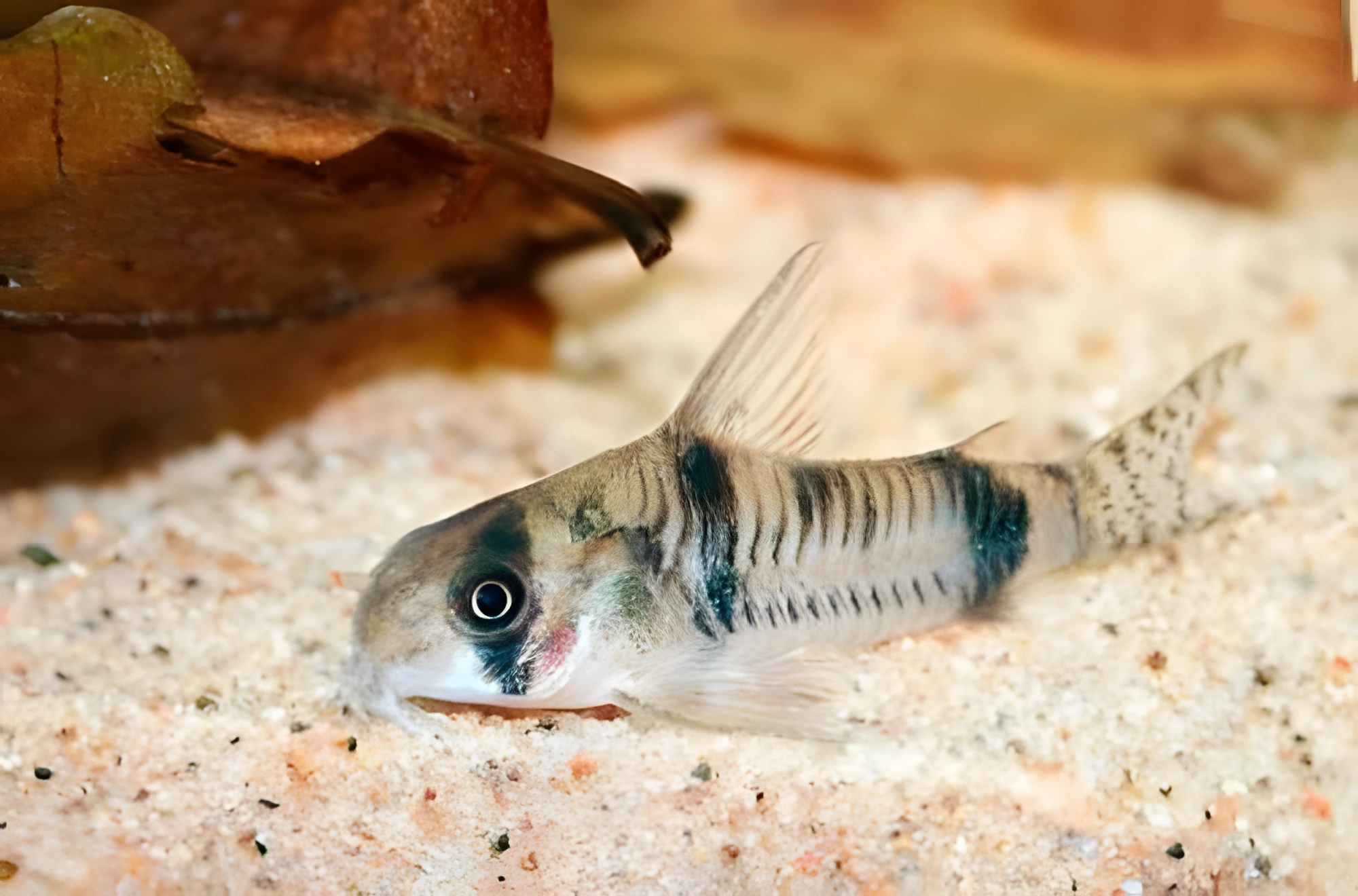
These fish reach a length of about 3 cm. Their body has the typical Corydoras shape — robust and stocky, with small fins. Sharp spines are formed by the first rays of the dorsal and pectoral fins. The bony plates covering the body are modified scales. Their coloration is light, with gray speckles. Vertical black stripes run across the head, then along the dorsal fin, and towards the base of the tail. These body pattern features led to the species' common name — Bumblebee Corydoras. For quite a long time, a related species, Corydoras tucano, which has a similar coloration and inhabits the same region, was supplied under the same name — Corydoras reynoldsi.
Habitat
Corydoras reynoldsi inhabits South America, primarily in the upper Caquetá River basin in Colombia. In nature, these fish populate shallow areas of rivers with sandy bottoms and slow currents. The water in their habitats is characterized by tropical temperatures, soft to moderately hard reaction, and neutral or slightly acidic pH levels.
Behavior and Compatibility
Corydoras are known as some of the most peaceful inhabitants of aquariums. They prefer to stay in groups, so it is recommended to keep them in schools of 3–4 individuals. These catfish coexist perfectly with many other fish species of comparable size.
Care and Maintenance
For a group of 3–4 catfish, the optimal aquarium volume starts at 40 liters. The setup minimally requires sandy substrates, several natural snags, as well as bark and leaves from various trees. Aquarium plants can also be used. These fish prefer well-lit habitats with warm, soft, slightly acidic water and moderate current. Despite this, they can successfully adapt to conditions with higher pH and GH values. Standard aquarium maintenance includes weekly partial water changes, regular removal of organic waste, and keeping equipment in working order. They readily accept most common foods, such as flakes and granules. Small invertebrates like Daphnia, Gammarus, bloodworms, and Artemia, offered fresh, dry, or frozen, will also be an excellent choice. Information sources: fishbase.se, planetcatfish.com.
Diet
The diet of these fish can include most popular foods, such as flakes and granules. It is also recommended to add small invertebrates (e.g., Daphnia, Gammarus, bloodworms, Artemia) to the menu, which can be fresh, dried, or frozen.
Breeding and Reproduction
Breeding in aquarium conditions is rated as moderately difficult. The fish are egg-layers, depositing their eggs on an open substrate. To stimulate spawning, water changes with cooler, fresh water are often used, mimicking the rainy season. It is recommended to keep a group of individuals, as the reproduction process proceeds more naturally in a shoal. After spawning, the parents should be removed to prevent egg consumption.
Diseases
The species has good endurance but is sensitive to water quality and substrate condition. When kept on coarse or sharp substrate, the fish can damage their sensitive barbels, which opens the way for bacterial infections. Like other members of the family, corydoras do not tolerate salt in the water. Prevention includes maintaining a clean bottom, regular filtration, and avoiding sudden fluctuations in water parameters.
How to choose
When purchasing, choose active individuals with intact fins and barbels, showing no signs of damage or film on the body. It is important to ensure that the fish swim in a shoal and show interest in searching for food on the bottom. Avoid specimens with sunken bellies or signs of apathy, as this may indicate stress or exhaustion. It is optimal to acquire a group of 6–8 individuals to ensure comfortable adaptation in the new aquarium.
Frequently asked questions
The essentials: size, tank volume, water parameters and care
How big does Corydoras reynoldsi get?
An adult reaches 3 cm in length. Plan the tank around the maximum size: the fish quickly outgrows a cramped setup.
What size aquarium does Corydoras reynoldsi need?
The minimum recommended volume is 40 L. A smaller tank speeds up nitrate build-up and raises stress levels.
What water parameters does Corydoras reynoldsi need?
Temperature 22–26 °C, pH 6–8, hardness 5–25 dGH. Stability matters more than exact values: sudden swings are harder on the fish than a small deviation from the ideal.
How long does Corydoras reynoldsi live?
Around 8 years when kept properly. Lifespan depends directly on tank volume, water quality and a varied diet.
Is Corydoras reynoldsi aggressive?
Temperament: peaceful (regular). Keep this in mind when choosing tank mates.
How many Corydoras reynoldsi should be kept together?
Recommended setup: small group (3–4 individuals). Ignoring this is a common cause of stress and disease.
What does Corydoras reynoldsi eat?
Diet type: any (universal). Feed small portions that are finished within a couple of minutes — overfeeding does more harm than underfeeding.
What is the scientific name of Corydoras reynoldsi?
The scientific name of the species is Corydoras reynoldsi, family Armored Catfish (Callichthyidae).