Temperature20 – 27 °C
Natural range
- Javari River
- Amazon River basin
- Peru area
- Brazil area
CorydorasConservation status: Least concern LC
Other scientific names: Corydoras meyersi, Corydoras myersi
Rabaut's Corydoras, also known as the Orange or Rusty Corydoras, bears the scientific name Corydoras rabauti and is classified in the family Callichthyidae. Its natural habitat is located in the Javarí River basin, which is one of the right tributaries of the Amazon. This river originates in the Peruvian Andes and flows into the Amazon where the borders of Brazil, Peru, and Colombia converge. Although it is presumed that this species may also be found in other areas of the Amazon, there is no confirmed data to date. The fish prefers to live in small streams and channels with slow currents, as well as in backwaters and small lakes that form during seasonal flooding of forested areas.
- Required aquarium volume
- 80 L
- Size in aquarium
- 5 – 6 cm
- Temperature
- 20 – 27 °C
- Temperament
- Peaceful (regular)
Parameters
Water pHSlightly acidic (5.5) – Neutral (7.2)
Water dHVery soft (2) – Hard (12)
Water salinityno salt (freshwater)
Size in aquarium5 – 6 cm
Lifespan6 years
TemperamentPeaceful (regular)
Toward small fishnot a predator
Required aquarium volume80 L
Lightingdimmed or moderate
Substratesandy (regular, light)
Water flowweak or moderate
FeedingSinking (any)
CareSmall group (5–6 individuals)
Description
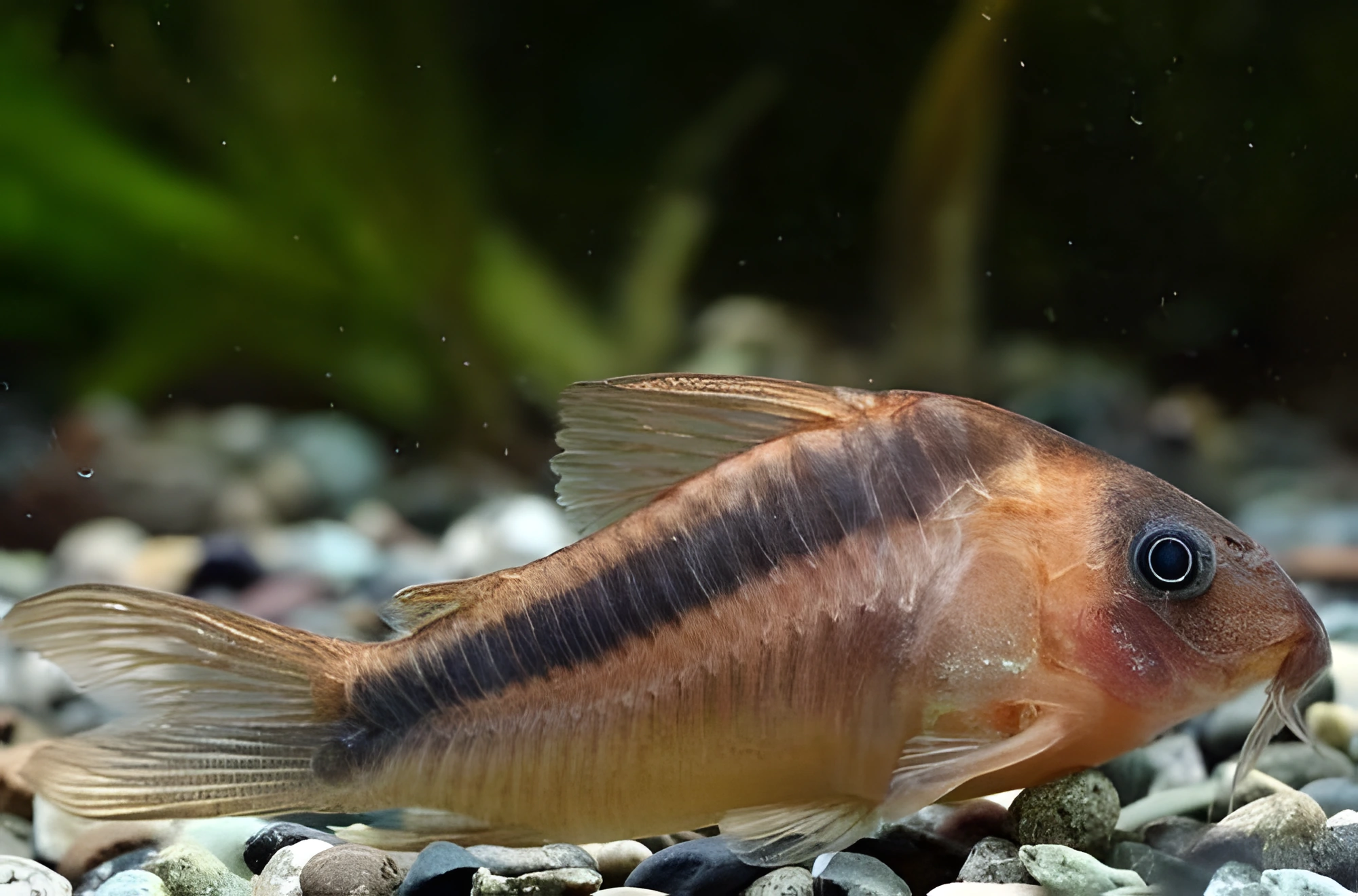
Adults of this fish typically reach a length of about 5–6 cm. Their main coloration is a rich orange-rusty hue, with a broad dark stripe running along the upper part of the body, extending from the head to the tail. Their fins are translucent and lack any patterns. Additionally, there is an artificially bred form known as Cory Albino or Albino Corydoras. A distinctive feature of this morphological form is the complete absence of pigmentation: the body and even the eyes of the fish are completely white. Sexual dimorphism in this species is not pronounced; it is quite difficult to distinguish males from females. Nevertheless, females usually appear slightly larger, which becomes particularly noticeable during spawning when their abdomen rounds out with roe.
Habitat
Rabaut's Corydoras inhabits South America, primarily in the upper Amazon River basin, including the Solimões and Rio Negro tributaries. In nature, it populates both riverine biotopes and floodplain lakes with slow currents. The water in its habitats is characterized by tropical parameters, softness, and variable acidity [fishbase.se], [seriouslyfish.com].
Behavior and Compatibility
A peaceful schooling fish, exhibiting social behavior. For their comfort, it is recommended to keep a group of 4–6 or more individuals. Corydoras are bottom-dwelling, actively exploring the substrate. They are compatible with most non-aggressive fish, but due to their activity, they may disturb more timid or slow-moving bottom dwellers [seriouslyfish.com], [theaquariumwiki.com].
Care and Maintenance
For keeping a school, an aquarium with a bottom area of at least 90x30 cm is required. Fine river sand or rounded gravel without sharp edges is essential as a substrate to avoid injuring the sensitive barbels of the catfish. Filtration, weekly water changes, and regular substrate cleaning are mandatory. The aquarium should preferably be planted and include driftwood to create hiding places [seriouslyfish.com], [zooeco.com].
Diet
An omnivorous species, feeding on small invertebrates and organic particles in nature. In the aquarium, they accept any high-quality sinking foods: specialized tablets for bottom fish, frozen bloodworms, Artemia, or tubifex. One should not rely solely on leftover food from other fish, as a complete diet is necessary for maintaining health and activity [seriouslyfish.com], [theaquariumwiki.com].
Breeding and Reproduction
Breeding occurs in spawning tanks using a group of breeders, where there should be more males than females. A massive water change to cooler water and increased aeration serve as a stimulus. The female lays eggs on the substrate or aquarium glass. After spawning, the parents are removed to prevent them from eating the clutch. Fry are sensitive to water quality and require careful care [seriouslyfish.com], [zooeco.com].
Diseases
The species is sensitive to deteriorating water quality, accumulation of organic matter, and high nitrate levels, which can lead to barbels damage and skin infections. Like all Corydoras, these fish tolerate the addition of salt to the aquarium poorly. Caution should be exercised during handling: their fins have sharp spines capable of inflicting a painful prick, and toxic glands may be located at the base of the rays [seriouslyfish.com], [theaquariumwiki.com].
How to choose
When purchasing, choose active fish with clean skin and intact barbels. Avoid individuals with sunken bellies, signs of ulcers, or body damage. In the store, the fish should show interest in foraging for food at the bottom. Given that this is a schooling species, it is recommended to acquire several individuals at once to reduce stress levels during adaptation [seriouslyfish.com], [theaquariumwiki.com].
Frequently asked questions
The essentials: size, tank volume, water parameters and care
How big does Rabaut's Corydoras get?
An adult reaches 5–6 cm in length. Plan the tank around the maximum size: the fish quickly outgrows a cramped setup.
What size aquarium does Rabaut's Corydoras need?
The minimum recommended volume is 80 L. A smaller tank speeds up nitrate build-up and raises stress levels.
What water parameters does Rabaut's Corydoras need?
Temperature 20–27 °C, pH 5.5–7.2, hardness 2–12 dGH. Stability matters more than exact values: sudden swings are harder on the fish than a small deviation from the ideal.
How long does Rabaut's Corydoras live?
Around 6 years when kept properly. Lifespan depends directly on tank volume, water quality and a varied diet.
Is Rabaut's Corydoras aggressive?
Temperament: peaceful (regular). Keep this in mind when choosing tank mates.
How many Rabaut's Corydoras should be kept together?
Recommended setup: small group (5–6 individuals). Ignoring this is a common cause of stress and disease.
What does Rabaut's Corydoras eat?
Diet type: sinking (any). Feed small portions that are finished within a couple of minutes — overfeeding does more harm than underfeeding.
What is the scientific name of Rabaut's Corydoras?
The scientific name of the species is Corydoras rabauti, family Armored Catfish (Callichthyidae). It also appears in the literature as: Corydoras meyersi, Corydoras myersi.