Temperature20 – 26 °C
Natural range
- Guaporé River basin
- Brazil area
- Bolivia area
CorydorasConservation status: Least concern LC
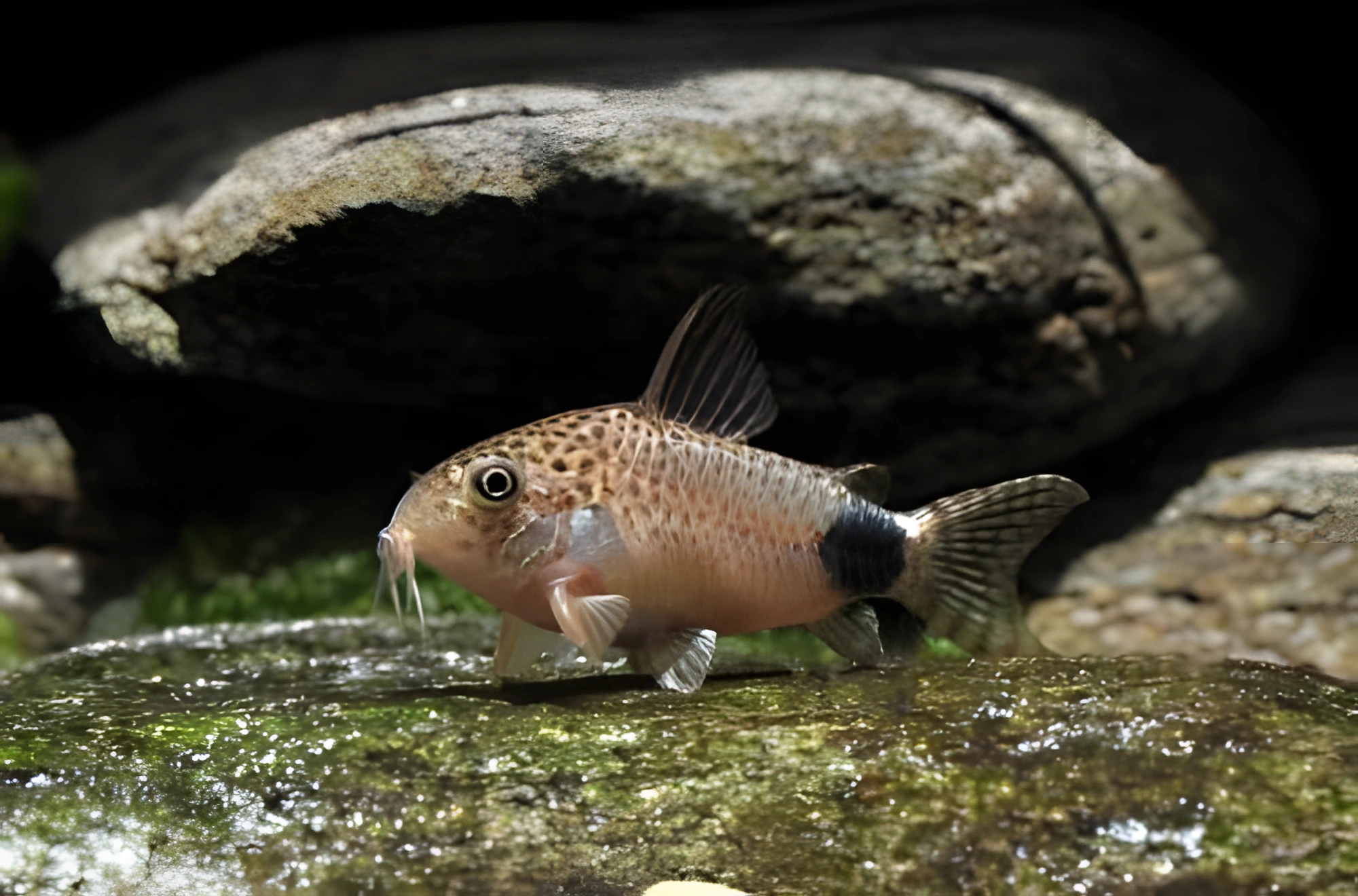
The spotted-tail Corydoras, scientifically known as Corydoras caudimaculatus, belongs to the family Callichthyidae – the armored or callichthyid catfishes. The fish is named for a distinctive feature of its body pattern: a large dark spot located at the base of its tail.
- Required aquarium volume
- 70 L
- Size in aquarium
- 4 – 5 cm
- Temperature
- 20 – 26 °C
- Temperament
- Peaceful (regular)
Parameters
Water pHSlightly acidic (6) – Neutral (7)
Water dHVery soft (2) – Medium hardness (10)
Water salinityno salt (freshwater)
Size in aquarium4 – 5 cm
Lifespan5 years
TemperamentPeaceful (regular)
Toward small fishnot a predator
Required aquarium volume70 L
Lightingdimmed or moderate
Substratesandy (regular, light)
Water flowweak or moderate
FeedingSinking (any)
CareSmall group (5–6 individuals)
Description
Adults grow up to 4–5 cm in length. This catfish is externally typical for its genus and differs from closely related species only in the details of its body pattern. Its coloration consists of gray shades with a pinkish tint, scattered with numerous dark speckles. The most notable feature, as mentioned, is the round black spot on the caudal peduncle. It is noteworthy that young fish look different from adults; they lack the characteristic spot, and their primary coloration consists of black and gray pigmentation.
Habitat
The species is endemic to the Rio Guaporé basin, which flows along the border of Brazil and Bolivia [seriouslyfish.com]. In nature, it inhabits river channels and tributaries, preferring areas with sandy bottoms and semi-open shoals. Water parameters in its natural habitat are characterized by tropical temperatures of 20 to 26 °C, soft to moderately hard water, and neutral to slightly acidic pH values [fishbase.ca].
Behavior and Compatibility
A peaceful and schooling fish, exhibiting pronounced social activity. For their well-being, it is necessary to keep a group of 4–6 individuals or more [seriouslyfish.com]. The catfishes spend most of their time in the bottom layer, actively exploring the substrate in search of food. In an aquarium, they can be timid, so the presence of shelters and dense vegetation is recommended [tropica.ru].
Care and Maintenance
For comfortable keeping of the spotted-tail Corydoras, an aquarium of 70–80 liters will be optimal, equipped with a sandy substrate and several shelters at the bottom. These can be snags or dense thickets of plants. The water should be warm, soft, and slightly acidic. It is extremely important to prevent the accumulation of organic matter and sudden fluctuations in pH and dGH parameters. To maintain a stable biological balance in the aquarium, all necessary equipment, such as heaters, a filtration system, and lighting, should be installed, and regular maintenance should be carried out. These procedures include equipment prophylaxis, weekly partial water changes with fresh water, and cleaning of the substrate and decor elements. Feeding: This species is omnivorous and readily accepts most sinking foods of appropriate size – dry, freeze-dried, frozen, or live. An important condition is that the food must be sinking, as these catfishes are bottom dwellers. Behavior and compatibility: The spotted-tail Corydoras is a calm and friendly fish. It will prefer to be in a group of its own kind, and good neighbors for it will be other peaceful species of comparable size. These corydoras can get along with almost anyone who does not pose a threat to them.
Diet
An omnivorous species that in nature feeds on small invertebrates and organic detritus. In the aquarium, they accept most types of sinking foods: high-quality dry tablets for bottom fish, as well as frozen or live foods such as bloodworms, tubifex, or brine shrimp [seriouslyfish.com]. It is recommended to diversify the diet and ensure that the food is eaten by the catfishes without polluting the substrate [tropica.ru].
Breeding and Reproduction
Reproduction occurs by laying eggs on the substrate, often on the aquarium glass or broad plant leaves. Spawning is stimulated by imitating the rainy season: massive water changes with cooler water and an increase in oxygen levels [tropica.ru]. A ratio of 2 males to 1 female is recommended. After spawning, the parents should be removed, as they may eat the eggs [seriouslyfish.com].
Diseases
The species is sensitive to water quality and the accumulation of nitrogenous compounds, which can lead to bacterial infections and damage to their delicate barbels [tropica.ru]. If an unsuitable substrate (large gravel) is used, oral injuries are possible. Prevention includes maintaining cleanliness, using fine sand as a substrate, and regular water changes [seriouslyfish.com].
How to choose
When purchasing, choose active individuals with intact fins and undamaged barbels. It is important to ensure that the fish show no signs of emaciation, ulcers, or spots on their bodies, and that their breathing is even [tropica.ru]. Since these catfishes have sharp pectoral fins capable of piercing skin, caution should be exercised when catching and transporting them [seriouslyfish.com].
Frequently asked questions
The essentials: size, tank volume, water parameters and care
How big does Spotted-tail Corydoras get?
An adult reaches 4–5 cm in length. Plan the tank around the maximum size: the fish quickly outgrows a cramped setup.
What size aquarium does Spotted-tail Corydoras need?
The minimum recommended volume is 70 L. A smaller tank speeds up nitrate build-up and raises stress levels.
What water parameters does Spotted-tail Corydoras need?
Temperature 20–26 °C, pH 6–7, hardness 2–10 dGH. Stability matters more than exact values: sudden swings are harder on the fish than a small deviation from the ideal.
How long does Spotted-tail Corydoras live?
Around 5 years when kept properly. Lifespan depends directly on tank volume, water quality and a varied diet.
Is Spotted-tail Corydoras aggressive?
Temperament: peaceful (regular). Keep this in mind when choosing tank mates.
How many Spotted-tail Corydoras should be kept together?
Recommended setup: small group (5–6 individuals). Ignoring this is a common cause of stress and disease.
What does Spotted-tail Corydoras eat?
Diet type: sinking (any). Feed small portions that are finished within a couple of minutes — overfeeding does more harm than underfeeding.
What is the scientific name of Spotted-tail Corydoras?
The scientific name of the species is Corydoras caudimaculatus, family Armored or Callichthyid Catfish (Callichthyidae).