Temperature20 – 26 °C
Natural range
- Rio Negro basin
- Meta River basin
- Guaviare River (Orinoco tributary)
- Caquetá River (Amazon tributary)
CorydorasConservation status: Least concern LC
Melini's Corydoras, scientifically known as Corydoras melini, belongs to the family Callichthyidae, which includes armored or callichthyid catfishes. The name of this fish commemorates the Swedish biologist Douglas Melin, who discovered and first described this species of catfish. The native habitat of these aquatic dwellers is in South America: the Brazilian state of Amazonas, as well as the eastern parts of Colombia. They inhabit the basins of rivers such as the Guaviare (a tributary of the Orinoco) and the Caquetá (a tributary of the Amazon). They are most often found in pristine streams and small rivers that wind through dense tropical forest thickets. The bottom landscape here is usually covered with a thick layer of fallen leaves, branches, and various snags. The water in these places acquires a rich brown hue, which is explained by the high concentration of tannins actively released during the decomposition of organic plant material.
- Required aquarium volume
- 70 L
- Size in aquarium
- 4 – 5 cm
- Temperature
- 20 – 26 °C
- Temperament
- Peaceful (regular)
Parameters
Water pHAcidic (4) – Neutral (7)
Water dHVery soft (1) – Soft (5)
Water salinityno salt (freshwater)
Size in aquarium4 – 5 cm
Lifespan5 years
TemperamentPeaceful (regular)
Toward small fishnot a predator
Required aquarium volume70 L
Lightingdimmed or moderate
Substratesandy (regular, light)
Water flowweak or moderate
FeedingSinking (any)
CareSmall group (5–6 individuals)
Description
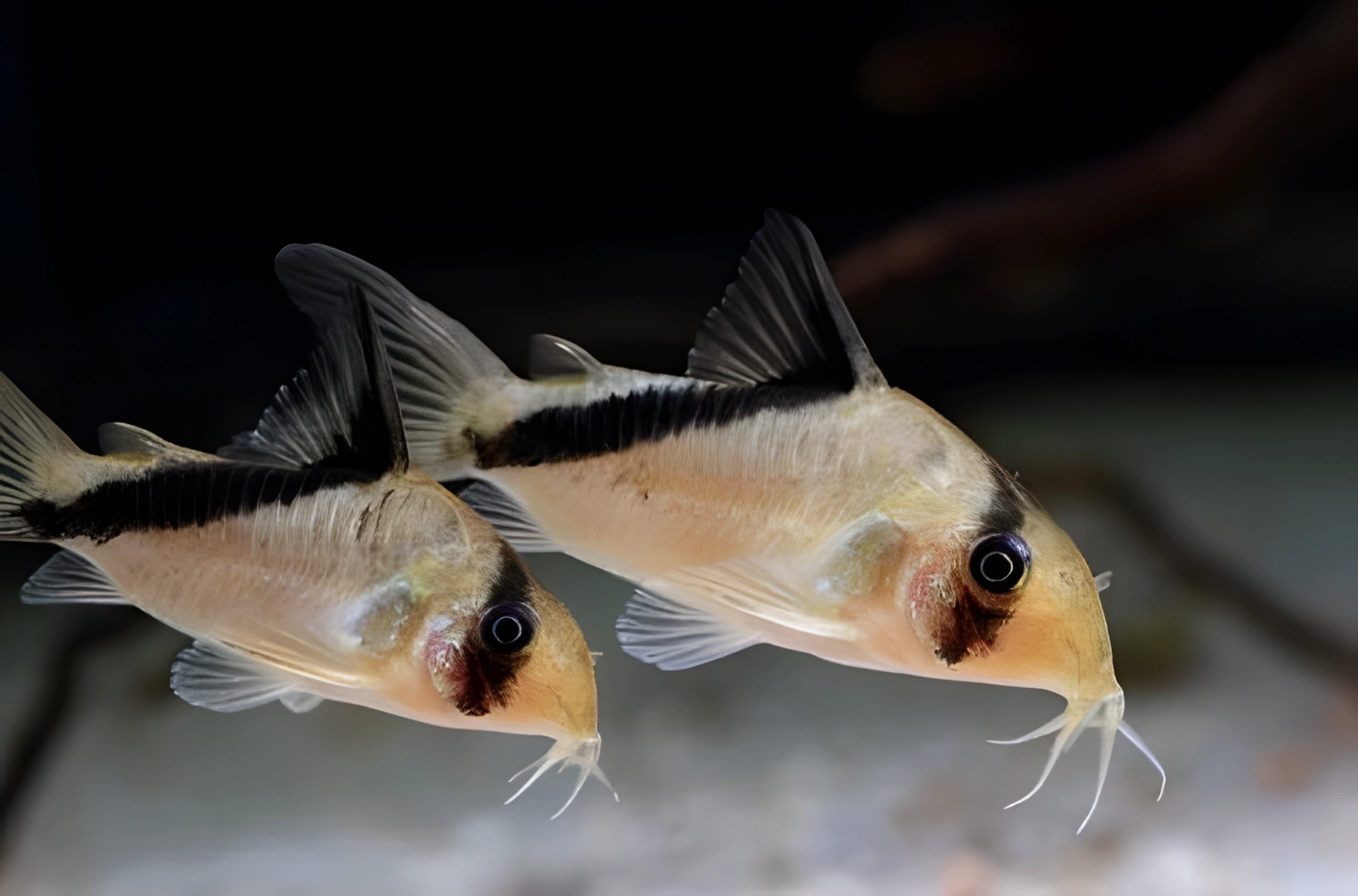
This species of catfish is a close relative of Corydoras adolfoi, Corydoras burgessi, Corydoras imitator, Corydoras sandsi, and other similar species. They share common features in their coloration and body pattern, expressed as characteristic black stripes running across the head and along the back. The coloration itself is light: silvery or white. Two natural varieties of Melini's Corydoras, indexed as “C084” and “C085,” have been noted in scientific literature. The differences between them are minimal and of interest only to biologists. Therefore, if you encounter these indices next to the fish's name when purchasing, the average aquarist should not pay much attention to them.
Habitat
Melini's Corydoras inhabits the basins of the Rio Negro and Meta rivers, which flow through Brazil and Colombia. In nature, these fish live in sections of rivers with clean, flowing water, preferring bottom layers with soft or sandy substrate, where they can use their sensitive barbels to search for food.
Behavior and Compatibility
This is a peaceful and shoaling fish that is recommended to be kept in groups of 5–6 individuals. In the aquarium, they primarily lead a benthic lifestyle, showing the most activity at dusk and during the day if there are sufficient hiding places. They get along well with most calm fish species that inhabit the middle and upper water layers.
Care and Maintenance
This fish is considered undemanding, and its keeping is well within the capabilities of even beginner aquarists. To create a favorable environment for these catfishes, several important conditions must be met: a spacious tank of at least 70 L for a group of 4–6 individuals, maintaining low pH and dGH values, and choosing a soft sandy or fine-gravel substrate. An important element is also the presence of hiding places on the bottom. Maintaining a healthy ecosystem in the aquarium directly depends on the uninterrupted operation of equipment, primarily the filtration system, as well as weekly partial water changes with fresh water of similar hydrochemical parameters and regular removal of organic waste. Experienced aquarists often add leaves from certain trees to the bottom: during decomposition, they release tannins, which helps to recreate a water chemistry as close as possible to the fish's natural habitat. You can learn more about this in the article “What tree leaves can be used in an aquarium.” As for feeding, Melini's Corydoras readily accepts most popular foods – dry, frozen, and live. A varied diet, including different types of food, is always welcome. It is preferable to use sinking foods. This is a peaceful and friendly fish. It prefers to be in a group of its own kind, so it is recommended to acquire a shoal of 4–6 individuals. Usually, different Corydoras species stay separate, but closely related species often form mixed groups. They are well compatible with many non-aggressive fish of comparable size.
Diet
In their natural environment, they feed on small crustaceans, insect larvae, worms, and organic detritus. In the aquarium, they accept all types of quality sinking foods: specialized catfish tablets, frozen or live foods (brine shrimp, bloodworms, tubifex). It is important to provide a varied diet and ensure that the food reaches the bottom.
Breeding and Reproduction
Spawning occurs in a separate breeding tank. The female lays eggs in batches, holding them between her pelvic fins for fertilization by the male, after which she attaches them to plant leaves or the glass. Parents do not show care for their offspring and may eat the eggs, so it is recommended to remove the adults after spawning is complete.
Diseases
The species has a strong immune system when water purity is maintained. The main health problems arise from high nitrate, ammonia content, or injury to the barbels from sharp substrate. Regular water changes and the use of a soft substrate are important to avoid bacterial infections and erosion of soft tissues.
How to choose
When purchasing, choose active fish with clean fins and no white film on the body. It is important to ensure that the fish's barbels are intact and the abdomen does not appear sunken, which may indicate emaciation or internal parasitic diseases. Healthy individuals should show interest in foraging for food on the aquarium bottom.
Frequently asked questions
The essentials: size, tank volume, water parameters and care
How big does Melini's Corydoras get?
An adult reaches 4–5 cm in length. Plan the tank around the maximum size: the fish quickly outgrows a cramped setup.
What size aquarium does Melini's Corydoras need?
The minimum recommended volume is 70 L. A smaller tank speeds up nitrate build-up and raises stress levels.
What water parameters does Melini's Corydoras need?
Temperature 20–26 °C, pH 4–7, hardness 1–5 dGH. Stability matters more than exact values: sudden swings are harder on the fish than a small deviation from the ideal.
How long does Melini's Corydoras live?
Around 5 years when kept properly. Lifespan depends directly on tank volume, water quality and a varied diet.
Is Melini's Corydoras aggressive?
Temperament: peaceful (regular). Keep this in mind when choosing tank mates.
How many Melini's Corydoras should be kept together?
Recommended setup: small group (5–6 individuals). Ignoring this is a common cause of stress and disease.
What does Melini's Corydoras eat?
Diet type: sinking (any). Feed small portions that are finished within a couple of minutes — overfeeding does more harm than underfeeding.
What is the scientific name of Melini's Corydoras?
The scientific name of the species is Corydoras melini, family Armored or Callichthyid Catfish (Callichthyidae).