Temperature20 – 23 °C
Natural range
- Colombia area
CorydorasConservation status: Least concern LC
Corydoras melanotaenia, also known as the Rainbow Corydoras (scientific name Corydoras melanotaenia), belongs to the family Callichthyidae, or armored catfishes. This catfish is native to South America, where it inhabits the Meta River basin—a large tributary of the Orinoco, located in Colombia and Venezuela. In nature, these fish are found in small tributaries, streams, on sandy shoals, and in areas of flooded forest.
- Required aquarium volume
- 50 L
- Size in aquarium
- 6 cm
- Temperature
- 20 – 23 °C
- Temperament
- Peaceful, calm/shy/inactive
Parameters
Water pHSlightly acidic (6) – Neutral (7.2)
Water dHVery soft (2) – Hard (15)
Water salinityno salt (freshwater)
Size in aquarium6 cm
Lifespan5 years
TemperamentPeaceful, calm/shy/inactive
Toward small fishnot a predator
Required aquarium volume50 L
Lightingdimmed or moderate
Substratesoft silted
Water flowweak or moderate
FeedingSinking (any)
CareSmall group (3–4 individuals)
Description
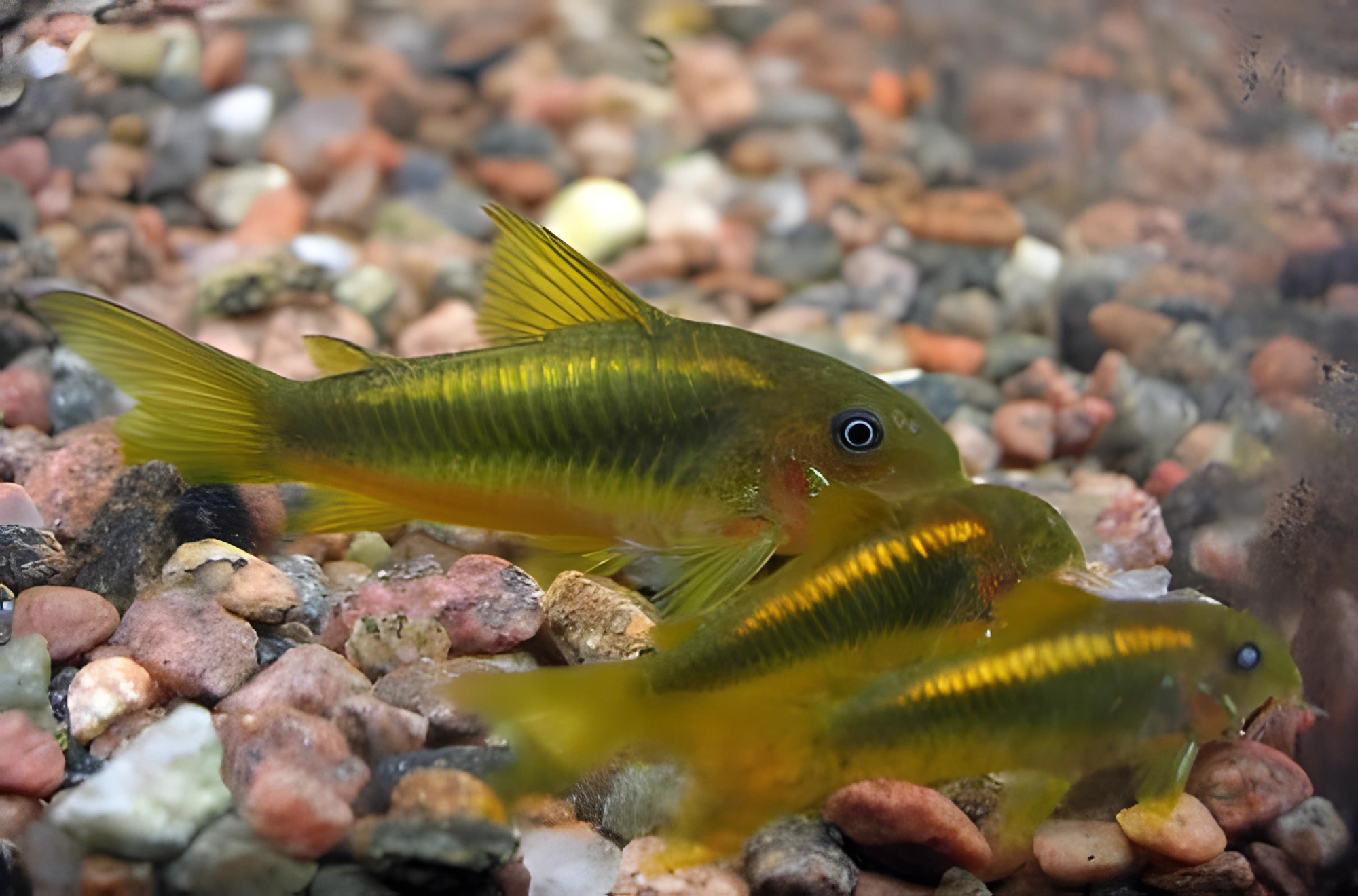
Adults grow to approximately 6 cm in length. Their appearance is typical of armored catfishes: the body is protected by two rows of bony plates instead of ordinary scales, and the first rays of the pectoral fins are modified into sharp spines. Although at first glance they resemble Golden Corydoras, upon closer inspection, Corydoras melanotaenia exhibit characteristic golden-yellow hues that shimmer into green tones. As with most Corydoras, determining the sex of these fish is quite difficult, as males and females are practically identical in external characteristics.
Habitat
The species is endemic to the Meta River basin in Colombia [seriouslyfish.com]. In nature, it inhabits small tributaries, streams, as well as flooded forest areas and sandy shoals. It prefers areas with soft substrate and moderate current, where the water may be stained a weak tea color by organic matter.
Behavior and Compatibility
These fish are distinguished by their particular peacefulness and calm disposition. They are schooling fish, so it is recommended to keep groups of at least 3–4 individuals in aquariums. They coexist well with most other aquarium fish species of comparable size. However, since they are bottom dwellers, care should be taken to avoid keeping them with territorial species, such as some loaches or other catfishes.
Care and Maintenance
For keeping 3–4 catfishes, an aquarium of at least 50 liters will be optimal. The setup should preferably include a sandy substrate, several natural snags, and dense thickets of live plants. Tree bark and leaves can also be placed on the bottom. These fish prefer subdued lighting and often hide during the day, becoming active mainly at dusk or night. They are capable of using atmospheric air for breathing, rising to the surface for a gulp, so it is important to leave open water areas free of floating plants. Corydoras melanotaenia are not particularly demanding regarding water parameters; they adapt well to a wide range of pH and GH values, but still prefer a softer and more acidic environment. However, they are sensitive to pollution by organic waste, such as food remnants and excrement, which can lead to diseases and damage to their sensitive barbels. Therefore, it is necessary to regularly, at least once a month, clean the substrate of accumulated deposits. These catfishes are omnivorous and readily accept most popular foods. Natural foods such as fresh, frozen, or dry daphnia, bloodworms, Artemia, and other zooplankton will be an especially good choice.
Diet
Corydoras melanotaenia are omnivorous and readily accept most popular types of food. Natural foods such as fresh, frozen, or dry daphnia, bloodworms, Artemia, and other zooplankton will be an excellent choice. Under favorable conditions, this species often breeds successfully, but the catfishes show no parental care. To protect eggs and fry from predation by adult fish during breeding, a separate spawning tank is required. Detailed information on breeding Corydoras at home can be found in a separate article.
Breeding and Reproduction
Under suitable conditions, Corydoras melanotaenia breed quite frequently. It should be noted that these catfishes do not exhibit parental care. For successful breeding, it is recommended to use a separate spawning tank to protect the eggs and fry from being eaten by adult fish. More detailed information on breeding Corydoras in home aquariums can be found in a specialized article. Sources: fishbase.org, seriouslyfish.com, scotcat.com
Diseases
Fish are sensitive to water quality and substrate cleanliness. When kept in unsanitary conditions or on contaminated substrate, individuals often show erosion and damage to their barbels, which can lead to secondary bacterial infections. Prevention includes regular water changes, gravel vacuuming, and the use of soft sand to prevent injury to their delicate sensory organs.
How to choose
When choosing, attention should be paid to the integrity of the fins and the absence of damage in the barbel area. Healthy individuals should be active, show interest in foraging for food in the substrate, and have no signs of emaciation or spots on the body. When purchasing, it is important to consider that fish feel most comfortable in a group, so it is recommended to acquire at least six individuals to reduce stress levels [seriouslyfish.com].
Frequently asked questions
The essentials: size, tank volume, water parameters and care
How big does Corydoras melanotaenia get?
An adult reaches 6 cm in length. Plan the tank around the maximum size: the fish quickly outgrows a cramped setup.
What size aquarium does Corydoras melanotaenia need?
The minimum recommended volume is 50 L. A smaller tank speeds up nitrate build-up and raises stress levels.
What water parameters does Corydoras melanotaenia need?
Temperature 20–23 °C, pH 6–7.2, hardness 2–15 dGH. Stability matters more than exact values: sudden swings are harder on the fish than a small deviation from the ideal.
How long does Corydoras melanotaenia live?
Around 5 years when kept properly. Lifespan depends directly on tank volume, water quality and a varied diet.
Is Corydoras melanotaenia aggressive?
Temperament: peaceful, calm/shy/inactive. Keep this in mind when choosing tank mates.
How many Corydoras melanotaenia should be kept together?
Recommended setup: small group (3–4 individuals). Ignoring this is a common cause of stress and disease.
What does Corydoras melanotaenia eat?
Diet type: sinking (any). Feed small portions that are finished within a couple of minutes — overfeeding does more harm than underfeeding.
What is the scientific name of Corydoras melanotaenia?
The scientific name of the species is Corydoras melanotaenia, family Armored Catfish (Callichthyidae).