Temperature22 – 28 °C
Natural range
- Guaporé River basin
- Rondônia area
- Brazil area
- Bolivia area
Corydoras
The Guapore Corydoras, officially known as Corydoras guapore, belongs to the extensive armored catfish family (Callichthyidae). This catfish was named after its initial discovery location – the basin of the eponymous Guaporé River. This river serves as a natural border between the Bolivian northeastern provinces and the Brazilian state of Rondônia in South America. It prefers to inhabit small rivers and streams, only occasionally being found in the main channel. The natural habitat of this species is characterized by water of a rich brown hue. This is due to the high concentration of tannins, which dissolve in the water during the decomposition of organic plant materials.
- Required aquarium volume
- 80 L
- Size in aquarium
- 4 – 5 cm
- Temperature
- 22 – 28 °C
- Temperament
- Peaceful (regular)
Parameters
Water pHSlightly acidic (5) – Neutral (7)
Water dHVery soft (2) – Hard (12)
Water salinityno salt (freshwater)
Size in aquarium4 – 5 cm
Lifespan5 years
TemperamentPeaceful (regular)
Toward small fishnot a predator
Required aquarium volume80 L
Lightingweak (low)
Substratesandy (regular, light)
Water flowweak or moderate
FeedingAny (universal)
CareSmall group (5–6 individuals)
Description
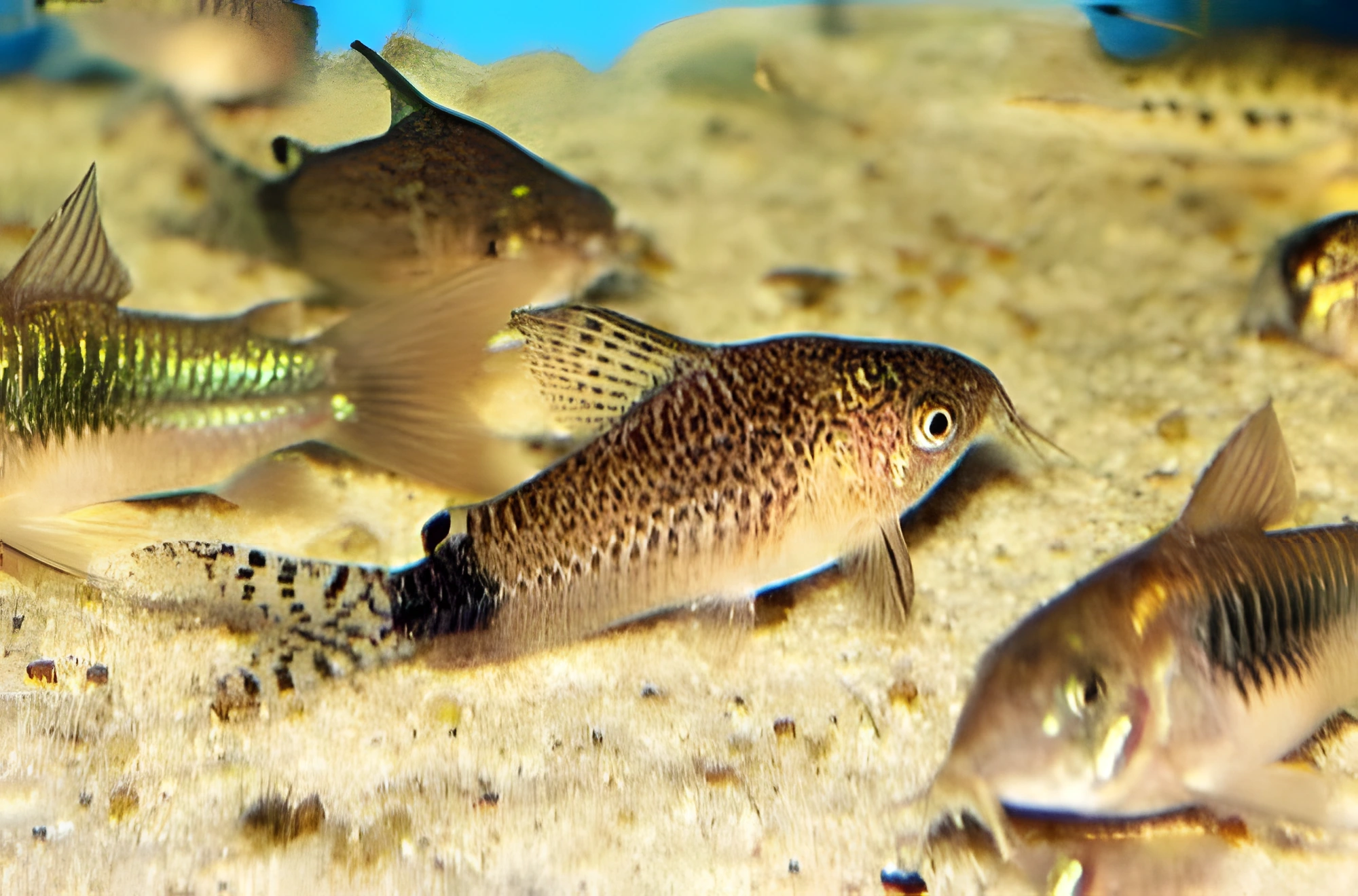
Occasionally, this catfish can be confused with other similar species, particularly the Spot-tailed Corydoras. Both species have a similar body pattern, consisting of numerous small dark speckles, as well as a distinct large black spot at the base of the caudal fin. However, the similarities end there. The Guapore Corydoras exhibits a somewhat different lifestyle, which is reflected in its morphological features. Unlike most other catfish, this fish spends a significant portion of its time not at the bottom, but in the water column. Its body has acquired a more symmetrical shape, and its tail has become forked, which facilitates swimming. Its eyes are larger, which helps in finding food in murky water, while the barbels around its mouth, conversely, have become less pronounced.
Habitat
The species is endemic to the Guaporé River basin, which flows through Brazil and Bolivia. In nature, it inhabits bodies of water with warm, acidic, and clear water, often rich in tannins. It prefers areas with sandy bottoms and abundant riparian vegetation.
Behavior and Compatibility
A peaceful and schooling fish. Unlike most of its relatives, this species often spends time in the water column, not just at the bottom, which is due to its biological characteristics. It is recommended to keep them in a group of 4–6 individuals to ensure comfortable social behavior.
Care and Maintenance
For a group of 4–6 catfish, the optimal aquarium volume starts from 80 liters. In the aquascape, it is important to provide open water areas, offering ample space for swimming. Excessive overgrowth or the use of too many tall decorative elements is not recommended. Nevertheless, the presence of shelters will be very useful, and natural snags are perfectly suited for this purpose. The use of snags, as well as leaves from certain tree species, has a beneficial effect on the water's chemical composition, bringing it closer to natural conditions. These elements are a source of tannins, which soften the water and give it a characteristic brownish tint. Additional information can be found in the article “What Tree Leaves Can Be Used in an Aquarium”. Successful long-term keeping requires maintaining a stable aquatic environment within acceptable temperature and hydrochemical parameters. The accumulation of organic waste, such as food remnants and excrement, should be avoided, and regular aquarium maintenance should be performed: weekly partial water changes, cleaning the substrate, glass, and decor elements, as well as prophylactic inspection of equipment. Regarding feeding, the best choice will be a varied diet, including dry, frozen, or live foods. It is advisable to use foods that float on the surface, or nutritious tablets and gels that can be attached to decor elements or the glass. Behavior and Compatibility: This peaceful and friendly fish coexists well with many non-aggressive species of comparable size. Compatibility problems are usually absent.
Diet
An omnivorous species. In the aquarium, the diet should consist of high-quality sinking foods for bottom-dwelling fish, supplemented with live or frozen products such as daphnia, artemia, and small insect larvae. It is important to ensure dietary diversity, as the species is partially adapted to feeding on plankton in the water column.
Breeding and Reproduction
Breeding in an aquarium is rare. Spawning is stimulated by a large water change (50–70%) with cooler water and increased aeration. Females lay their eggs on plant leaves or the aquarium glass. After spawning, it is recommended to remove the parents, as they may eat the eggs. Rearing fry requires high water quality and the use of small starter foods.
Diseases
The species is sensitive to water quality and the accumulation of organic waste. Under poor keeping conditions, it is susceptible to diseases typical for catfish, such as bacterial infections of the fins and skin. Prevention includes regular water changes, using a sand substrate without sharp edges, and maintaining stable hydrochemical parameters.
How to choose
When purchasing, choose active fish with clean fins and no visible body damage. It is important to ensure that the specimens show no signs of emaciation or skin lesions. Avoid individuals with sunken bellies or apathetic behavior, as weakened fish have difficulty adapting to a new aquarium.
Frequently asked questions
The essentials: size, tank volume, water parameters and care
How big does Guapore Corydoras get?
An adult reaches 4–5 cm in length. Plan the tank around the maximum size: the fish quickly outgrows a cramped setup.
What size aquarium does Guapore Corydoras need?
The minimum recommended volume is 80 L. A smaller tank speeds up nitrate build-up and raises stress levels.
What water parameters does Guapore Corydoras need?
Temperature 22–28 °C, pH 5–7, hardness 2–12 dGH. Stability matters more than exact values: sudden swings are harder on the fish than a small deviation from the ideal.
How long does Guapore Corydoras live?
Around 5 years when kept properly. Lifespan depends directly on tank volume, water quality and a varied diet.
Is Guapore Corydoras aggressive?
Temperament: peaceful (regular). Keep this in mind when choosing tank mates.
How many Guapore Corydoras should be kept together?
Recommended setup: small group (5–6 individuals). Ignoring this is a common cause of stress and disease.
What does Guapore Corydoras eat?
Diet type: any (universal). Feed small portions that are finished within a couple of minutes — overfeeding does more harm than underfeeding.
What is the scientific name of Guapore Corydoras?
The scientific name of the species is Corydoras guapore, family (Armored or Callichthyid Catfishes).