Temperature20 – 26 °C
Natural range
- Amazon River Basin
- Orosa River Basin
- Peru area
- Ecuador area
CorydorasConservation status: Least concern LC
Other scientific names: Corydoras pestai, Corydorus elegans
The Elegant Corydoras, scientifically known as Corydoras elegans, belongs to the family Callichthyidae, which includes armored or callichthyid catfishes. Its name is derived from the Latin word "elegans," meaning "beautiful, elegant, graceful." This fish species originates from South America, where it inhabits vast areas of the upper Amazon River basin, including northern Peru, Ecuador, and the western regions of Brazil. The typical habitat of the corydoras is forest streams or small rivers characterized by silty sandy substrates, often strewn with fallen leaves and tree branches.
- Required aquarium volume
- 80 L
- Size in aquarium
- 5 – 5.1 cm
- Temperature
- 20 – 26 °C
- Temperament
- Peaceful (regular)
Parameters
Water pHSlightly acidic (6) – Neutral (7.5)
Water dHVery soft (1) – Hard (15)
Water salinityno salt (freshwater)
Size in aquarium5 – 5.1 cm
Lifespan5 years
TemperamentPeaceful (regular)
Toward small fishnot a predator
Required aquarium volume80 L
Lightingweak (low)
Substratesandy (regular, light)
Water flowweak or moderate
FeedingSinking (any)
CareSmall group (5–6 individuals)
Description
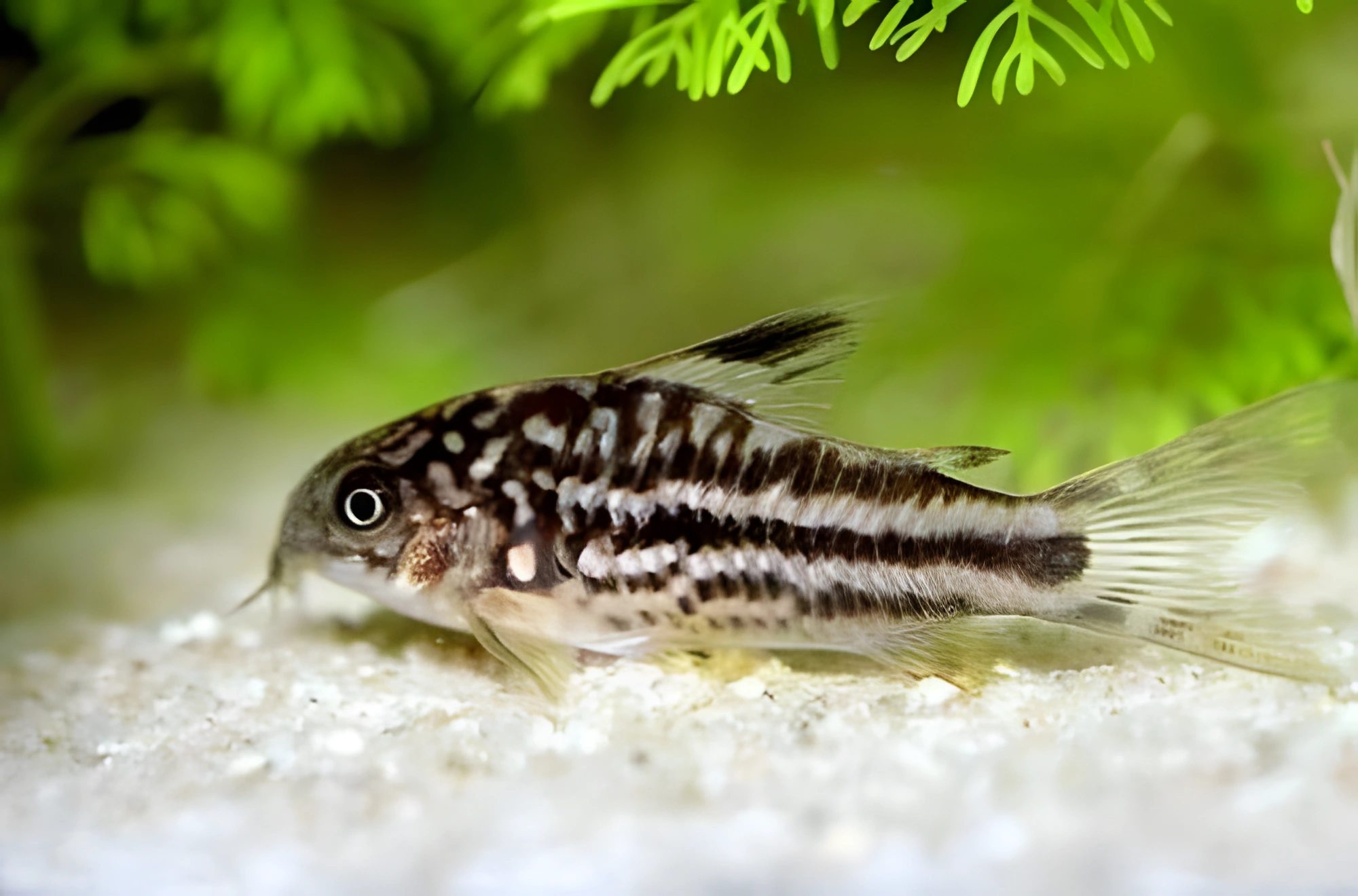
Adults grow up to 5 cm in length. Their coloration is gray, adorned with a mosaic pattern of dark speckles and dashes. Two light stripes run along the body from head to tail. The spotted pattern continues on the dorsal fin, while the other fins and tail remain translucent.
Habitat
The Elegant Corydoras inhabits the Amazon River basin, including the Orosa River basin in Peru [theaquariumwiki.com]. In nature, it lives in slow-flowing waters with soft water, preferring areas with dense vegetation and soft substrate.
Behavior and Compatibility
A peaceful schooling fish, it is recommended to keep them in groups of 5-6 individuals to ensure a sense of security [theaquariumwiki.com]. They are primarily bottom-dwellers, actively exploring the substrate in search of food. They are compatible with most non-aggressive fish that occupy the middle and upper water layers. Caution should be exercised when using a net, as their fins have sharp spines that can get entangled [theaquariumwiki.com].
Care and Maintenance
This species is one of the popular corydoras and is often found in the aquarium trade. Corydoras elegans has been kept in captivity for many generations, which has allowed it to adapt well to conditions different from its wild relatives' habitat. It is quite easy to care for and demonstrates excellent adaptability to a wide range of pH and dGH values. Regular aquarium maintenance, including partial water changes and waste removal, as well as an effective filtration system, helps maintain high water quality. For aquarium decor, a sandy or fine-gravel substrate is recommended; natural or artificial driftwood, as well as dense plant thickets and other decorative elements, will serve as suitable shelters. Diet: This is an omnivorous species that readily accepts various common aquarium foods. Its diet can include dry and freeze-dried foods, as well as live and frozen products such as brine shrimp, daphnia, and bloodworms. Behavior and compatibility: Unlike many of its relatives, this corydoras prefers to stay in the water column rather than exclusively at the bottom. It is a peaceful, friendly fish. For comfortable existence, it is advisable to keep these fish in groups of at least 4–6 individuals. They are well compatible with other corydoras species and non-aggressive fish of comparable size.
Diet
An omnivorous species, it will eat any sinking food in the aquarium [theaquariumwiki.com]. The diet should include high-quality sinking tablets for catfish, supplemented with frozen foods such as bloodworms or brine shrimp. Due to the fish's slow eating habits, it is important to ensure that the food reaches the bottom and is available to the corydoras for a sufficient amount of time.
Breeding and Reproduction
Breeding is possible in a separate spawning tank [aquael.ru]. Stimulation is provided by frequent water changes with cooler water and increased feeding with protein-rich foods. After spawning, the parents should be removed to prevent them from eating the eggs. Fry hatch after a few days and begin feeding after the yolk sac is absorbed [aquael.ru].
Diseases
The species is sensitive to water quality and substrate cleanliness. If kept on sharp or coarse gravel, their delicate barbels may be damaged, opening the way for bacterial infections [theaquariumwiki.com]. The fish tolerate salt poorly in the water, so its use for medicinal purposes is not recommended. Prevention involves regular gravel vacuuming and maintaining stable environmental parameters.
How to choose
When purchasing, choose active individuals with clean skin, free from visible damage, spots, or ulcers. It is important to inspect the barbels: they should be intact, without signs of erosion or truncation [theaquariumwiki.com]. Healthy fish show interest in searching for food on the bottom and do not appear emaciated.
Frequently asked questions
The essentials: size, tank volume, water parameters and care
How big does Elegant Corydoras get?
An adult reaches 5–5.1 cm in length. Plan the tank around the maximum size: the fish quickly outgrows a cramped setup.
What size aquarium does Elegant Corydoras need?
The minimum recommended volume is 80 L. A smaller tank speeds up nitrate build-up and raises stress levels.
What water parameters does Elegant Corydoras need?
Temperature 20–26 °C, pH 6–7.5, hardness 1–15 dGH. Stability matters more than exact values: sudden swings are harder on the fish than a small deviation from the ideal.
How long does Elegant Corydoras live?
Around 5 years when kept properly. Lifespan depends directly on tank volume, water quality and a varied diet.
Is Elegant Corydoras aggressive?
Temperament: peaceful (regular). Keep this in mind when choosing tank mates.
How many Elegant Corydoras should be kept together?
Recommended setup: small group (5–6 individuals). Ignoring this is a common cause of stress and disease.
What does Elegant Corydoras eat?
Diet type: sinking (any). Feed small portions that are finished within a couple of minutes — overfeeding does more harm than underfeeding.
What is the scientific name of Elegant Corydoras?
The scientific name of the species is Corydoras elegans, family Armored or Callichthyid Catfish (Callichthyidae). It also appears in the literature as: Corydoras pestai, Corydorus elegans.