Temperature20 – 26 °C
Natural range
- Rio Negro basin
- Brazil-Colombia border region
- Brazil area
- Colombia area
CorydorasConservation status: Data deficient DD
Corydoras duplicareus, known scientifically as Corydoras duplicareus, belongs to the family Callichthyidae, which unites armored or callichthyid catfishes. The name "duplicareus" has Latin roots, deriving from the word "duplicare," which translates to "to double" or "to multiply by two." Thus, the scientists who gave it this name aimed to emphasize its external resemblance to Corydoras adolfoi, which had been discovered earlier.
- Required aquarium volume
- 80 L
- Size in aquarium
- 4 – 5 cm
- Temperature
- 20 – 26 °C
- Temperament
- Peaceful (regular)
Parameters
Water pHSlightly acidic (5) – Neutral (7)
Water dHVery soft (1) – Medium hardness (8)
Water salinityno salt (freshwater)
Size in aquarium4 – 5 cm
Lifespan8 years
TemperamentPeaceful (regular)
Toward small fishnot a predator
Required aquarium volume80 L
Lightingweak (low)
Substratesandy (regular, light)
Water flowweak or moderate
FeedingSinking (any)
CareSmall group (5–6 individuals)
Description
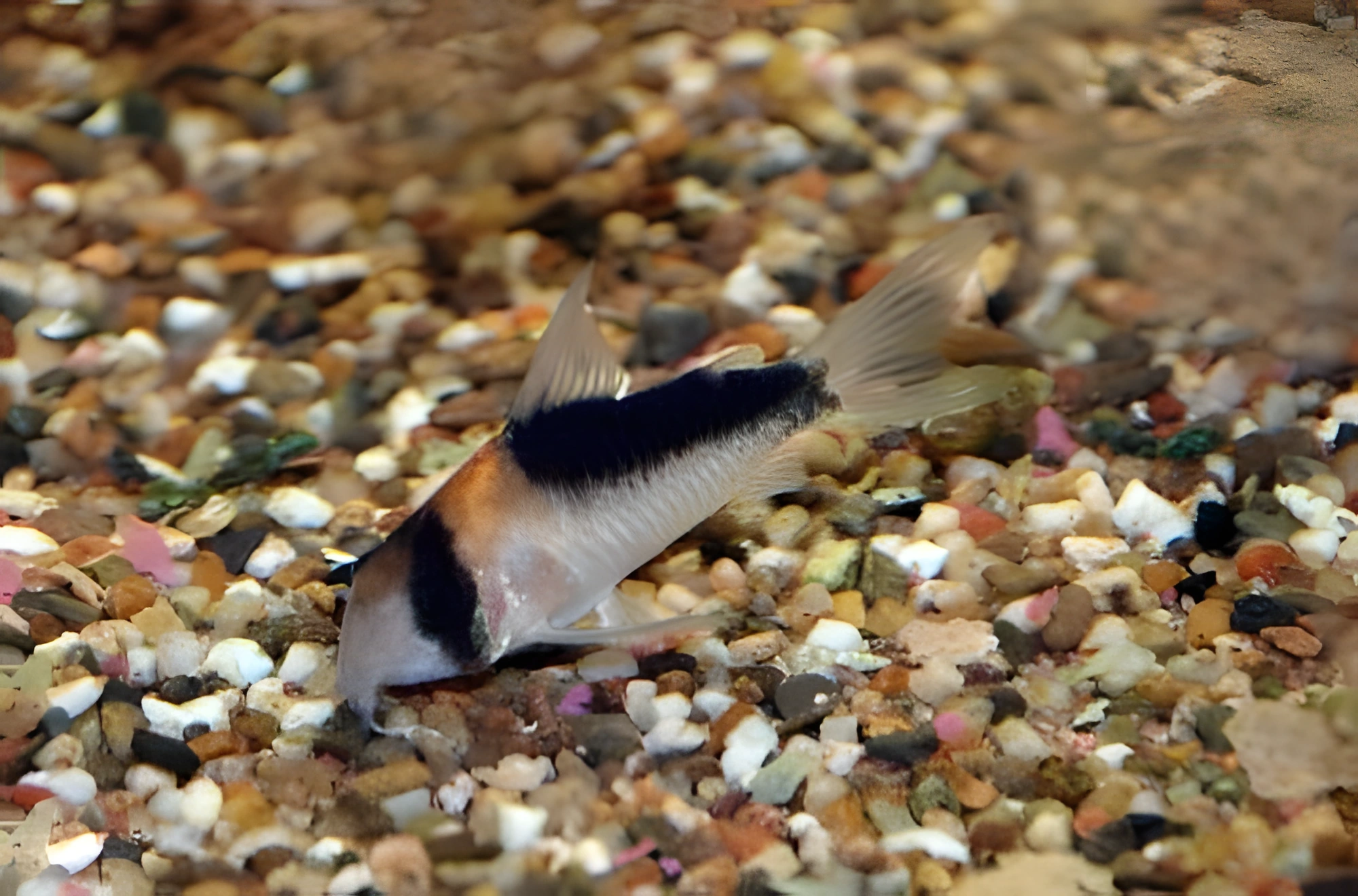
Adults of this species reach 4–5 cm in length. Distinguishing Corydoras adolfoi from Corydoras duplicareus by external features is quite difficult. The latter usually has wider and more intense dark stripes on its back and head, and the orange pigment is more pronounced. However, these characteristics are not reliable for precise species identification. The only reliable difference lies in the presence of very fine serrations on the posterior edge of the pectoral fins of Corydoras duplicareus, which, however, are impossible to see without magnifying devices.
Habitat
The species inhabits South America, in the Rio Negro basin, primarily in areas adjacent to the border of Brazil and Colombia. It populates small forest streams and tributaries with slow to moderate currents, where the bottom is covered with a layer of fallen leaves and organic matter. The water in these biotopes is characterized by a rich brown tint due to high tannin content, low hardness, and acidic pH.
Behavior and Compatibility
A peaceful and social schooling fish, it feels most comfortable in groups of 4–6 individuals. It leads a bottom-dwelling lifestyle, spending most of its time searching for food in the substrate. It is well compatible with other peaceful fish species of comparable size. When kept in a community tank, avoid cohabitation with aggressive or excessively large fish that may exhibit territoriality or cause injury.
Care and Maintenance
Keeping these fish is not particularly difficult. They require a soft, slightly acidic water environment and a varied and balanced diet. It is important to avoid cohabitation with aggressive fish species. For a group of 4–6 individuals, an aquarium of at least 80 liters will be optimal. For decor, sandy or fine gravel substrate is preferred. Also use various shelters: driftwood, dense plant thickets, or other natural or artificial decorative elements. Experienced aquarists often add dried leaves from certain tree species to the aquarium, which not only gives the decor a more natural look but also positively affects the water's chemical composition, bringing it closer to the fish's natural habitat conditions. As they decompose, the leaves release tannins. More detailed information can be found in the article “What tree leaves can be used in an aquarium.” Maintaining a stable biological balance in the aquarium directly depends on the uninterrupted operation of equipment, primarily the filtration system, as well as regular maintenance. Weekly partial water changes with fresh water are required, maintaining the same pH and dGH values, and removing accumulating organic waste such as food particles and excrement. Regarding feeding, these fish are omnivores. Over many generations of life in artificial conditions, Corydoras duplicareus has adapted well to consuming dry foods, presented as flakes, granules, tablets, or gels. It is recommended to supplement their diet with live or frozen foods such as brine shrimp, daphnia, bloodworms, and others. As for behavior and compatibility, these are peaceful and social fish that thrive in the company of other calm and non-aggressive species of comparable size. Other Corydoras species can be good tank mates, but it should be remembered that closely related species, such as Corydoras adolfoi, Corydoras sanda, Corydoras burgessi, and others, can potentially interbreed and produce hybrid offspring.
Diet
An omnivorous species. In the aquarium, it accepts all types of sinking foods: specialized tablets for bottom-dwelling fish, granules, and flakes. To maintain health and vibrant coloration, it is recommended to regularly include live or frozen foods in the diet, such as brine shrimp, daphnia, or bloodworms. Food must reach the bottom, as the fish are adapted to feed exclusively in the benthic layer.
Breeding and Reproduction
Breeding takes place in a separate spawning tank using soft, slightly acidic water. A stimulus for spawning is a partial water change with fresh water and a reduction in temperature. The female lays eggs on broad plant leaves or flat stones, which are cleaned beforehand. Parents generally do not exhibit pronounced cannibalism towards the eggs; however, to increase fry survival, it is best to remove the parents after spawning.
Diseases
Sensitive to water quality and the accumulation of organic waste, which can lead to bacterial infections, fin rot, or fungal lesions. The species tolerates elevated concentrations of salt and copper in the water poorly. Prevention involves weekly water changes, maintaining substrate cleanliness, and using quality food. If barbels are damaged by sharp-edged substrate, the risk of secondary infections increases.
How to choose
When purchasing, choose active individuals with clean fins and no spots or cottony growth on the body. It is important to ensure that the fish's barbels are intact, as their absence indicates poor keeping conditions or injury from sharp substrate. Healthy Corydoras should show interest in foraging for food on the bottom and not appear emaciated.
Frequently asked questions
The essentials: size, tank volume, water parameters and care
How big does Corydoras duplicareus get?
An adult reaches 4–5 cm in length. Plan the tank around the maximum size: the fish quickly outgrows a cramped setup.
What size aquarium does Corydoras duplicareus need?
The minimum recommended volume is 80 L. A smaller tank speeds up nitrate build-up and raises stress levels.
What water parameters does Corydoras duplicareus need?
Temperature 20–26 °C, pH 5–7, hardness 1–8 dGH. Stability matters more than exact values: sudden swings are harder on the fish than a small deviation from the ideal.
How long does Corydoras duplicareus live?
Around 8 years when kept properly. Lifespan depends directly on tank volume, water quality and a varied diet.
Is Corydoras duplicareus aggressive?
Temperament: peaceful (regular). Keep this in mind when choosing tank mates.
How many Corydoras duplicareus should be kept together?
Recommended setup: small group (5–6 individuals). Ignoring this is a common cause of stress and disease.
What does Corydoras duplicareus eat?
Diet type: sinking (any). Feed small portions that are finished within a couple of minutes — overfeeding does more harm than underfeeding.
What is the scientific name of Corydoras duplicareus?
The scientific name of the species is Corydoras duplicareus, family Armored or Callichthyid Catfish (Callichthyidae).