Temperature21 – 28 °C
Natural range
- Suriname area
CorydorasConservation status: Least concern LC
Boeseman's Corydoras, scientifically known as Corydoras boesemani, belongs to the family Callichthyidae, which includes armored or callichthyid catfishes. This fish is named in honor of Dr. Marcus Boeseman, as he collected most of the type series. This catfish originates from South America, where its habitat is the Suriname River basin, which serves as a natural border between Suriname and French Guiana. These fish prefer shallow areas of rivers flowing through humid tropical forests. Their typical biotope often consists of a stream with a substrate of sand and silt, rich in organic debris such as branches, roots, and fallen leaves.
- Required aquarium volume
- 80 L
- Size in aquarium
- 4 cm
- Temperature
- 21 – 28 °C
- Temperament
- Peaceful (regular)
Parameters
Water pHSlightly acidic (5.5) – Neutral (7.5)
Water dHVery soft (1) – Medium hardness (10)
Water salinityno salt (freshwater)
Size in aquarium4 cm
Lifespan5 years
TemperamentPeaceful (regular)
Toward small fishnot a predator
Required aquarium volume80 L
Lightingweak (low)
Substratesandy (regular, light)
Water flowweak or moderate
FeedingSinking (any)
CareSmall group (5–6 individuals)
Description
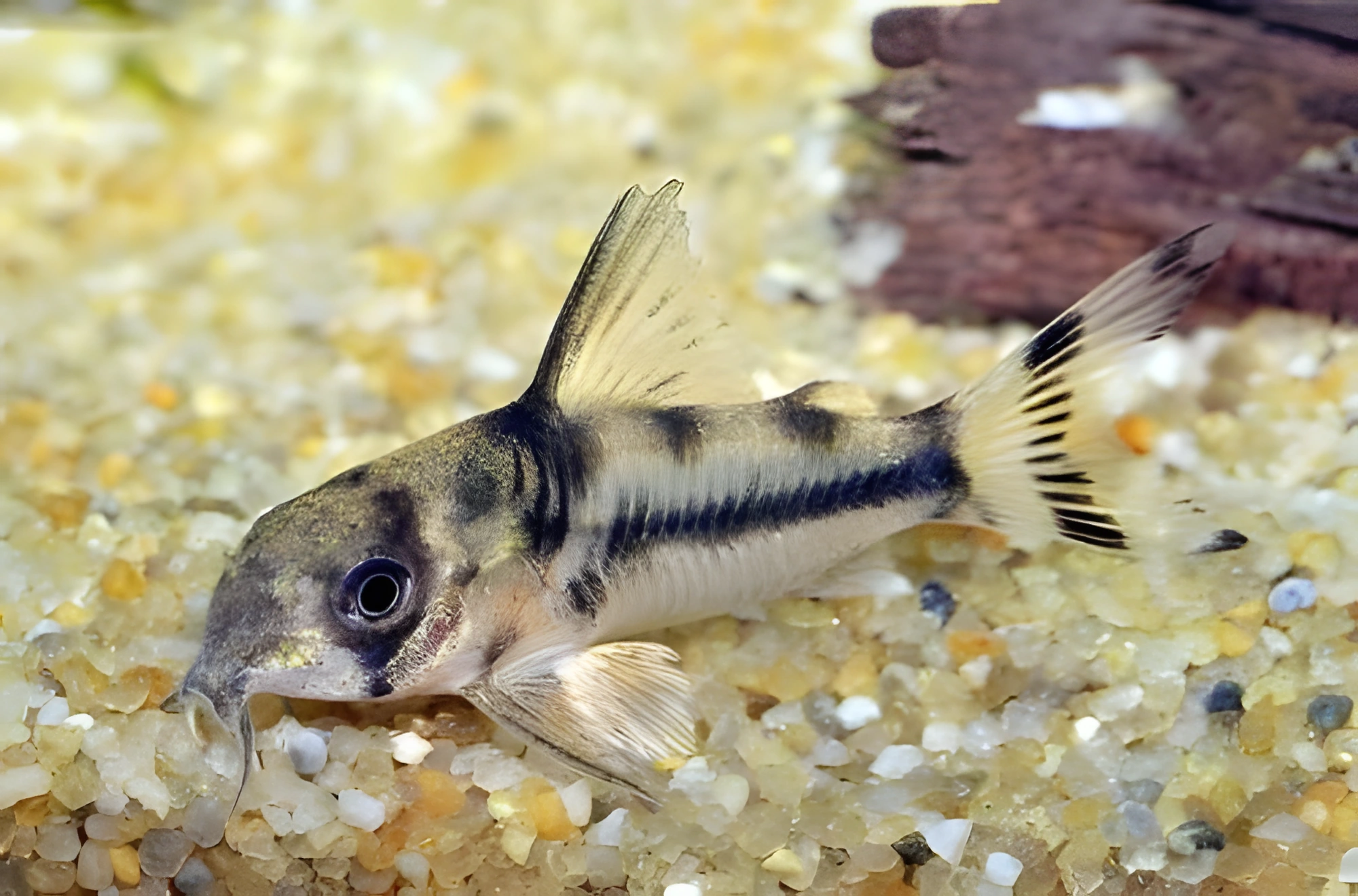
Adult specimens of this fish typically reach about 4 centimeters in length. Their coloration is quite light, characterized by a dark horizontal stripe running along the side and black spots. Interestingly, under certain angles of light, pleasant golden hues can be observed on their scales.
Habitat
Corydoras boesemani is endemic to the upper reaches of the Suriname River basin in South America. In nature, it inhabits rivers with clear, soft, and acidic water. It prefers areas with sandy or silty bottoms, where a large amount of fallen leaves accumulates and overhanging vegetation is present [aquaportail.com].
Behavior and Compatibility
This is a peaceful, schooling fish that lives on the bottom. In nature, adults form small groups, while juveniles can form large aggregations. In an aquarium, it is recommended to keep a group of at least 6 individuals to ensure comfortable social behavior. The species has a calm temperament and is well-suited for community tanks with non-aggressive tankmates [aquaportail.com].
Care and Maintenance
Keeping and maintaining an aquarium for Boeseman's Corydoras, which are already acclimated and are offspring of captive-bred individuals, presents no particular difficulties, similar to most other freshwater species. It is important to provide a soft, slightly acidic, and warm aquatic environment, and to regularly prevent the accumulation of organic waste. However, if the catfish was exported from America, there is a possibility that it was wild-caught. In such a case, the fish may be more sensitive to water parameters, requiring conditions as close as possible to its natural habitat. In terms of diet, Boeseman's Corydoras readily accept most common aquarium foods. It is advisable to offer sinking products of appropriate size. Regarding behavior and compatibility, these catfishes are distinguished by their peaceful and calm nature. They prefer to live in groups of 4–6 individuals. They get along well with other aquarium inhabitants of similar size, provided they are not aggressive or territorial.
Diet
An omnivorous species that feeds on small invertebrates and detritus in nature. In the aquarium, it accepts most types of dry foods intended for bottom-dwelling fish, as well as frozen and live foods such as bloodworms, brine shrimp, or tubifex. It is important to provide a varied diet rather than relying solely on food scraps falling from the surface [aquaportail.com].
Breeding and Reproduction
Reproduction occurs by egg-laying. To stimulate spawning, water changes with fresh water, simulating the rainy season, are often used. The female lays 30 to 80 eggs, preferring to place them among fallen leaves or on the substrate. The fish do not show special care for their offspring [aquaportail.com].
Diseases
The species is sensitive to water quality and substrate condition. When kept in aquariums with sharp or contaminated substrate, damage to the sensitive barbels is possible, which opens the way for bacterial infections. Prevention includes using a soft sandy substrate and maintaining water purity through regular water changes and effective filtration [akvaforum.no].
How to choose
When purchasing, choose active fish with intact fins and undamaged barbels. It is important to avoid individuals with signs of emaciation, sunken bellies, or visible spots on the body. Since this species is rarely available for sale, it is recommended to clarify the keeping conditions with the seller in advance and ensure there are no signs of stress in the fish at the store [aquaportail.com].
Frequently asked questions
The essentials: size, tank volume, water parameters and care
How big does Boeseman's Corydoras get?
An adult reaches 4 cm in length. Plan the tank around the maximum size: the fish quickly outgrows a cramped setup.
What size aquarium does Boeseman's Corydoras need?
The minimum recommended volume is 80 L. A smaller tank speeds up nitrate build-up and raises stress levels.
What water parameters does Boeseman's Corydoras need?
Temperature 21–28 °C, pH 5.5–7.5, hardness 1–10 dGH. Stability matters more than exact values: sudden swings are harder on the fish than a small deviation from the ideal.
How long does Boeseman's Corydoras live?
Around 5 years when kept properly. Lifespan depends directly on tank volume, water quality and a varied diet.
Is Boeseman's Corydoras aggressive?
Temperament: peaceful (regular). Keep this in mind when choosing tank mates.
How many Boeseman's Corydoras should be kept together?
Recommended setup: small group (5–6 individuals). Ignoring this is a common cause of stress and disease.
What does Boeseman's Corydoras eat?
Diet type: sinking (any). Feed small portions that are finished within a couple of minutes — overfeeding does more harm than underfeeding.
What is the scientific name of Boeseman's Corydoras?
The scientific name of the species is Corydoras boesemani, family Armored or Callichthyid Catfishes (Callichthyidae).