Temperature24 – 28 °C
Natural range
- Rio Negro basin
- Orinoco basin
- Brazil area
- Venezuela area
CharacinsConservation status: Least concern LC
Other scientific names: Copeina compta
Copella compta, or Copella compta, belongs to the family Lebiasinidae. This fish originates from the subtropical regions of South America, where it can be found in numerous forest streams and rivers located in the upper reaches of the Rio Negro and Orinoco in Colombia and Venezuela.
- Required aquarium volume
- 80 L
- Size in aquarium
- 5 cm
- Temperature
- 24 – 28 °C
- Temperament
- Peaceful (regular)
Parameters
Water pHSlightly acidic (6) – Neutral (7)
Water dHVery soft (2) – Medium hardness (11)
Water salinityno salt (freshwater)
Size in aquarium5 cm
Lifespan3 years
TemperamentPeaceful (regular)
Toward small fishnot a predator
Required aquarium volume80 L
Lightingdimmed
Substrateany (no restrictions)
Water flowweak
FeedingFloating (protein)
CareGroup (8–10 individuals)
Description
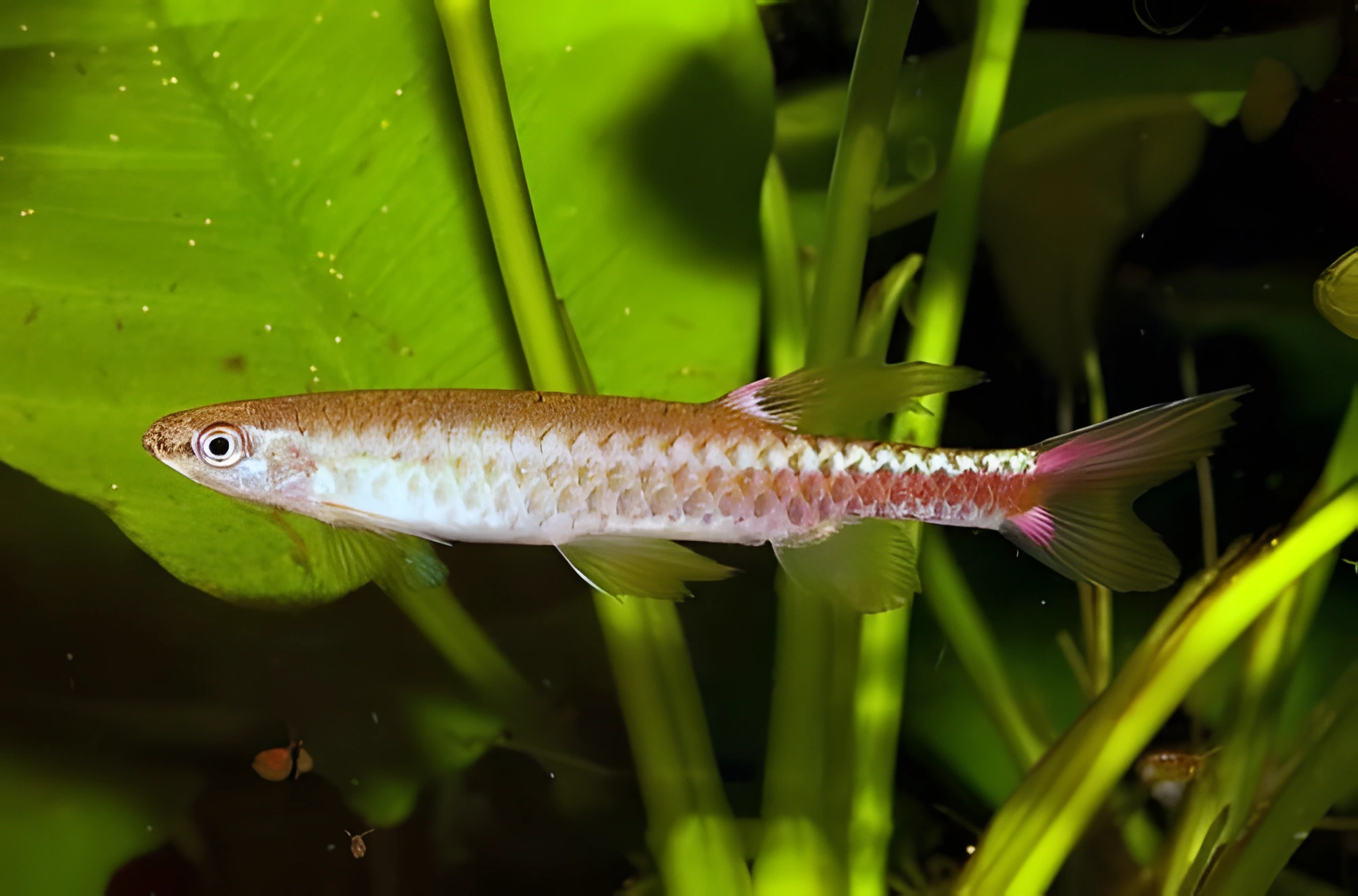
Adults of this fish can reach approximately 5 cm in length. Males are typically larger and distinguished by a beige coloration with a characteristic broad horizontal stripe. Sometimes, their coloration may include pinkish hues. Their scales are quite large, with dark pigmentation, which creates a reticulated pattern. Slight reddish strokes can be observed on the caudal peduncle. Females, as a rule, are smaller than males and have less expressive coloration.
Habitat
The species inhabits the basins of the Rio Negro (Brazil) and Orinoco (Venezuela, Colombia) rivers. In nature, it populates forest streams and small tributaries with clear or "black" water, rich in humic substances. It prefers areas with slow currents, staying in the upper and middle water layers.
Behavior and Compatibility
By nature, Copella compta is a timid and peaceful fish. It is not recommended to keep it with larger or excessively active species. Other Copella species, as well as Pyrrhulina and fish that prefer to inhabit the bottom layers, would be good tank mates.
Care and Maintenance
For a group of 8–10 Copella compta, an aquarium of 80–100 L will be comfortable. It is important to consider that for these fish, the surface area of the water is significantly more important than the depth of the tank itself, as they primarily stay in the upper water layers. They need many hiding places, which can be provided by floating plants. The rest of the aquarium decor is less important and can be chosen at the owner's discretion or based on the needs of other inhabitants. Lighting should be subdued. For long-term well-being, the key aspect is maintaining stable water parameters: the water should be warm, soft, and slightly acidic. A system to reduce water hardness, such as specialized filter media, may be required. When choosing filtration equipment, it is important to remember that these fish do not tolerate strong currents, which are often a consequence of filtration systems. Copella compta are prone to jumping out of the aquarium, so a lid is essential. In their natural habitat, these fish feed on small aquatic insects and their larvae; therefore, in a home aquarium, their diet should be rich in protein, and the food should remain on the water surface for a long time.
Diet
In its natural environment, Copella compta preys on larvae and small aquatic insects, so in a home aquarium, they should be provided with a protein-rich diet, and it is important that the food remains on the surface of the aquarium for a long time. This group of fish has developed a unique strategy for reproduction and offspring protection. During spawning, eggs are laid on leaves hanging low over the water. The male and female, pressing against each other synchronously, jump out of the water to the leaf. On it, they manage to attach and fertilize several eggs. As soon as spawning is complete, the female leaves the spawning site, while the male remains nearby. His main task is to spray the clutch with water splashes to prevent it from drying out. In some cases, the clutch can also be formed on the surface of a wide leaf of an aquatic plant.
Breeding and Reproduction
This group of fish has developed a very peculiar strategy for reproduction and protecting their offspring. During spawning, female Copella compta lay eggs on leaves positioned low above the water. The male and female, pressing against each other, synchronously jump out of the water to the chosen leaf. Once on it, the pair manages to attach several eggs and fertilize them. After the spawning process is complete, the female departs, and the male remains nearby; his main task is to spray the clutch with water splashes to prevent it from drying out. Sometimes, the eggs can be laid directly on the surface of a broad aquatic plant leaf.
Diseases
These fish are susceptible to typical diseases of freshwater tropical fish, such as ichthyophthiriasis (white spots on the body), saprolegniasis (cotton-like growths), or bacterial infections manifesting as impaired coordination or bloating. Their sensitivity to keeping conditions is high: stress from unsuitable water parameters, sudden temperature fluctuations, or poor filtration quickly reduces immunity. For prevention, it is necessary to maintain stable water quality, avoid overcrowding, and provide a varied diet.
How to choose
When purchasing, choose active fish with clean fins and no visible spots or film on the body. It is important to ensure there are no signs of emaciation or unnatural behavior, such as constantly staying at the surface with labored breathing or attempting to swim on their side. It is recommended to acquire individuals from the same batch, as they are schooling fish and adapt better in a group of 8–10 specimens.
Frequently asked questions
The essentials: size, tank volume, water parameters and care
How big does Copella compta get?
An adult reaches 5 cm in length. Plan the tank around the maximum size: the fish quickly outgrows a cramped setup.
What size aquarium does Copella compta need?
The minimum recommended volume is 80 L. A smaller tank speeds up nitrate build-up and raises stress levels.
What water parameters does Copella compta need?
Temperature 24–28 °C, pH 6–7, hardness 2–11 dGH. Stability matters more than exact values: sudden swings are harder on the fish than a small deviation from the ideal.
How long does Copella compta live?
Around 3 years when kept properly. Lifespan depends directly on tank volume, water quality and a varied diet.
Is Copella compta aggressive?
Temperament: peaceful (regular). Keep this in mind when choosing tank mates.
How many Copella compta should be kept together?
Recommended setup: group (8–10 individuals). Ignoring this is a common cause of stress and disease.
What does Copella compta eat?
Diet type: floating (protein). Feed small portions that are finished within a couple of minutes — overfeeding does more harm than underfeeding.
What is the scientific name of Copella compta?
The scientific name of the species is Copella compta, family Lebiasinidae. It also appears in the literature as: Copeina compta.