Temperature20 – 28 °C
Natural range
- Upper Amazon Basin
- Middle Amazon Basin
- Peru area
- Brazil area
CharacinsConservation status: Least concern LC
Other scientific names: Copeina callolepis, Copella callolepis, Pyrrhulina nattereri
Copella nattereri, also known as Natterer's Copella (scientific name Copella nattereri), belongs to the family Lebiasinidae. This agile, schooling fish, like other members of its genus, exhibits a very unusual breeding strategy. This unique feature often becomes the decisive factor prompting aquarists to choose it for home keeping.
- Required aquarium volume
- 50 L
- Size in aquarium
- 4 – 4.5 cm
- Temperature
- 20 – 28 °C
- Temperament
- Semi-peaceful (including aggression during spawning / intraspecific conflicts)
Parameters
Water pHAcidic (4) – Neutral (7.5)
Water dHVery soft (1) – Medium hardness (9)
Water salinityno salt (freshwater)
Size in aquarium4 – 4.5 cm
Lifespan5 years
TemperamentSemi-peaceful (including aggression during spawning / intraspecific conflicts)
Toward small fishnot a predator
Required aquarium volume50 L
Lightingdimmed
Substratesandy (regular, light)
Water flowweak
FeedingMeat with plant additives (omnivores)
CareSchooling (usually from 5–6 individuals and more)
Description
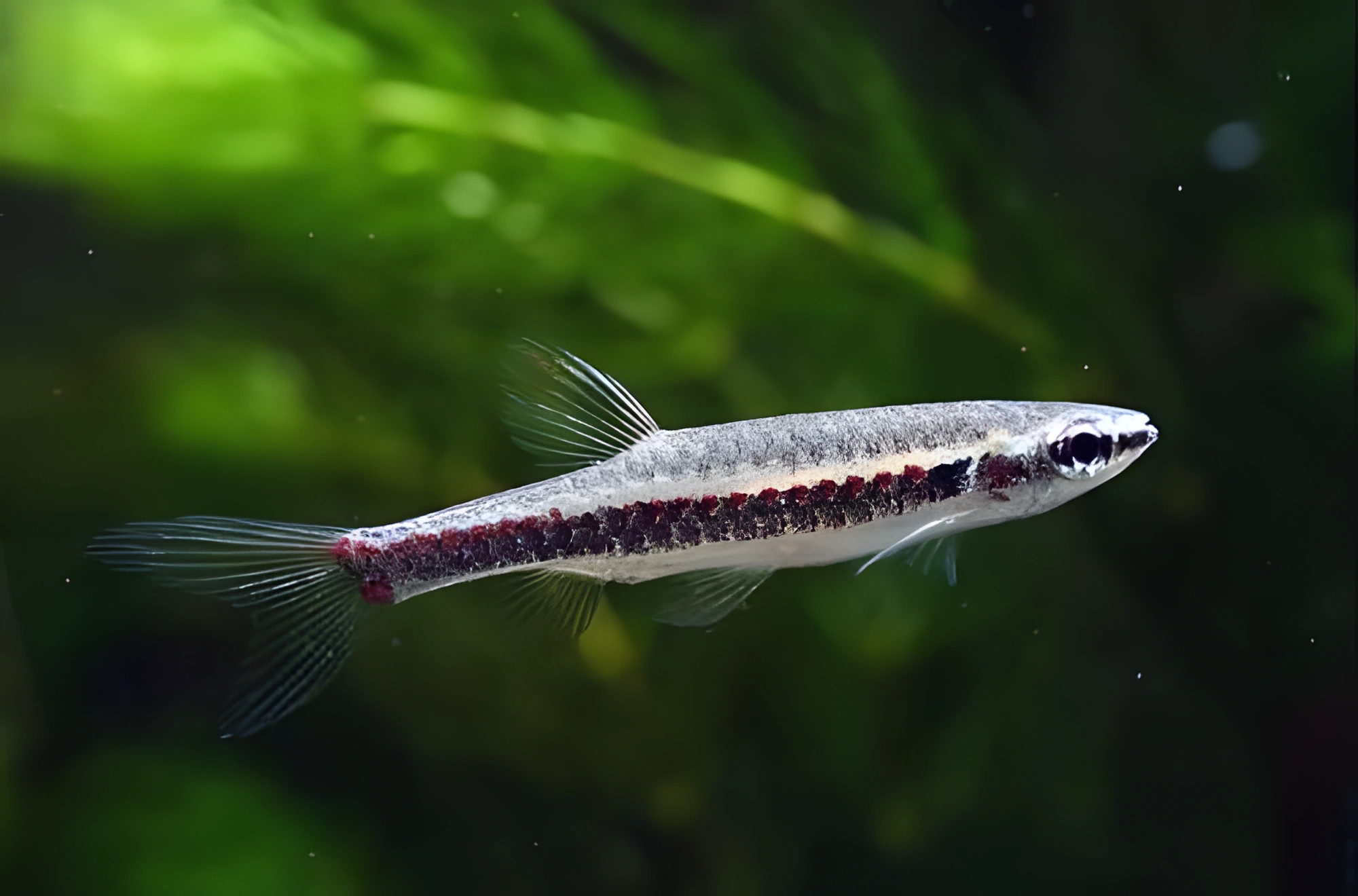
Adults of this fish reach an average length of about 4 cm. A distinguishing feature of males is their slightly larger size compared to females, as well as more developed fins. The body coloration is silvery, adorned with a broad dark horizontal stripe, on which red specks stand out. During the breeding season, this stripe temporarily dulls or disappears entirely, while the red specks become significantly brighter.
Habitat
Its natural habitat is in South America. This species is widely distributed throughout the upper and middle Amazon River basins, covering territories in Peru and Brazil. It prefers to live in small streams and channels that flow through dense tropical forests. It particularly favors areas with abundant aquatic vegetation and places where tree branches hang low over the water's surface.
Behavior and Compatibility
Copella nattereri is a peaceful, schooling fish. It coexists well with many other non-aggressive species of similar size. It is recommended to keep a mixed group of at least 8–10 individuals. In the presence of females, males often display their best and brightest colors, competing for attention.
Care and Maintenance
To maintain a school of 8–10 Copella nattereri, an aquarium of at least 50–60 liters, or a paludarium of similar size, is recommended. Given their breeding peculiarities (which will be discussed later), it is important to maintain the water level approximately 10 cm or more below the top edge of the tank. In terms of decor, it is desirable to use plants whose leaves will hang low over the water surface. A lid is strictly mandatory to prevent fish from accidentally jumping out. Copella nattereri will look most impressive in an aquarium that mimics its natural habitat — among dense thickets of aquatic plants and snags, under subdued lighting. An additional element, both decorative and functional, can be fallen leaves of certain trees, placed on the bottom. They will not only enhance the setting but also help recreate the water's chemical composition, bringing it as close as possible to natural conditions. During decomposition, the leaves release tannins, which beneficially affect parameters such as pH and dGH, and also give the water a light brownish tint. Long-term and successful keeping of these fish largely depends on ensuring stable water conditions within acceptable temperature and hydrochemical ranges. For this, regular aquarium maintenance procedures are necessary: partial water changes with fresh water, removal of organic waste, and preventive equipment maintenance.
Diet
The diet of these fish should be based on protein-rich foods. These can include various flakes, granules, as well as live or frozen foods such as brine shrimp, daphnia, and Drosophila larvae.
Breeding and Reproduction
Under favorable conditions, these fish readily reproduce, and in a sufficiently large group, the appearance of fry can be quite frequent. Their spawning process differs significantly from that observed in most aquarium fish and requires special conditions. With the onset of the breeding season, the male and female form a temporary pair and choose a suitable place for the future clutch, which will be out of water, on the surface of a low-hanging leaf. Both fish synchronously jump out of the water and briefly stick to the leaf; during these moments, they manage to attach the eggs. After several such jumps, the leaf is covered with several dozen eggs. Once spawning is complete, the female swims away, and the male remains to care for the clutch. He makes sharp tail movements, splashing water onto the eggs, thereby preventing them from drying out. The incubation period lasts from 36 to 72 hours. With the appearance of fry, the male's parental care ceases. Young fish are recommended to be transferred to a separate tank to avoid being eaten by adults. If the fish do not have the opportunity to lay eggs above water, they may lay eggs among dense thickets of plants. In such a case, the male also remains nearby, warding off any potential predators.
Diseases
The main health problems in these fish most often arise from unfavorable keeping conditions, which lead to a weakened immune system and, consequently, increased susceptibility to various diseases. More detailed information on symptoms and treatment methods can be found in our section "Diseases of Aquarium Fish."
How to choose
When purchasing, choose active fish with clean fins and no visible damage or film on the body. It is important to ensure that the individuals do not show signs of emaciation, as this species is prone to weight loss if kept improperly in the store. It is recommended to acquire a group of 6–8 individuals, as fish kept alone become timid and lose their natural coloration. Before purchasing, it is worth clarifying the keeping conditions in the store's aquarium and observing the fish's behavior: healthy specimens should show interest in food and stay in the upper or middle layers of the water.
Frequently asked questions
The essentials: size, tank volume, water parameters and care
How big does Copella nattereri get?
An adult reaches 4–4.5 cm in length. Plan the tank around the maximum size: the fish quickly outgrows a cramped setup.
What size aquarium does Copella nattereri need?
The minimum recommended volume is 50 L. A smaller tank speeds up nitrate build-up and raises stress levels.
What water parameters does Copella nattereri need?
Temperature 20–28 °C, pH 4–7.5, hardness 1–9 dGH. Stability matters more than exact values: sudden swings are harder on the fish than a small deviation from the ideal.
How long does Copella nattereri live?
Around 5 years when kept properly. Lifespan depends directly on tank volume, water quality and a varied diet.
Is Copella nattereri aggressive?
Temperament: semi-peaceful (including aggression during spawning / intraspecific conflicts). Keep this in mind when choosing tank mates.
How many Copella nattereri should be kept together?
Recommended setup: schooling (usually from 5–6 individuals and more). Ignoring this is a common cause of stress and disease.
What does Copella nattereri eat?
Diet type: meat with plant additives (omnivores). Feed small portions that are finished within a couple of minutes — overfeeding does more harm than underfeeding.
What is the scientific name of Copella nattereri?
The scientific name of the species is Copella nattereri, family Lebiasinidae. It also appears in the literature as: Copeina callolepis, Copella callolepis, Pyrrhulina nattereri.