Temperature22 – 26 °C
Natural range
- Lower Congo River Basin
- Republic of the Congo area
- Democratic Republic of the Congo area
CharacinsConservation status: Least concern LC
Other scientific names: Alestopetersius hilgendorfi, Alestopetersius leopoldianus, Alestopetersius xenurus, Hemigrammopetersius caudalis, Hemigrammopetersius xenurus, Hemmigrammopetersius brumpti
Alestopetersius caudalis, known as the Yellow-tailed Congo Tetra or Congo Gold Tetra, belongs to the family Alestidae. Although this species may not be as widely distributed as some other African tetras, it can be acquired in pet stores. It is considered a suitable choice for aquarists because it is easy to keep and breed, and it coexists well with fish of similar size.
- Required aquarium volume
- 100 L
- Size in aquarium
- 5 – 6.2 cm
- Temperature
- 22 – 26 °C
- Temperament
- Peaceful (regular)
Parameters
Water pHSlightly acidic (5) – Neutral (7.5)
Water dHVery soft (2) – Hard (15)
Water salinityno salt (freshwater)
Size in aquarium5 – 6.2 cm
Lifespan5 years
TemperamentPeaceful (regular)
Toward small fishnot a predator
Required aquarium volume100 L
Lightingdimmed or moderate
Substratesoft sandy (including silted)
Water flowweak
FeedingSmall / appropriate size / pieces
CareGroup (8–10 individuals)
Description
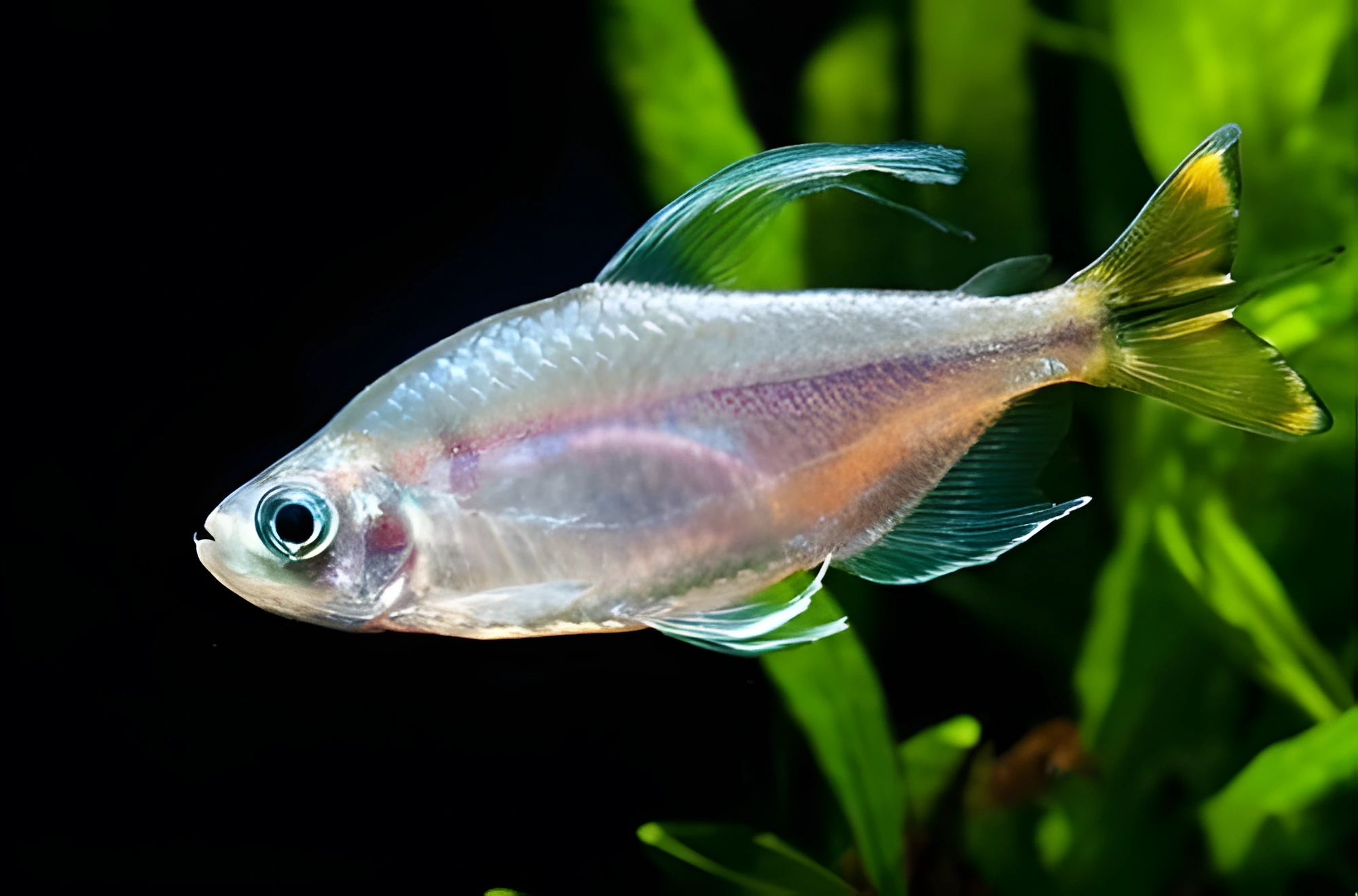
Adults reach up to 5–6 cm in length. A distinguishing feature of males is their slightly larger size, silvery body coloration, and elongated dorsal and anal fins adorned with white edging. Their tails have yellow markings. Females, on the other hand, are generally smaller and have a more yellowish base color.
Habitat
The natural habitat of this fish is located on the African continent, in the lower Congo River basin, in the territories of modern-day Congo and the Democratic Republic of Congo. It prefers to inhabit streams and small rivers that flow into the main channel. These fish choose areas with calm currents, where there are dense thickets of aquatic vegetation and numerous snags, which serve as reliable cover from predators.
Behavior and Compatibility
These fish are peaceful and prefer to live in shoals. It is recommended to keep a group of at least 8–10 individuals, as with fewer numbers, Yellow-tailed Congo Tetras may exhibit excessive shyness. They coexist well with non-aggressive species, such as cyprinids, some riverine African cichlids, catfish, loaches, and other similar fish.
Care and Maintenance
For keeping a shoal of 8–10 Congo Gold Tetras, the optimal aquarium volume starts from 100 L. Although the decor can be arbitrary, the fish will look best in a biotope design, imitating their natural environment with snags, dense thickets of aquatic plants, and sandy substrate. It is also important to provide sufficient open swimming space. Long-term and successful keeping depends on maintaining stable water parameters, avoiding sharp changes in temperature, hydrochemical indicators, and the accumulation of harmful nitrogen cycle products — ammonia, nitrites, and nitrates. For this, it is necessary to equip the aquarium with all the necessary equipment and regularly perform maintenance, including weekly partial water changes, timely removal of organic residues such as uneaten food and excrement, and equipment prophylaxis.
Diet
This species is omnivorous and readily consumes most standard foods of appropriate size intended for aquarium fish. The daily diet can consist exclusively of dry foods, such as flakes and granules.
Breeding and Reproduction
Under favorable conditions, spawning in these fish is not uncommon. However, they do not care for their offspring and, moreover, may eat both eggs and fry. During spawning, the eggs are scattered among plant thickets. To preserve them, fertilized eggs should be transferred to a separate aquarium where identical water parameters will be maintained. This breeding tank is equipped with a simple air-driven sponge filter, a heater, and a basic lighting system. Special decor is not required, but if desired, undemanding plants, as well as mosses and ferns, including their artificial counterparts, can be used. Initially, the fry feed on microscopic organisms, such as infusoria, and only after a week are they ready to accept larger food — Artemia nauplii or special powdered food.
Diseases
Specific diseases that affect only this particular fish species have not been identified. When kept in suitable conditions, including high water quality, a balanced diet, and peaceful tank mates, health issues usually do not arise. The most common cause of illness is a deterioration of living conditions, which weakens the immune system and makes the fish susceptible to infections that are always present in their environment. Upon noticing initial signs of sickness (such as lethargy, emaciation, refusal to eat, or clamped fins), it is crucial to immediately check the basic water parameters. Often, restoring acceptable living conditions will lead to self-recovery, but if the fish is too weak or has suffered visible damage, medicinal treatment may be required. For more details on symptoms and treatment methods, consult the section “Diseases of Aquarium Fish.”
How to choose
When selecting individuals, attention should be paid to their activity and the condition of their skin. Healthy fish should show curiosity, be active, and stay in a shoal, rather than hiding in the corners of the aquarium. Avoid specimens with damaged fins, open sores, or film on the body, as any wounds in this species quickly become infected. Since males often engage in territorial disputes, it is advisable to assess the sex ratio in the group beforehand when purchasing, trying to choose more females to minimize aggression between individuals when transferring them to a new aquarium.
Frequently asked questions
The essentials: size, tank volume, water parameters and care
How big does Congo Gold Tetra get?
An adult reaches 5–6.2 cm in length. Plan the tank around the maximum size: the fish quickly outgrows a cramped setup.
What size aquarium does Congo Gold Tetra need?
The minimum recommended volume is 100 L. A smaller tank speeds up nitrate build-up and raises stress levels.
What water parameters does Congo Gold Tetra need?
Temperature 22–26 °C, pH 5–7.5, hardness 2–15 dGH. Stability matters more than exact values: sudden swings are harder on the fish than a small deviation from the ideal.
How long does Congo Gold Tetra live?
Around 5 years when kept properly. Lifespan depends directly on tank volume, water quality and a varied diet.
Is Congo Gold Tetra aggressive?
Temperament: peaceful (regular). Keep this in mind when choosing tank mates.
How many Congo Gold Tetra should be kept together?
Recommended setup: group (8–10 individuals). Ignoring this is a common cause of stress and disease.
What does Congo Gold Tetra eat?
Diet type: small / appropriate size / pieces. Feed small portions that are finished within a couple of minutes — overfeeding does more harm than underfeeding.
What is the scientific name of Congo Gold Tetra?
The scientific name of the species is Alestopetersius caudalis, family African Tetras (Alestidae). It also appears in the literature as: Alestopetersius hilgendorfi, Alestopetersius leopoldianus, Alestopetersius xenurus.