Temperature20 – 26 °C
Natural range
- Southern Guinea area
- Sierra Leone area
- Liberia area
- West Africa area
KillifishConservation status: Least concern LC
Other scientific names: Aplocheilus annulatus, Haplochilus annulatus, Panchax annulatus, Pseudepiplatys annulatus
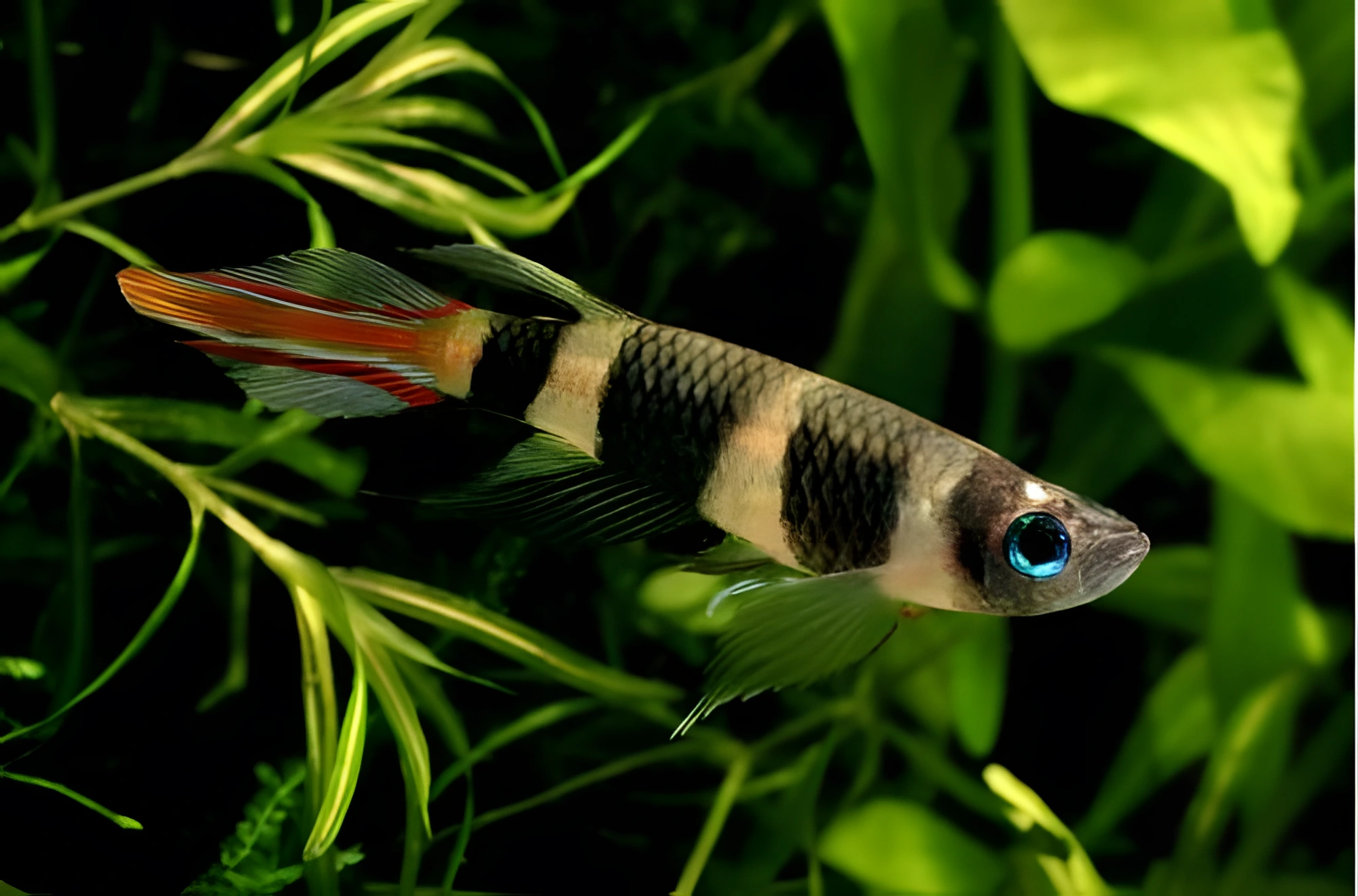
The Torch Epiplatys, or Clown Killifish (scientific name Epiplatys annulatus), belongs to the family Nothobranchiidae. This fish attracts with its vibrant coloration, activity, and unique appearance. It is considered relatively undemanding in terms of care and breeding. There are various varieties of this species, depending on their region of origin; cross-breeding is possible if they are kept together. To avoid hybridization, professional breeders often include additional geographical tags in the name, such as Maca, Conakry, Robertsport, Monrovia, and others, indicating the specific range of a particular variety.
- Required aquarium volume
- 40 L
- Size in aquarium
- 3 cm
- Temperature
- 20 – 26 °C
- Temperament
- Peaceful (regular)
Parameters
Water pHAcidic (4) – Neutral (7)
Water dHVery soft (1) – Medium hardness (8)
Water salinitywide range (from ~1 to ~20 g/L)
Size in aquarium3 cm
Lifespan3 years
TemperamentPeaceful (regular)
Toward small fishnot a predator
Required aquarium volume40 L
Lightingdimmed or moderate
Substratefine-grained (fine crushed stone, gravel, etc.)
Water flowweak or moderate
FeedingHigh protein (predominantly meat)
CareGroup (8–10 individuals)
Description
This miniature fish has a slender body and a slightly compressed head. The structure of its mouth is ideally adapted for collecting food from the water surface. Males are slightly larger than females and have wider fins, as well as brighter coloration with alternating contrasting stripes. Their tail deserves special attention, as its shape and color resemble a torch.
Habitat
The natural habitats of the Clown Killifish are located in the low-lying coastal areas of southern Guinea and Sierra Leone, extending to Liberia, in West Africa. These fish prefer to live in lowland swamps, slow-flowing streams, and small rivers, found in both open savannas and humid tropical forests. Here, they dwell among bankside or aquatic vegetation. They can also often be found in brackish water.
Behavior and Compatibility
The Clown Killifish is a peaceful and friendly species that coexists well with other fish of similar size and temperament. It is recommended to avoid introducing larger species. Optimal tank mates include small tetras, neon tetras, other killifish species, some cyprinids, and livebearers. They prefer to stay in groups, so a shoal of 8–10 individuals is highly desirable: in such a company, the fish will appear brighter and feel more confident in the presence of other species.
Care and Maintenance
A group of 8–10 Clown Killifish will feel comfortable in an aquarium of 40 liters or more. When decorating the tank, it is important to use a large amount of vegetation, both rooted and floating. Floating plants provide additional shade, which is important because Epiplatys annulatus does not tolerate bright light. A sandy substrate and several natural shelters, such as driftwood, tree branches, or roots, are recommended. Adding a few dried leaves is also beneficial; as they decompose, they release natural humic substances that give the water a slight brownish tint, characteristic of swampy areas. Leaves should be replaced weekly. When choosing a filter, it is important to ensure it provides effective purification without creating a strong current, as these fish are poorly resistant to powerful water flow. In addition to the filter, the minimum necessary equipment includes a heater, an aerator, and a lighting system set to low power. Water conditions should match the characteristics of most swamps: a pH below 7.0 and hardness not exceeding 10 dGH. More detailed information on pH and dGH parameters can be found in the "Hydrochemical composition of water" section. To maintain biological balance, about 20% of the water volume needs to be replaced weekly with fresh water. The temperature and parameters of the new water must be identical, as the fish are extremely sensitive to sudden changes in the external environment. A marine salt concentration of 1–2 g per 1 liter of water is permissible.
Diet
In their natural habitat, the diet of the Clown Killifish consists of terrestrial and aquatic invertebrates, as well as other zooplankton. In a home aquarium, they readily accept any dry food of appropriate size. It is also recommended to supplement their daily menu with frozen or live meaty foods, such as Artemia, Daphnia, bloodworms, grindal worms, and others. Feeding should be done 2–3 times a day, offering an amount of food that the fish will consume within 5 minutes. Dry food must be floating.
Breeding and Reproduction
Breeding Torch Epiplatys in a home aquarium is quite simple and does not require special conditions; they can produce offspring year-round. Spawning is recommended in a separate tank, as parents or other fish may eat the fry. The spawning aquarium should be equipped with a simple sponge filter, a heater, and a lamp for lighting. For decorations, dense thickets of Riccia, Java moss, and similar plants are desirable, where females will lay their eggs. Adding a few dried leaves is also beneficial: they not only enrich the water with tannins but also promote the growth of microorganism colonies and beneficial bacteria, which serve as natural microscopic food for the fry. Signs of an approaching breeding period include a noticeable enlargement of the female's abdomen and active attention from the males. At this time, several females and one male are placed in the spawning aquarium. After a few days, once the eggs are laid, the fish are returned to the main tank. Fry hatch after 9–12 days at a temperature of 24–25°C. In the initial stage of life, they feed on microorganisms present in the water and on the substrate; then their diet should be supplemented with Artemia nauplii, infusoria, and finely crushed dry flakes.
Diseases
Clown Killifish are sensitive to sudden changes in water composition and environmental quality, which can provoke stress and weaken their immune system. If living conditions are violated, the fish are susceptible to bacterial infections, such as fin rot, which manifests as the erosion of fin edges. Fungal diseases are also possible with injuries or poor aquarium hygiene. Prevention involves maintaining stable water parameters, regular water changes, and avoiding overpopulation, as the species reacts extremely negatively to the accumulation of organic waste.
How to choose
When purchasing, choose active individuals with clean fins and no visible body damage. Healthy fish should display the natural coloration characteristic of the species and show no signs of emaciation or sunken bellies. It is recommended to avoid specimens that stay at the bottom or appear lethargic, as this may indicate hidden diseases or recent severe stress. It is advisable to acquire a group of individuals, as they feel more confident in a shoal and adapt more easily to new aquarium conditions.
Frequently asked questions
The essentials: size, tank volume, water parameters and care
How big does Clown Killifish get?
An adult reaches 3 cm in length. Plan the tank around the maximum size: the fish quickly outgrows a cramped setup.
What size aquarium does Clown Killifish need?
The minimum recommended volume is 40 L. A smaller tank speeds up nitrate build-up and raises stress levels.
What water parameters does Clown Killifish need?
Temperature 20–26 °C, pH 4–7, hardness 1–8 dGH. Stability matters more than exact values: sudden swings are harder on the fish than a small deviation from the ideal.
How long does Clown Killifish live?
Around 3 years when kept properly. Lifespan depends directly on tank volume, water quality and a varied diet.
Is Clown Killifish aggressive?
Temperament: peaceful (regular). Keep this in mind when choosing tank mates.
How many Clown Killifish should be kept together?
Recommended setup: group (8–10 individuals). Ignoring this is a common cause of stress and disease.
What does Clown Killifish eat?
Diet type: high protein (predominantly meat). Feed small portions that are finished within a couple of minutes — overfeeding does more harm than underfeeding.
What is the scientific name of Clown Killifish?
The scientific name of the species is Epiplatys annulatus, family Nothobranchiidae. It also appears in the literature as: Aplocheilus annulatus, Haplochilus annulatus, Panchax annulatus.