Temperature15 – 30 °C
Natural range
- Congo River Basin
- Angola area
- Democratic Republic of the Congo area
CatfishConservation status: Least concern LC
Other scientific names: Clarias assamensis, Clarias betrachus, Clarias marpus, Clarias punctatus, Clarius bartrachus, Clarius batrachus
The marbled African sharptooth catfish, also known as the spotted or Angolan walking catfish, bears the scientific name Clarias angolensis and belongs to the family Clariidae. Its name originates from the Latin word Clarias, meaning “lively.” This characteristic is linked to the catfish's unique ability to survive for extended periods outside of water, absorbing oxygen directly from the air. The prefix “Angolan” indicates the region of Angola, where the species was first discovered. The designation “walking” refers to another remarkable ability: to move between bodies of water and emerge onto land at night in search of food.
- Required aquarium volume
- 400 L
- Size in aquarium
- 35 cm
- Temperature
- 15 – 30 °C
- Temperament
- Semi-peaceful (dangerous to smaller ones)
Parameters
Water pHSlightly acidic (6) – Slightly alkaline (8)
Water dHSoft (5) – Very hard (20)
Water salinityno salt (freshwater)
Size in aquarium35 cm
Lifespan15 years
TemperamentSemi-peaceful (dangerous to smaller ones)
Toward small fishnot a predator
Required aquarium volume400 L
Lightingdimmed or moderate
Substrateany (no restrictions)
Water flownone or stagnant (no flow)
FeedingAny (universal)
CareSolitary
Description
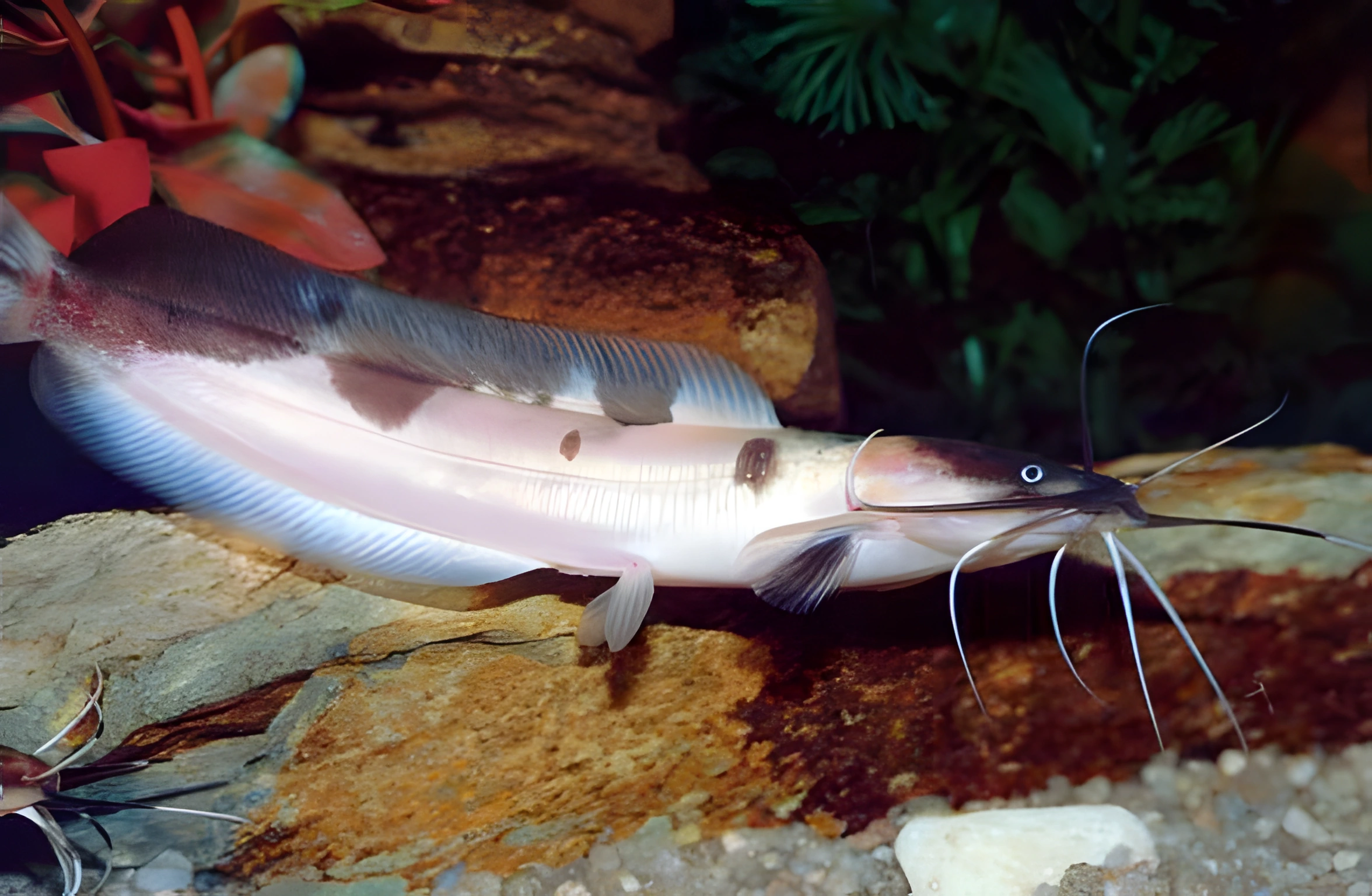
Adults can reach a length of up to 35 cm. The catfish has an elongated body. The dorsal and anal fins, consisting of soft rays, extend almost the entire length of the body. The pectoral fins are notable for their first ray, which is transformed into a sharp, serrated spine. The head is somewhat flattened and protected by bony plates. Sensitive barbels are located near the mouth. Young fish are characterized by a light coloration with irregular brown spots, which led to the names “marbled” or “spotted.” As they mature, their coloration changes, becoming uniformly brown. Albino specimens, with a snow-white hue, are sometimes encountered.
Habitat
The homeland of this catfish is the African continent, where it inhabits the middle and lower basins of the Congo River. It is found in diverse biotopes, including those that periodically dry out and exhibit a deficiency of dissolved oxygen in the water. These conditions explain the development of the Marbled Clarias's unique ability to breathe atmospheric air.
Behavior and Compatibility
This fish is characterized by a calm, non-aggressive disposition. However, the Marbled Clarias is exceptionally voracious, consuming any prey that can fit into its mouth, including small fish. For this reason, cohabitation is only possible with large and robust fish. Potential tank mates include species with complex temperaments, such as Cichlids, Malawian Cichlids, or large Gouramis. It is recommended to keep it alone or in the company of other species. In a cramped aquarium, several catfish can injure each other. The Marbled Clarias is primarily nocturnal, preferring to hide in shelters during the day.
Care and Maintenance
For keeping a single adult Angolan walking catfish, a spacious aquarium of at least 400 liters is required. In terms of decor, it is important to provide a suitably sized hiding place, such as a cave. Dark, coarse substrate is recommended. It is advisable to choose plants with strong root systems and tough leaves. The aquarium should be equipped with a secure lid or other protective device to prevent the catfish's possible accidental “escape,” which is quite likely. This species is completely undemanding regarding water chemistry and quality. The catfish adapts perfectly to a wide range of temperatures, pH, and GH values, surviving even in conditions unfavorable to other species. However, one should not intentionally create such extreme conditions. Since the fish produces a lot of organic waste, commensurate aquarium maintenance is required. It is important to regularly clean the substrate and perform partial water changes with fresh water. The Marbled Clarias is an omnivorous species. It eats anything that can fit into its mouth. A feeling of satiety is not characteristic of it, which can lead to overeating. Feeding should be moderate. Suitable diets include flakes, pellets, live or frozen foods, small feeder fish, as well as mollusk or shrimp meat, and so on.
Diet
The marbled Clarias is an omnivorous species. It is ready to consume any food that can fit into its mouth. However, the catfish does not have a sense of satiety, which can lead to overeating. Therefore, it is important to feed in moderation. Its diet can include flakes, pellets, as well as live or frozen foods. Small feeder fish, mollusk meat, shrimp, and other similar products can also be part of its diet.
Breeding and Reproduction
Breeding marbled Clarias is possible in aquariums with a volume of 80 L or more. Spawning is paired and stimulated by raising the water temperature to 28 °C. Stones or other objects are used as a substrate, and shelters are also necessary. The female lays large, cream-colored eggs. In nature, the male guards the clutch, but in aquarium conditions, it is recommended to remove him immediately after spawning. The incubation period lasts from 36 to 70 hours. Larvae begin to feed independently around the sixth day, with powdered compound feed serving as the starter food. At temperatures below 28 °C, fry are at risk of saprolegniasis.
Diseases
The marbled Clarias has high endurance and a strong immune system, but if the temperature regime is not observed, especially at a young age, the fish are prone to saprolegniasis. The main health risk is trauma when kept in cramped conditions or with unsuitable tankmates. It is important to note that the fish's pectoral fins are equipped with sharp spines, the punctures from which can be painful for humans and cause local inflammation or an allergic reaction. Disease prevention comes down to regular water changes, quality filtration, and maintaining substrate cleanliness, as the species produces a significant amount of organic waste.
How to choose
When purchasing, choose active individuals without visible skin damage, as the absence of scales makes the fish vulnerable to external infections. It is important to ensure that the catfish shows no signs of emaciation and that its eyes are clear and bright. It is recommended to ask the seller about the current diet to ensure a smooth transition to home food. Avoid purchasing individuals that appear apathetic or have a film on their body, which may indicate poor keeping conditions in the store. Given the predatory nature of the species, plan compatibility with other aquarium inhabitants in advance.
Frequently asked questions
The essentials: size, tank volume, water parameters and care
How big does Marbled Clarias get?
An adult reaches 35 cm in length. Plan the tank around the maximum size: the fish quickly outgrows a cramped setup.
What size aquarium does Marbled Clarias need?
The minimum recommended volume is 400 L. A smaller tank speeds up nitrate build-up and raises stress levels.
What water parameters does Marbled Clarias need?
Temperature 15–30 °C, pH 6–8, hardness 5–20 dGH. Stability matters more than exact values: sudden swings are harder on the fish than a small deviation from the ideal.
How long does Marbled Clarias live?
Around 15 years when kept properly. Lifespan depends directly on tank volume, water quality and a varied diet.
Is Marbled Clarias aggressive?
Temperament: semi-peaceful (dangerous to smaller ones). Keep this in mind when choosing tank mates.
How many Marbled Clarias should be kept together?
Recommended setup: solitary. Ignoring this is a common cause of stress and disease.
What does Marbled Clarias eat?
Diet type: any (universal). Feed small portions that are finished within a couple of minutes — overfeeding does more harm than underfeeding.
What is the scientific name of Marbled Clarias?
The scientific name of the species is Clarias batrachus, family Clariidae (Clariidae). It also appears in the literature as: Clarias assamensis, Clarias betrachus, Clarias marpus.